



Conformal coating adhesion failure means the protective film is separating from the surface it should remain bonded to. Before adding another coat, identify which layer is lifting, when the failure appeared and whether it exposes an area that must remain protected. A harder or thicker coating is not automatically a better repair.
Why Is Conformal Coating Peeling Off a PCB?
First distinguish the clear protective coating from solder mask, flux residue or an earlier coating. In one Reddit discussion about coatings that would not stick, the board reportedly already carried another coating. That changes the question from bonding to solder mask to compatibility with an existing film. A separate discussion about peeling on an outdoor control board shows why appearance alone cannot establish whether protection is acceptable.
A surface can look clean yet provide poor bonding conditions. Substrate chemistry, handling history and cure conditions can matter, and failure may emerge only after environmental exposure. The SCH adhesion bulletin describes this broader compatibility problem. Treat these as investigation categories, not a diagnosis of your board from a photograph.
Quarantine affected assemblies and preserve an untouched sample. Record the assembly revision, coating lot, first observation and location. Photograph a wide view and a close-up before any cleaning or scraping. For mains-powered equipment, isolation and stored-energy discharge must be handled by qualified personnel; coating inspection is not a reason to work on an energized board.
Dewetting vs Adhesion Failure: What Is the Difference?
Watch the process stage. Liquid pulling back during application is different from a continuous cured film later lifting. Chemtronics’ defect guide distinguishes wetting, application and curing problems. Its historical standard references do not replace the acceptance revision specified by your customer.
| Observation | Working hypothesis | Evidence to collect before changing anything |
|---|---|---|
| Wet coating retreats into islands | Dewetting; surface/coating interaction | Video during application; location relative to joints, markings and handled edges |
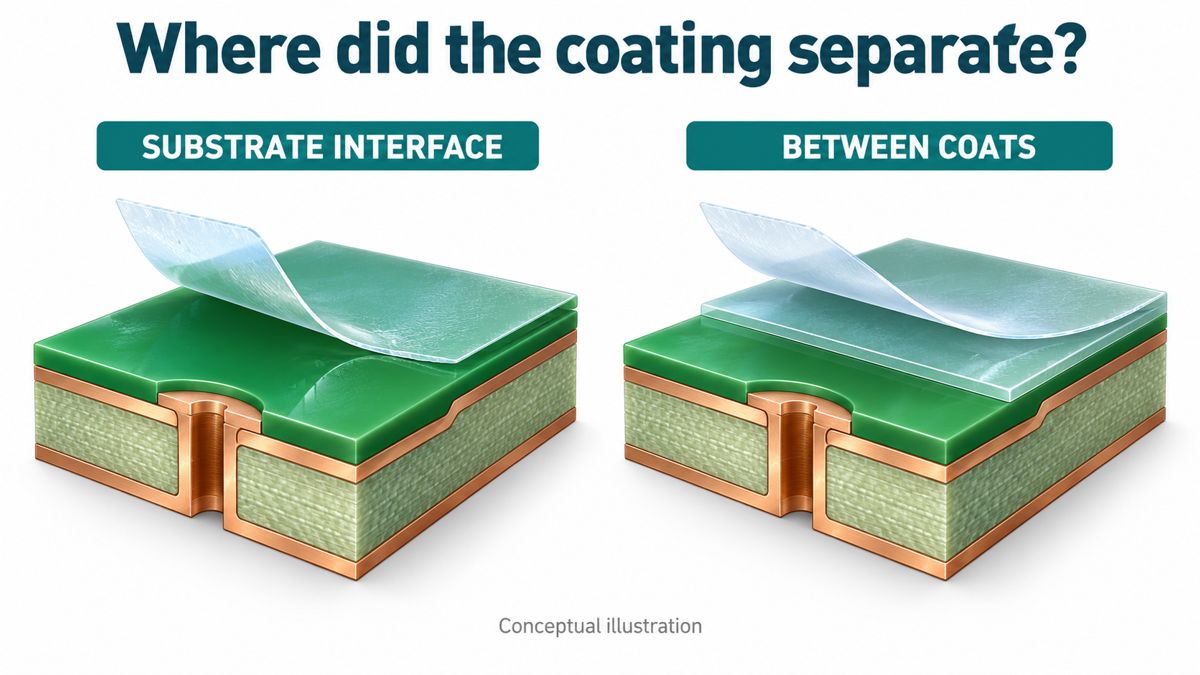
| Cured film lifts from the underlying surface | Adhesion failure at that interface | Which material remains on each side; coating and substrate lot history |
| Top coat separates while an older layer remains | Intercoat bonding problem | Both material identities, elapsed recoat time and preparation history |
| Film tears within itself | Cohesive damage, not proof of substrate debonding | Failure location, cure age and mechanical handling history |
This is a sorting tool, not a pass/fail standard. For example, lifting confined to one connector housing calls for a different trial than lifting across the whole solder-mask surface. Mark the affected material on the assembly drawing instead of recording only “poor adhesion.”
Which MG 419D Liquid Parameters Matter for a Coating Trial?
The following example is specific to MG Chemicals 419D Liquid acrylic conformal coating, from its version 4.0 technical data sheet, dated July 31, 2025. It is not an aerosol specification or a PCBtry process capability claim.
| Published item | 419D Liquid value | Trial implication |
|---|---|---|
| Recommended film thickness | 25–75 µm | Use this product’s range; do not transfer it to another chemistry. |
| Viscosity at 25 °C | 115 cP | Record temperature and any approved dilution. |
| Handling time | 10 min for one coat; 20 min for two | Handling readiness is not the full cure schedule. |
| Minimum recoat time | 3 min | Do not infer compatibility with an unknown older coating. |
| Room-temperature drying schedule | 24 h | Record elapsed time before comparing specimens. |
The sheet also provides heat-cure alternatives after a 10-minute flash period. Select any heated process only after checking assembly and equipment limits. The listed values have no numeric tolerances or guaranteed adhesion rating in this sheet; they are not universal acceptance limits. Read the SDS and application instructions before use.
For measurement planning rather than failure diagnosis, use the separate conformal coating thickness guide. Keeping film-build records alongside adhesion observations helps prevent unlike specimens from being compared as though preparation were their only difference.
How Do You Test Adhesion Without Damaging Production Boards?
Use sacrificial, representative specimens and a written test agreement. A smooth generic panel may tell you something about application consistency but cannot stand in for every solder mask, component housing or existing coating on an assembly.
- Define the substrate. Include the relevant board finish or component material and its actual production history. Label every specimen before processing.
- Define the method. Agree the applicable test standard and revision, specimen geometry, cure age, conditioning and acceptance criteria with the responsible engineer or customer.
- Keep a control. Retain an untested specimen and a current-process baseline. Record environmental conditions and coating build.
- Apply the agreed test. If a cut-and-tape method is specified, use its required equipment and procedure on the designated specimen. Do not improvise cross-cuts over traces on saleable boards.
- Record the interface. Photograph the tested area and describe where separation occurred, not just a subjective “good” or “bad.”
- Check the relevant exposure. Where the product qualification requires humidity or thermal conditioning, compare results at the prescribed stages. An initial result alone does not establish field life.
A numerical rating is meaningful only with its method. A fingernail scratch, arbitrary office tape and a formal adhesion test are not interchangeable. This workflow intentionally supplies no universal tape type, cut spacing or passing score.
Cleaning vs Changing the Coating: What Should You Compare First?
PVA’s preparation guidance identifies upstream residue and handling as relevant causes of wetting trouble. That does not mean any solvent, cleaning cycle or plasma treatment is safe for every assembly. Confirm compatibility with components, labels, plastics and the coating supplier before a trial.
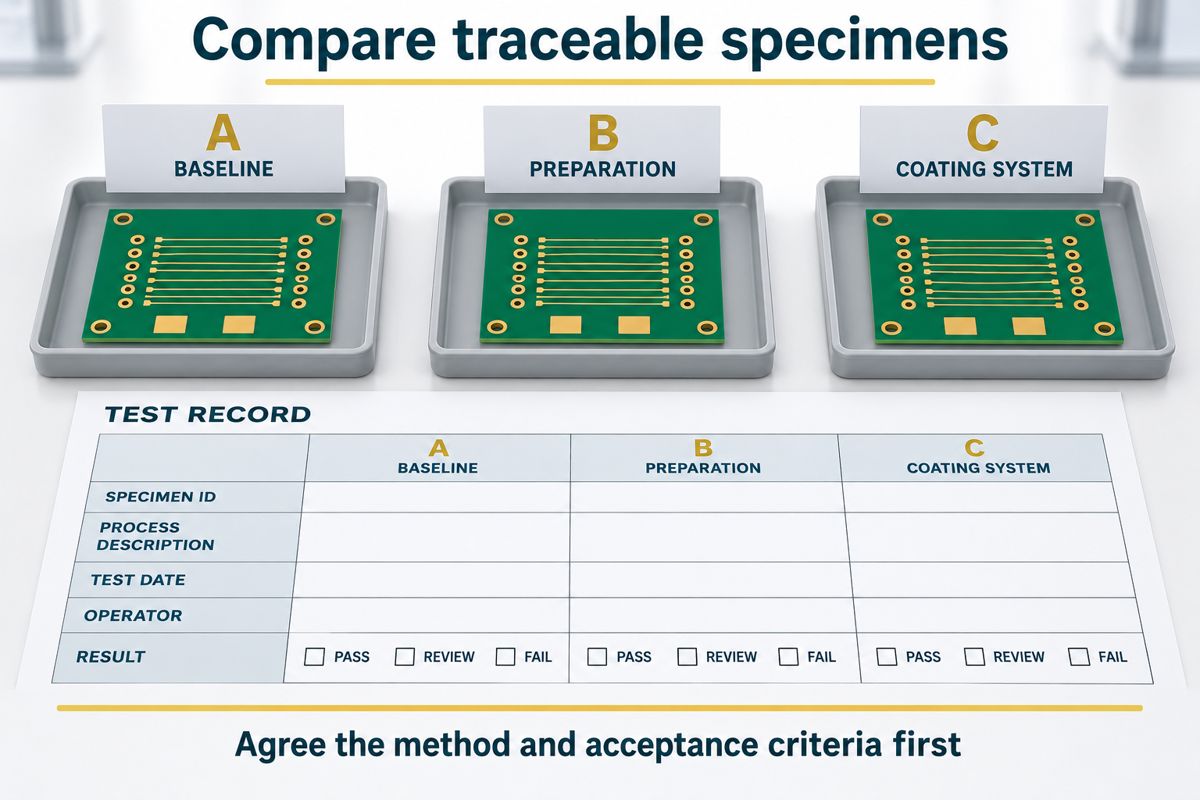
The worksheet below is a proposed investigation template. It is not a validated manufacturing recipe. Approve the factor levels and sample plan before using it.
| Trial | Change | Hold constant | Record and decision |
|---|---|---|---|
| A: current-process baseline | None | Representative substrate, coating lot, film build, cure and test method | Reproduce or fail to reproduce the symptom; retain photos and specimen IDs |
| B: approved preparation | One documented cleaning/preparation variable | Same coating and remaining conditions as A | If improved, repeat before attributing cause; document drying and handling |
| C: candidate coating | Coating system, with its own approved application/cure instructions | Comparable substrate and agreed test objective | This compares complete systems, not chemistry alone; reassess electrical and environmental requirements |
Attach fields for operator, date, substrate lot, material expiry, cure record, thickness record, test method/revision, conditioning, result and disposition. If B succeeds once while A fails once, that is a useful lead, not proof of a stable production process. Repeat under an agreed sampling plan and include the material variation that originally caused concern.
Do not change cleaner, coating, film build and oven profile simultaneously and then label the result a cleaning fix. If no baseline specimen reproduces the problem, investigate the missing production or service condition before declaring success.
Can You Recoat a PCB After the Coating Starts Peeling?
Not without a disposition decision. Applying fresh material over a loose layer leaves the original weak interface underneath. Establish the extent of separation, the required protected areas, the identity of both materials and the approved rework process first.
For a returned assembly, ask whether contamination or damage has already occurred beneath the film. Recoating is not evidence that electrical performance has recovered. Define the inspection and functional verification required after rework, and obtain approval before expanding a localized repair.
Keep contacts, test access and other specified areas free of coating; the masking and keep-out guide covers those boundaries. Avoid scraping intact neighboring areas merely to make the repair look uniform.
What Should You Send for a PCB Assembly Coating Review?
Prepare a compact evidence pack: annotated failure photographs; assembly revision; coating and substrate identities; material lots; cleaning, application and cure records; required coverage and keep-outs; operating environment; and the proposed coupon test/acceptance plan. Include unknowns explicitly rather than filling them with guesses.
For an upcoming PCB assembly project, this pack makes coating requirements easier to discuss alongside the BOM and assembly drawing. Contact PCBtry with the files and ask which requirements can be supported and what validation evidence is needed before committing the production lot.
Frequently Asked Questions
Why does coating peel even when the PCB looks clean?
Visual cleanliness does not establish surface compatibility. Record substrate identity, residue history, cure and failed interface, then compare an approved preparation change on representative specimens.
Can no-clean flux stay under conformal coating?
Do not decide from the phrase “no-clean” alone. Obtain compatibility evidence for the flux, coating and assembly process, including the relevant reliability requirements.
Will a thicker coat stop peeling?
It does not repair a weak underlying interface. Keep within the selected material’s approved process and investigate the bond before changing film build.
Can I coat over an unknown factory coating?
First identify it or obtain an approved compatibility and rework plan. A trial on known bare solder mask does not qualify bonding to an unidentified film.
Is clear peeling film always conformal coating?
No. Confirm from build records and qualified inspection. Do not identify a material by color alone or use aggressive scraping as a routine identification method.
Does UV fluorescence prove good adhesion?
No. Fluorescence can help locate a compatible tracer-containing coating, but it does not measure bond strength or establish environmental reliability.
Should I use primer or plasma treatment?
Only as an approved, evaluated process change. Include material compatibility, treatment settings, handling delay and post-treatment verification in the trial record.
Is a tape test on a finished board enough for acceptance?
Only if the governing specification explicitly defines and permits that test for that specimen. An improvised pull is not a substitute for agreed method, conditioning, sampling and acceptance criteria.

0 Comments