




What does PCB material handling actually control?
The PCB material handling process keeps the correct laminate, prepreg and copper foil identifiable and suitable for use from delivery through production. Start with the material supplier’s instructions, preserve lot identity when sheets are cut, and release material only when its condition and history meet the approved job requirements. A sealed bag alone does not prove that a lot is usable.
This guide covers materials for bare-board fabrication before layup, the stage where layers are arranged for pressing. It does not provide a storage specification for assembled electronics or a universal baking recipe. Use the checks below to build a job-specific control plan with your fabricator.
It controls three things: identity, condition and permission to use. Identity answers “Is this the material the design requires?” Condition asks whether transport, storage or handling may have changed it. Permission means someone has verified both before releasing it to a production job.
These are different checks. A sheet can look clean but carry the wrong copper thickness. A correctly labeled package can have an undocumented storage excursion. Neither problem is solved by counting the sheets again.
| Material | Plain-language role | What to establish before use |
|---|---|---|
| Copper-clad laminate/core | A cured insulating sheet with copper bonded to it; it can become an inner or outer circuit layer. | Exact grade, dielectric and copper thickness, lot, surface condition and approved construction. |
| Prepreg | Reinforcement carrying partially cured resin that bonds layers during pressing. | Exact resin system, reinforcement style, specified resin content, lot and applicable storage/exposure history. |
| Copper foil | A conductive sheet used in constructions that require separate foil. | Specified foil type, thickness, treatment/orientation requirements and protection from contamination or damage. |
A material name such as “FR-4” is not enough to identify every construction detail. Match the purchase specification to the approved stackup, the layer-by-layer construction drawing. If the available material differs, resolve the substitution before issuing it. A DFM review before manufacturing is the appropriate point to reconcile material availability with design requirements.
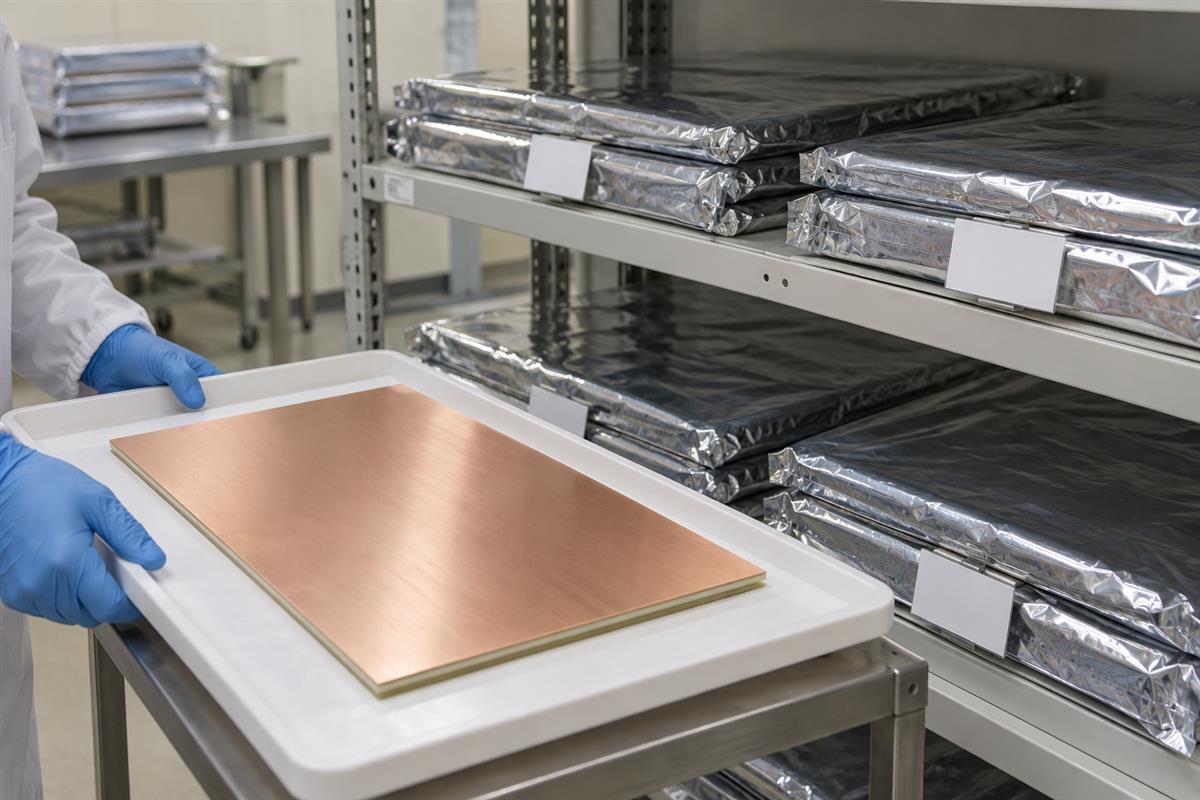
How should material move from receiving to layup?
Use one controlled route: receive, verify, store, condition as required, prepare, issue and reconcile. The following is a proposed control workflow, not a claim that every factory uses the same equipment or acceptance limits. Assign a responsible person and a retained record at each handoff.
1. Receive the shipment into a controlled status
Compare the shipment with the purchase order before moving it into usable stock. Record the supplier, product designation, lot, quantity and any date or handling restriction shown on the package or supplied documents. Inspect packaging for wetness, punctures, crushing and missing identification. Segregate discrepancies so “arrived” cannot be mistaken for “approved.”
Evidence to keep: receiving record, relevant label information and a discrepancy report when necessary. Do not leave condition-sensitive material in a receiving area while waiting for paperwork; move it to the required environment without prematurely releasing it.
2. Verify the material against the job specification
Check the product designation and construction rather than relying on color or familiar packaging. Confirm that certificates and material records refer to the actual lot. Where incoming measurements or tests are required by the quality plan, use the specified method and acceptance limits. A certificate does not automatically resolve a mismatch between the order and the label.
Handoff: only an accepted lot receives usable inventory status. Unclear substitutions go to engineering or quality for disposition, not directly to cutting.
3. Store under the applicable material instructions
Link each inventory location to the applicable storage requirement. Maintain the environmental records needed to demonstrate compliance and identify which lots were present if a condition goes outside the permitted range. Keep packages supported and protected against handling damage.
Rotate eligible stock using the approved inventory method. Date order is not permission to use expired or held material. Make the status visible in the inventory system and at the point of issue; a physical hold label should agree with the electronic status.
4. Prepare unopened material for the next environment
Follow the product instructions before opening a package moved between environments. Isola’s FR408 guide calls for packaged prepreg to reach layup-room conditions before opening to avoid condensation; it does not provide one universal waiting time. Its guide also calls for clean gloves, careful handling and suitable precision cutting. These are FR408-specific instructions to incorporate into an approved procedure, not a substitute for other suppliers’ guidance. Source: Isola FR408 processing guide.
Record the relevant transfer and opening events where the control plan requires them. “It feels warm now” is not a documented conditioning method. Obtain an approved endpoint or procedure for the actual package and environment.
5. Cut and handle without losing identity
Before separating material from its original package, create the child-container or cut-sheet identification. Use the approved handling and cutting procedure for that material. Prevent different grades or lots from becoming indistinguishable on the same work surface.
Check the prepared pieces for the damage and contamination defined in the inspection plan. Identification must travel with the material without introducing an unapproved marking substance onto a functional surface. Record accepted quantity, scrap and the parent lot.
6. Issue a verified kit to the production job
Match the kit to the current stackup revision. Verify material type, quantity, orientation requirements where applicable and release status at the point of use. This second check catches a correct lot issued to the wrong job.
The production traveler should connect the job to the issued material lots. If a planned kit is incomplete, stop and resolve the shortage; a visually similar sheet is not an authorized replacement. Record substitutions only after the required engineering and customer approvals.
7. Reconcile leftovers, scrap and consumed material
Return only identified material through the approved return procedure. Keep any relevant exposure history and disposition with the returned quantity. If the history is missing, hold the remainder instead of resetting its clock or assigning a fresh identity.
Close the issue record by reconciling consumption, returns and scrap. Investigate an unexplained difference before the next issue. The aim is not perfect-looking paperwork; it is the ability to identify affected jobs if a supplier later flags the original lot.
Which storage rules are product-specific?
Temperature, humidity, shelf life, package handling and conditioning requirements belong to the exact material, not to the word “PCB.” Two official examples show why copying one limit into a plant-wide instruction is risky.
SpeedWave 300P prepreg: Rogers’ published processing guideline specifies storage below 23°C and below 55% relative humidity, with a three-month shelf life from shipment under those conditions. It also addresses moisture-barrier packaging for opened material. The shipment-date reference matters: a receipt date is not automatically the start of shelf life. Confirm the applicable current instructions for the supplied lot. Source: Rogers SpeedWave 300P guideline.
TMM laminate: Rogers’ quick-reference guide identifies ambient storage and warns about handling damage to its rigid, ceramic-filled material, particularly thin laminates. This is a different material state and handling problem from prepreg. “Ambient” should be interpreted through the supplier’s applicable instructions, not as permission for uncontrolled transport or wet storage. Source: Rogers TMM processing guide.
For each stocked product, maintain a short control entry containing the exact grade, source document revision, storage limits, date basis, opening/return rules and escalation contact. If the package label and a general guide disagree, ask the supplier to resolve the discrepancy. Do not choose whichever requirement is easier.
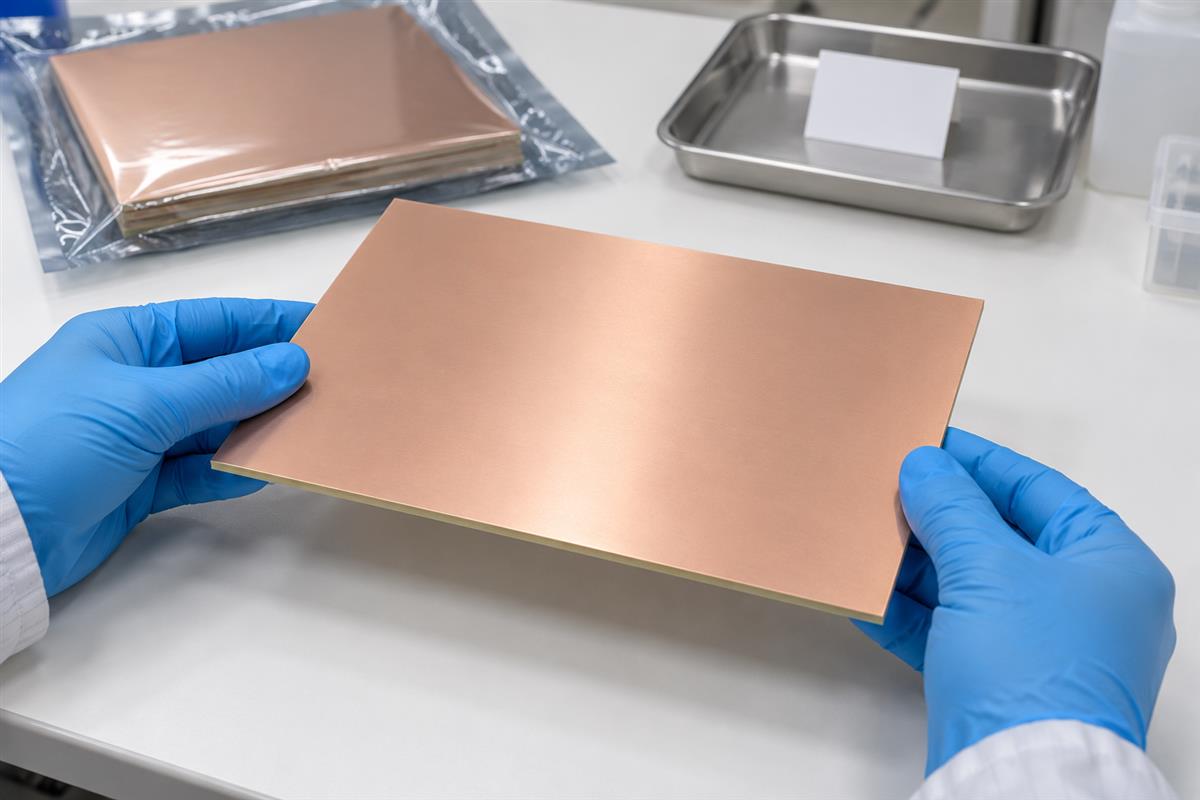
How do cut sheets and leftovers stay traceable?
Give each separated quantity a link back to the original lot and a record of where it went. Traceability fails when the original package retains the label but the material moves elsewhere.
Consider this illustrative inventory example, not an actual factory record. Parent lot L2609 contains 20 equal-size sheets. Six sheets go to Job A and eight to Job B; one becomes scrap and five remain in controlled stock. The reconciliation is 20 = 6 + 8 + 1 + 5. Each job record and the remainder must still resolve to L2609.
If those sheets are cut into unequal pieces, sheet count alone is no longer a meaningful balance. Record parent-sheet identity, cut sizes and quantities, or use a validated area-based method. Do not compare kilograms received with pieces issued without an approved conversion basis.
| Record field | Example entry | Question it answers |
|---|---|---|
| Parent identity | L2609, exact grade and construction | Which supplied lot did this come from? |
| Child identity | L2609-C02, cut size and quantity | Which separated material is here? |
| Destination | Job B, stackup revision C | Where was it used? |
| Relevant history | Transfer/opening/return events and linked environment record | Can eligibility still be established? |
| Status and disposition | Released, held or rejected; approver and reason | May production use it now? |
Test the system in both directions: select a finished job and find its material lots, then select a parent lot and find every job and remaining quantity associated with it. A spreadsheet can support this for a small operation, but only if identities are stable, changes are controlled and users do not silently overwrite history.
When should a material lot be held?
Hold it when identity, condition or eligibility cannot be demonstrated. A hold is a temporary decision to prevent use while the issue is investigated; it is not automatically a scrap decision.
| Trigger | Immediate control | What is needed before disposition |
|---|---|---|
| Missing or conflicting lot label | Segregate affected pieces; stop issue | A defensible link to source records, or rejection if identity cannot be recovered |
| Storage excursion | Identify all potentially affected stock | Actual duration and conditions, product requirements and approved engineering/supplier assessment |
| Damaged or wet packaging | Preserve the observation and protect other stock | Inspection and material-specific assessment; dry appearance alone is insufficient |
| Out-of-date or unknown exposure history | Block release; do not relabel as new | Applicable supplier guidance and authorized disposition, with any required validation |
| Grade or construction differs from stackup | Stop substitution | Documented design review and required approvals before manufacture |
Do not prescribe baking as a universal recovery action. A treatment that is appropriate for one material or production stage may not restore another material’s eligibility. Ask what evidence supports the recovery procedure and who is authorized to approve it.
Also separate material control from finished-board acceptance. A later electrical test does not reconstruct missing storage history or prove the right material was used. Define the required PCB testing process alongside, rather than instead of, material traceability.
Before releasing a kit, check:
- The exact grade and construction match the current stackup.
- Every issued quantity links to an accepted parent lot.
- Applicable storage and handling history is available.
- Inspection findings and deviations have an approved disposition.
- The job, quantity and remaining stock balance are recorded.
- No held or unidentified remainder is mixed into the kit.
Frequently asked questions
Is prepreg the same as a laminate core?
No. A core is already cured; prepreg provides resin that bonds layers during lamination. Their material states differ, so one storage or recovery instruction should not automatically be applied to both.
Can all PCB materials use one humidity limit?
Do not assume that. Build the control plan from the exact product instructions. A shared storage area is acceptable only when its qualified conditions meet the requirements of every material placed there.
Does FIFO guarantee that material is usable?
No. FIFO controls order of issue. Release still depends on identity, applicable dates, handling history and disposition. The oldest lot may be held and therefore ineligible for use.
Can we open a cold package immediately?
Check the material instructions first. Where packaged conditioning is required, follow it before opening. The appropriate endpoint depends on the package and environment; this article does not assign a universal waiting period.
Can leftover pieces go back into general stock?
Only through the approved return route, with identity and relevant history intact. Keep an unknown remainder on hold rather than mixing it with known material.
Is a supplier certificate enough for incoming release?
It is one part of the evidence. Verify that it identifies the supplied lot and matches the order, then complete the incoming checks required by the quality plan.
Does material handling mean the same thing as ESD control?
No. ESD control addresses electrostatic risk where applicable. It does not replace grade verification, storage control, physical protection or lot traceability. Add task-specific ESD measures when the product and process require them.
What should a buyer send for a material review?
Provide the stackup revision, specified material grades or substitution policy, dielectric and copper thickness requirements, relevant drawings and required certificates or traceability level. Include known storage or handling concerns instead of waiting until production starts.
To discuss a board’s material requirements with PCBtry, send the stackup and fabrication requirements through the contact page. Ask for confirmation of the proposed material construction, any substitutions and the records needed for your job before approving manufacture.



0 Comments