



Cleaning flux off a PCB means removing soldering residues that may affect electrical reliability,
corrosion resistance, coating adhesion and long-term product performance. The correct method depends
on the flux chemistry, component sensitivity, production volume and cleanliness requirements.
For high-reliability PCB and PCBA manufacturing, flux residue removal is not just a cosmetic step.
It is part of process control, failure prevention and quality assurance, especially for automotive,
medical, industrial, RF, power electronics and conformal-coated assemblies.
What Is Flux Residue on a PCB?
Flux residue is the material left on a printed circuit board after soldering. Flux is used to remove
oxides from metal surfaces, improve solder wetting and help form reliable solder joints. After reflow,
wave soldering, selective soldering or hand soldering, some activators, resins, acids or salts may remain
on the board surface.
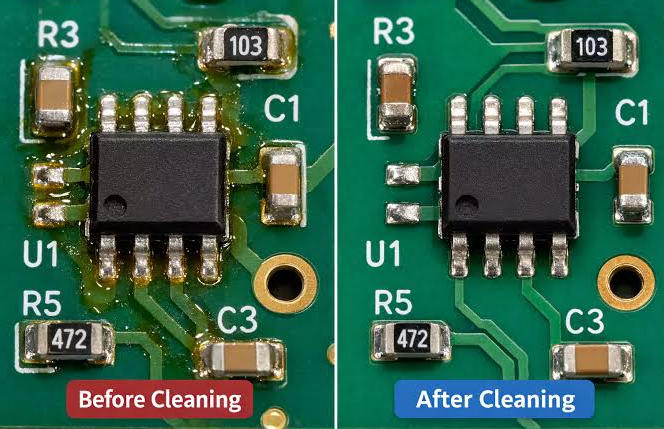
Common residue appearances include amber sticky film, white haze, powdery deposits, shiny transparent
residue or dark baked-on contamination. Some residues are mostly cosmetic, while others can become ionic,
corrosive or conductive when exposed to humidity and electrical bias.
Why Cleaning Flux Off PCB Is Important
Cleaning flux off PCB is important because some residues can reduce surface insulation resistance,
promote electrochemical migration, trigger corrosion and interfere with conformal coating adhesion.
The risk becomes higher in humid, high-voltage, high-impedance, outdoor or mission-critical applications.
In consumer electronics, minor no-clean residue may sometimes be acceptable if the process is validated.
In automotive, medical, aerospace, industrial control and RF applications, cleanliness requirements are
usually stricter. A board that looks visually acceptable may still fail ionic contamination or SIR testing
if hidden residue remains under components.
How Flux Works During Soldering
Flux works by chemically reducing surface oxides and protecting the solderable surface from re-oxidation
during heating. This improves wetting between solder alloy and copper pads, component leads or surface
finishes such as ENIG, HASL, immersion silver or OSP.
Residue forms when flux activators are not fully consumed, when resin carriers remain on the board,
when excessive flux is applied or when the thermal profile does not fully activate and volatilize the
flux system. Low-standoff components, dense layouts and shadowed solder joints often make residue more
difficult to remove.
Main Types of PCB Flux and Their Cleaning Needs
Different flux types leave different residues. Before choosing a cleaning method, engineers should confirm
the flux type from the solder paste, flux pen, solder wire or wave soldering flux datasheet.
| Flux Type | Typical Residue | Cleaning Need | Common Applications |
|---|---|---|---|
| Rosin Flux | Sticky amber or brown resin residue | Often cleaned for appearance, coating or reliability | Hand soldering, repair, general electronics |
| RMA Flux | Mildly activated rosin residue | May be acceptable if validated, but cleaning is recommended for high reliability | Industrial PCBA, mixed assembly |
| RA Flux | More active and potentially corrosive residue | Usually requires cleaning | Difficult soldering surfaces, repair work |
| Water-Soluble Flux | Ionic organic acid residue | Must be cleaned thoroughly | High-activity soldering, production assemblies |
| No-Clean Flux | Low-solid residue designed to remain on board | Optional only after validation; cleaned for coating, RF, high impedance or harsh environments | SMT reflow, mass production, compact electronics |
Materials and Tools Used to Clean Flux Off PCB
The most common tools include high-purity isopropyl alcohol, dedicated flux remover, deionized water,
ESD-safe brushes, lint-free wipes, spray bottles, ultrasonic cleaners, batch washers and drying ovens.
The safest choice depends on flux chemistry and component compatibility.
- IPA: 90% to 99% isopropyl alcohol is widely used for manual rosin flux residue removal.
- Dedicated flux remover: Better for stubborn no-clean residue or baked-on flux.
- DI water: Used with suitable cleaning chemistry for water-soluble flux.
- ESD-safe brush: Helps remove residue without generating electrostatic risk.
- Lint-free wipes: Prevent fiber contamination on solder joints and component leads.
- Ultrasonic cleaner: Useful for some assemblies, but must be validated for sensitive components.
- Drying equipment: Forced air, low-temperature oven or vacuum drying may be needed after wet cleaning.
How to Clean Flux Off PCB by Hand
Manual cleaning is suitable for prototypes, repair work, low-volume builds and localized flux residue removal.
It is flexible and low-cost, but operator technique strongly affects consistency.
- Confirm the flux type and check component compatibility with the cleaning solvent.
- Power off the board and remove batteries or external power connections.
- Apply 90% to 99% IPA or a compatible flux remover to the residue area.
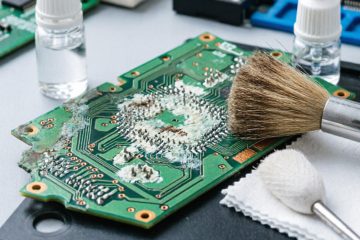
- Gently scrub with an ESD-safe brush, moving residue away from components and connectors.
- Use a lint-free wipe to absorb dissolved residue instead of spreading it across the board.
- Repeat until visible residue is removed.
- Dry the board completely using clean compressed air, warm air or controlled oven drying.
- Inspect under magnification for white haze, sticky film, trapped liquid or remaining contamination.
A common mistake is dissolving flux with IPA and allowing the contaminated liquid to dry on the board.
This only redistributes residue. Effective manual cleaning requires both dissolving and physically removing
the dissolved contamination.
IPA vs Flux Remover vs Aqueous Cleaning
IPA is convenient, but it is not always the best solution. Some no-clean flux residues are difficult to
dissolve with IPA alone. Water-soluble flux should be removed with a validated aqueous process rather than
simple alcohol wiping.
| Cleaning Option | Best Use | Relative Cost | Limitations |
|---|---|---|---|
| IPA Cleaning | Rosin flux, hand soldering residue, prototypes | Low | May not fully remove some no-clean residues; flammable; operator dependent |
| Dedicated Flux Remover | No-clean flux, stubborn resin residue, rework areas | Medium | Requires material compatibility check with plastics, labels and coatings |
| Aqueous Cleaning | Water-soluble flux and production cleaning | Medium to High | Requires DI rinse, drying control and wastewater management |
| Ultrasonic Cleaning | Residue under components and tight spaces | Medium | Can damage sensitive components if not validated |
| Inline or Batch Washer | Repeatable mass production cleaning | High | Requires process setup, chemistry control and cleanliness testing |
How to Clean No-Clean Flux Residue
No-clean flux is designed to leave a low-risk residue after proper soldering, but “no-clean” does not always
mean “never clean.” If the board will receive conformal coating, operate in humidity, use high-impedance
circuits or serve a safety-critical application, the residue should be evaluated carefully.
For no-clean flux remover selection, engineers should check the solder paste or flux datasheet first.
Some no-clean residues are resin-rich and require stronger solvent blends. Others may smear if cleaned
with the wrong solvent. For production, it is better to validate the cleaner, wash time, rinse process,
drying profile and cleanliness result instead of relying only on visual inspection.
How to Clean Water-Soluble Flux Residue
Water-soluble flux residue is usually ionic and must be removed after soldering. If left on a PCB, it can
absorb moisture, reduce insulation resistance and accelerate corrosion. This residue should not be treated
as harmless just because it is visually light or transparent.
A typical process uses warm DI water, suitable cleaning chemistry, controlled spray pressure, sufficient
rinse cycles and complete drying. In production, conductivity monitoring of rinse water and ionic
contamination testing help confirm that the process is stable.
Ultrasonic Cleaning for PCB Flux Removal
Ultrasonic cleaning uses cavitation to remove residue from small gaps and hidden areas. It can be effective
for dense assemblies, but it is not safe for every PCBA. Crystals, MEMS devices, ceramic resonators,
certain sensors, microphones, transformers and poorly secured components may be sensitive to ultrasonic energy.
Before using ultrasonic cleaning in production, validate frequency, power, cleaning time, liquid temperature
and component compatibility. A safer approach is to test sample boards first, then perform electrical testing,
visual inspection and reliability checks before approving the process.
PCB Cleaning Standards and Quality Testing
PCB cleaning quality should be verified through recognized industry methods, not only by appearance.
IPC standards and test methods are commonly used to define flux classification, cleaning guidance and
cleanliness evaluation.
- IPC-J-STD-004: Defines soldering flux classification and activity levels.
- IPC-CH-65: Provides guidelines for cleaning printed boards and assemblies.
- IPC-TM-650: Includes test methods for ionic contamination, surface insulation resistance and electrochemical migration.
- IPC-A-610: Provides acceptability criteria for electronic assemblies, including visual workmanship expectations.
For high-reliability products, common verification methods include visual inspection under magnification,
ionic contamination testing, SIR testing, ion chromatography and environmental stress testing. The required
acceptance criteria should be defined by product class, customer requirements and end-use environment.
Common Flux Cleaning Mistakes
Many PCB cleaning failures happen because the process removes visible residue but leaves ionic contamination
behind. A board can look clean while still failing in humidity or electrical bias conditions.
- Using 70% IPA, which contains more water and may dry slower.
- Spreading dissolved flux across the PCB instead of removing it with wipes or rinse steps.
- Cleaning no-clean flux with an incompatible solvent that creates white residue.
- Forgetting to clean under low-standoff components.
- Using aggressive solvents that damage plastics, labels, connectors or coatings.
- Failing to dry the board completely after aqueous cleaning.
- Skipping ionic contamination or SIR testing for high-reliability applications.
- Applying conformal coating over residue without validating coating adhesion.
Failure Analysis: What Happens If Flux Residue Is Not Cleaned?
Unremoved flux residue may cause intermittent failures that are difficult to reproduce. Problems often appear
after shipping, thermal cycling, humidity exposure or long-term field operation rather than during initial
functional testing.
| Failure Mode | Possible Cause | Typical Symptom | Prevention |
|---|---|---|---|
| Corrosion | Ionic or acidic residue under humidity | Green or dark deposits, open circuits, unstable resistance | Clean water-soluble and active residues; verify cleanliness |
| Electrochemical Migration | Residue, moisture and voltage bias | Dendrite growth, leakage current, short circuits | Improve cleaning, spacing, coating and process control |
| Low SIR | Conductive contamination on board surface | Noise, drift, malfunction in high-impedance circuits | Use validated cleaning and SIR testing |
| Coating Delamination | Flux residue trapped under conformal coating | Bubbles, peeling, poor adhesion | Clean and dry before coating; verify adhesion |
| RF Performance Drift | Residue altering surface characteristics | Insertion loss, impedance shift, unstable signal behavior | Use high-cleanliness process for RF boards |
Design Tips to Make PCB Flux Cleaning Easier
Cleanability should be considered during PCB layout and component selection. If residue is trapped under
components or in narrow gaps, even a strong cleaning process may not remove it completely.
- Choose component packages with adequate standoff height when cleaning is required.
- Avoid placing high-impedance nodes where residue can easily accumulate.
- Provide enough spacing around components for wash flow and inspection access.
- Confirm that labels, connectors, switches and plastics tolerate the selected cleaner.
- Control solder paste volume and flux application to avoid unnecessary residue.
- Use reflow profiles recommended by solder paste suppliers to avoid under-activated residue.
- For conformal coating, define cleaning and drying requirements before coating approval.
Factory Process Control for Flux Residue Removal
In PCBA mass production, repeatability matters more than one-time cleaning performance. A reliable factory
process should define cleaning chemistry, temperature, wash time, rinse method, drying profile, inspection
criteria and test frequency.
As a China-based PCB and PCBA source manufacturer supplying global customers, process control should be
aligned with product class and customer requirements. For overseas buyers, the most important procurement
point is not only whether the supplier says the board is clean, but whether the cleaning process is documented,
measurable and repeatable.
- Document flux type, solder paste model and soldering process.
- Define cleaning agent concentration and replacement interval.
- Monitor DI water quality for aqueous cleaning.
- Set drying requirements to prevent trapped moisture.
- Perform visual, ionic contamination or SIR testing when required.
- Keep batch records for traceability in OEM and ODM production.
Cost Factors in PCB Flux Cleaning
Flux cleaning cost depends on labor, cleaning chemistry, equipment investment, board complexity,
cleanliness standard, production volume and testing requirements. Manual cleaning may look cheaper for
prototypes, but it becomes inconsistent and labor-heavy for volume production.
| Cost Factor | Impact on Price | Procurement Note |
|---|---|---|
| Flux Type | Water-soluble and active flux usually require more controlled cleaning | Confirm flux chemistry before quoting |
| Board Density | Dense layouts need stronger process validation | Share drawings, BOM and assembly files early |
| Cleaning Method | Inline cleaning costs more but gives better repeatability | Suitable for batch PCBA manufacturing |
| Testing Requirement | Ionic testing, SIR testing and reliability testing add cost | Useful for automotive, medical and industrial products |
| Drying Control | Longer drying time affects throughput | Important for moisture-sensitive or coated assemblies |
How to Choose a PCB Manufacturer for Clean PCBA Production
Buyers should choose a PCB or PCBA manufacturer that understands both soldering quality and residue control.
For OEM, ODM, prototyping and mass production, the supplier should be able to explain which flux is used,
whether cleaning is required and how cleanliness is verified.
- Ask for flux and solder paste datasheets when needed.
- Confirm whether the assembly uses no-clean, rosin or water-soluble flux.
- Check if the supplier can support cleaning before conformal coating.
- Request inspection and test options for high-reliability products.
- Confirm component compatibility before ultrasonic or solvent cleaning.
- For global supply, align cleaning requirements with product market, operating environment and customer standards.
Recommended Cleaning Approach by Application
The best way to clean flux off PCB depends on the final application. A prototype development board and
an automotive control module should not be treated with the same cleanliness strategy.
| Application | Recommended Approach | Key Concern |
|---|---|---|
| Prototype PCB | Manual IPA or suitable flux remover | Fast turnaround and visual inspection |
| Consumer Electronics | No-clean process or selective cleaning after validation | Cost and appearance balance |
| Industrial Control | Validated cleaning and inspection | Humidity, dust and long service life |
| Automotive Electronics | Controlled cleaning with cleanliness testing when required | Temperature cycling, vibration and reliability |
| Medical Devices | Strict cleaning, traceability and reliability validation | Safety and compliance requirements |
| RF and High-Frequency PCB | High-cleanliness process and careful residue control | Signal integrity and impedance stability |
| Conformal-Coated PCBA | Clean and dry before coating | Coating adhesion and corrosion prevention |
FAQ
Can I use 70% IPA to clean flux off PCB?
70% IPA can remove some light residue, but it contains more water and dries slower than 90% to 99% IPA.
For PCB flux residue removal, higher-purity IPA is usually preferred because it dissolves rosin residue
more effectively and reduces drying concerns. Always remove dissolved residue with a wipe or rinse step.
Is no-clean flux really safe to leave on a PCB?
No-clean flux can be safe when the soldering process is properly controlled and the application environment
is not harsh. However, no-clean residue may still cause issues in high humidity, high impedance circuits,
RF boards or conformal-coated products. For critical assemblies, validate the residue through testing.
What is the best way to remove rosin flux from PCB?
Rosin flux is commonly removed with 90% to 99% IPA or a dedicated rosin flux remover. Apply the solvent,
scrub gently with an ESD-safe brush and wipe away dissolved residue. For baked-on or heavy residue, a
stronger compatible flux remover may be more effective than IPA alone.
Do water-soluble flux residues need to be cleaned?
Yes. Water-soluble flux residues are usually ionic and can become conductive or corrosive when exposed to
moisture. They should be removed using a validated aqueous cleaning process with proper rinse and drying.
Leaving water-soluble flux residue on a board is a significant reliability risk.
Can ultrasonic cleaning damage PCB assemblies?
Ultrasonic cleaning can damage certain sensitive components if the process is not validated. Crystals,
MEMS devices, microphones, sensors and some ceramic parts may be vulnerable to ultrasonic energy.
Always check component compatibility and test sample assemblies before using ultrasonic cleaning in production.
Why does white residue appear after cleaning flux?
White residue may appear when flux is only partially dissolved, when the wrong solvent is used, when rinse
quality is poor or when water reacts with resin-based residues. It may be cosmetic in some cases, but it
should be investigated if the product requires high reliability or conformal coating.
How do I know if a PCB is clean enough?
Visual inspection is useful but not sufficient for high-reliability products. Cleanliness can be verified
by ionic contamination testing, surface insulation resistance testing, ion chromatography or environmental
reliability testing. The correct acceptance level depends on product class, customer requirements and end use.
Should flux be cleaned before conformal coating?
In most high-reliability assemblies, flux residue should be removed before conformal coating. Residue can
reduce coating adhesion, trap ionic contamination and cause corrosion under the coating. Cleaning and complete
drying should be validated before coating is applied to production boards.
Can I clean a powered PCB?
No. A PCB should be powered off before cleaning. Remove external power sources and batteries where possible.
Cleaning liquids can create short circuits, corrosion or safety risks if used on energized circuits.
The board should be fully dry before power is restored.
Is acetone safe for cleaning PCB flux?
Acetone can dissolve some residues, but it may damage plastics, connectors, labels, coatings and some
component materials. It is generally not the first choice for assembled PCBs unless compatibility has been
confirmed. IPA or a dedicated electronics-grade flux remover is usually safer.
What causes flux residue under components?
Residue under components is often caused by low standoff height, excessive flux, dense layout, poor wash
flow or incomplete reflow activation. These areas are difficult to inspect and clean. Design for cleanability
and process validation are important for dense PCBA manufacturing.
Does cleaning flux improve PCB reliability?
Cleaning can improve reliability when residues are ionic, corrosive, moisture-absorbing or incompatible
with coatings. It is especially important for automotive, medical, industrial, RF and outdoor electronics.
The improvement depends on whether the cleaning process is properly matched to the flux chemistry.
What should buyers ask a PCB assembly supplier about flux cleaning?
Buyers should ask which flux is used, whether cleaning is required, what cleaning method is available,
how drying is controlled and what testing can verify cleanliness. For OEM and ODM projects, cleaning
requirements should be discussed before production to avoid reliability issues and unexpected costs.
Conclusion
The core principle is simple: clean the residue that can create reliability risk, and validate the process
instead of relying only on appearance. Rosin flux, no-clean flux and water-soluble flux require different
cleaning strategies, and the final decision should consider product environment, component compatibility,
coating requirements, IPC-related testing and production volume.
For selection, use IPA or compatible flux remover for many manual and prototype cleaning tasks, validated
aqueous cleaning for water-soluble flux, and controlled batch or inline cleaning for repeatable mass
production. For purchasing, choose a PCB or PCBA supplier that can document flux type, cleaning process,
drying control and cleanliness verification.
If you’re sourcing reliable PCB/PCBA manufacturing — OEM, ODM, prototyping, mass production, or custom engineering solutions — reach out to our engineering team for technical support and a quote at sales@pcbtry.com.
0 Comments