



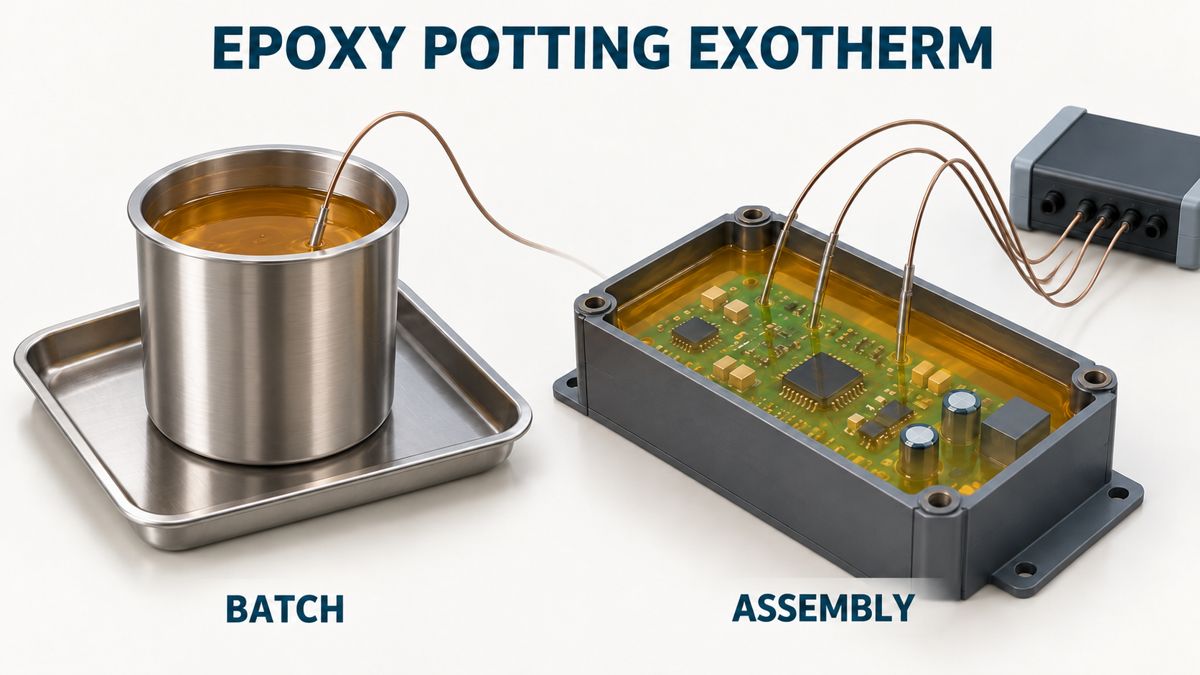
Epoxy potting exotherm is the heat released while resin and hardener react. Controlling it means qualifying the mixed batch, the filled enclosure and the cure schedule together. An oven setting or a data-sheet peak temperature cannot tell you what a sensitive component will experience inside your product.
Before increasing production volume, establish a repeatable temperature record and a clear stop condition. The aim is a cured, functional assembly, not merely a shorter wait before the next operation.
Why does epoxy potting get hot?
The curing reaction generates heat, and the surrounding geometry determines how readily that heat escapes. A deep mass can retain heat differently from a thin layer of the same material. Higher material temperature can accelerate the reaction, so the process is not a simple oven-temperature lookup.
WEST SYSTEM’s chemistry explanation describes this relationship between contained mass, surface area and reaction heat. Its application-specific thickness and heating instructions are not limits for an electronics encapsulant. Use your compound’s own instructions.
Separate two locations in the investigation: the mixing vessel and the product cavity. The batch can age and warm before dispensing begins; each enclosure then presents a different heat-transfer path. Also separate cure heat from the heat generated by powered electronics in service. Passing one assessment does not pass the other.
Which MG Chemicals 832C parameters affect exotherm checks?
The 832C technical data sheet, version 4.2 dated February 20, 2026, provides a useful named example. These are published product values, not PCBtry process limits or guaranteed tolerances.
| Parameter | Published value | Interpretation |
|---|---|---|
| Mix ratio | 2:1 by volume; 2.3:1 by weight | Do not interchange the two bases. |
| Mixed viscosity | 2,700 cP at 25°C | Temperature accompanies the number. |
| Working time | 3 h 15 min, 100 g sample | Varies with volume and geometry. |
| Peak exotherm | 107°C, ASTM D2471 | 250 g sample in fixed container geometry; not a universal maximum. |
| Hand-mixed batch warning | Above 500 g | Shorter working time and flash-cure risk; not approval of every smaller batch. |
Obtain the current SDS and supplier guidance before setting a process window. The table does not provide an assembly acceptance tolerance or all details needed to reproduce the exotherm test. A different formulation needs its own record.
Room-temperature vs oven cure: which should you qualify?
Choose between supplier-approved schedules by measuring the actual assembly and checking the required cured properties. A faster schedule is useful only when the complete product tolerates it.
| Decision | Room-temperature cure | Oven cure |
|---|---|---|
| Main process variable | Actual material and surrounding temperature over the waiting period | Actual resin/component exposure as well as oven air and loading |
| Capacity question | Can identified units wait without contamination or mix-ups? | Can fixtures, loading and transfer timing be repeated? |
| Evidence needed | Approved schedule, cure assessment and final function | The same evidence, plus a representative measured thermal profile |
| Reason to hold release | Cure condition is unknown or ambient range is uncontrolled | Component exposure exceeds an approved limit or the profile is unexplained |
A Reddit discussion about 70°C oven curing describes boards passing before potting and failing afterward. It identifies a real investigation need, not a standard temperature or a proven failure mechanism. Do not turn another product’s successful recipe into your work instruction.
Ask the resin supplier what schedule is appropriate for the intended volume and what evidence establishes adequate cure. Separately, ask the product engineer to approve the populated assembly’s exposure, including connectors, sensors, plastics, adhesives and any temperature-sensitive parts.
How do you measure the temperature inside potted electronics?
Use an instrumented, representative trial when the internal temperature matters. A surface thermal image does not directly measure a hidden resin core. In a power-supply encapsulation discussion, inconsistent surface readings led the author to try a thermocouple.
- Define the limits before mixing. List the approved component/process exposure limits and the material supplier’s restrictions. Assign the person who can stop the trial. An unknown critical limit is a reason to seek guidance, not to guess.
- Represent the real geometry. Use a sacrificial assembly or an agreed representative fixture with the actual enclosure, fill boundary and relevant components. Document differences from production.
- Locate sensors deliberately. Consider the thick resin region, a sensitive component and the surrounding air. Record positions on a section drawing. The responsible engineer should choose suitable sensors, attachment, insulation and logging equipment so the measurement does not create a short or materially change the geometry.
- Use one time reference. Record mix start, dispensing start/end, oven entry if applicable and the full temperature history through the approved cure. Keep the unpowered trial electrically safe; perform functional tests only under the approved test procedure.
- Evaluate temperature and function separately. Compare each trace with its relevant limit, then inspect and test the cured assembly. A permitted thermal profile does not prove adequate cure or exclude mechanical damage.
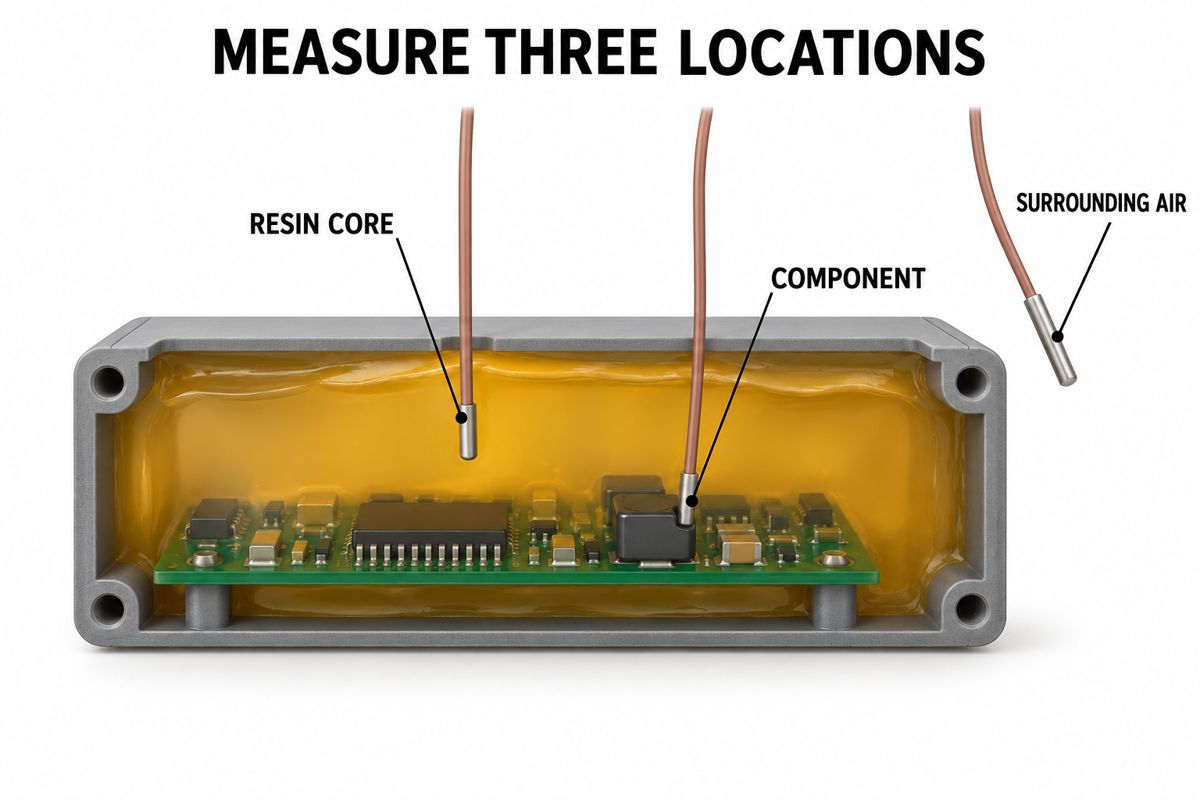
For example, a component-adjacent sensor and a core sensor may disagree without either being faulty: they measure different locations. Preserve both traces and the placement drawing. Do not select only the cooler trace to justify release.
How should you set batch size and dispensing time?
Qualify both the material held before dispensing and the material placed into each product. “Ten units per batch” is incomplete unless the resin mass, vessel geometry and elapsed time are also controlled.
Consider an illustrative planning calculation: ten enclosures requiring 20 g each need 200 g of dispensed material, before process losses. That calculation estimates supply quantity only. It does not establish that preparing 200 g in one cup is equivalent to preparing several smaller batches, or that the last enclosure receives material in the same state as the first.
- Record actual component quantities, batch mass, vessel identification, initial material temperature and mixing time.
- Identify the first and last dispensed units in the trial and retain their timing and results.
- Include planned interruptions, transfers and any approved de-airing operation in the available working period.
- Requalify a change in vessel, dispensing equipment, enclosure depth, resin grade or cure loading when it changes the approved conditions.
A low-exotherm formulation can be an alternative to investigate. For example, Master Bond describes EP37-3 as a low-exotherm system for larger encapsulations. That does not establish drop-in equivalence: compare the required cure, mechanical, electrical and environmental performance before substitution.
Plan abnormal-reaction handling before the trial using the material SDS and workplace procedure. Do not improvise a rescue by adding solvent, water or extra hardener to a heating batch. Unexpected rapid heating, fumes or vessel deformation require the established safety response and a held process, not continued dispensing.
What belongs in an epoxy cure qualification worksheet?
Keep this worksheet with the temperature traces and unit-level test results. It is a proposed record structure, not a certificate or a universal validation standard.
| Record field | Evidence to attach | Release question |
|---|---|---|
| Material and preparation | Product/lot, expiry, TDS revision, ratio basis, actual quantities, starting temperature | Was the intended formulation prepared reproducibly? |
| Batch and holding vessel | Mass, vessel dimensions/material, mix and dispensing timestamps | Does the trial cover the permitted holding condition? |
| Product geometry | Enclosure section, fill mass/depth, board revision, sensor map | Does this represent the production assembly? |
| Cure exposure | Schedule revision, loading, raw traces, peak/time at each sensor, applicable limits | Are all critical exposures within their approved windows? |
| Outcome | Cure assessment, inspection, pre/post electrical results and failed-unit IDs | Did the process preserve required function and material condition? |
| Approval | Repeat-trial plan, deviations, owner and change triggers | What evidence permits release, and what requires another trial? |
Use limits supplied by the product and material requirements, not an invented universal peak. Agree on repeat coverage that addresses expected production variation. If temperature exposure is acceptable but parts still fail, continue the investigation into potting-related mechanical stress. If the issue is void location or filling, use the separate potting bubble checks.
Epoxy potting exotherm FAQ
Why does the leftover cup get hotter than the filled enclosure?
The retained mass and heat-transfer paths differ. Record both geometries and quantities before comparing them. A hot cup is a reason to review batch handling, but its temperature is not automatically the component temperature inside an enclosure.
Is the data-sheet peak exotherm a safe temperature limit?
No. It describes a test under specified conditions. Your assembly limit comes from the applicable component, material and process requirements. Keep the sample mass and geometry attached to the published number rather than treating it as a universal ceiling.
Can an infrared camera replace an internal sensor?
Not when the question concerns a hidden resin region. It can provide useful surface information, but that is a different measurement. Use an engineered internal measurement where needed and preserve sensor-position evidence with the trace.
Can I reduce the hardener amount to slow the reaction?
Do not depart from the formulation’s specified ratio to control temperature. That changes the material preparation rather than qualifying it. Discuss batch handling, an approved schedule or another qualified formulation with the supplier.
Does a smaller batch guarantee the PCB will be safe?
No. Smaller preparation batches do not establish the exposure inside a deep filled enclosure, nor do they prove chemical or mechanical compatibility. Qualify the complete route and the finished assembly’s required function.
Can I split the potting into multiple pours?
Only with a material- and product-specific procedure. Confirm the interval, interface preparation and final performance with the responsible suppliers and engineer. Additional interfaces and waiting periods need evaluation; a forum’s timing is not transferable approval.
Does a failure after curing prove the resin overheated?
No. Preserve the electrical symptom, location and before/after data. Temperature, mechanical loading, contamination and existing marginal connections may need separate checks. A time correlation identifies where to investigate, not the cause by itself.
Does low-exotherm epoxy keep powered components cool?
Low exotherm concerns heat generated during cure. Operating heat removal is a separate design question involving the component, compound, enclosure and environment. Validate both rather than using a cure description as an operating thermal specification.
Request an assembly and cure-process review
For a PCB assembly project, send the BOM, assembly drawing, enclosure section, resin TDS, intended batch size and available temperature traces through PCBtry’s contact page. Include the worksheet and identify missing limits or failed-unit symptoms.
Ask the team to confirm the available assembly scope and any specialist material or process qualification needed before quotation. This makes the request actionable without assuming that a published resin specification already qualifies your product.

0 Comments