




CAF in a PCB means conductive anodic filament: an internal electrochemical failure mechanism that can create a conductive path through insulating laminate between conductors at different electrical potentials. It is not a name for every short circuit, nor something a clean-looking board automatically rules out.
For an engineer or buyer, the useful question is not simply whether a laminate is advertised as CAF resistant. Ask whether the supporting evidence represents the material construction, manufacturing route and electrical geometry you intend to use.
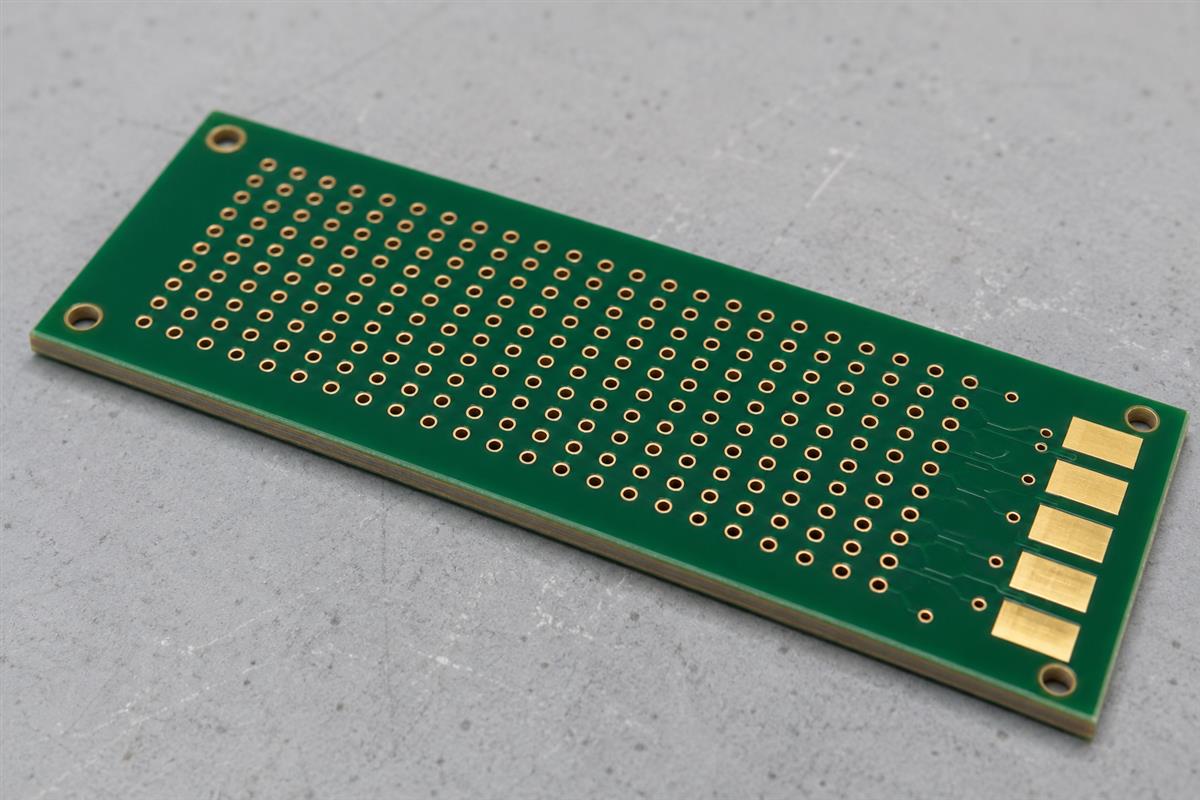
What CAF is, and what a short circuit does not prove
CAF involves a buried conductive path, commonly associated with the glass-resin interface in reinforced laminate. Moisture, electrical bias and a susceptible path can enable copper-containing conductive growth. Imagine two nearby plated holes belonging to different nets: the artwork may keep their copper separate while a path develops inside the material between them.
Isola’s CAF research describes interface degradation followed by electrochemical growth. Importantly, it also reports resistance changes without confirmed CAF in some experiments. A resistance drop is evidence to investigate, not a photograph of the mechanism.
| What you observe | What it establishes | What remains open |
|---|---|---|
| Low resistance between normally isolated nets | An electrical isolation problem under the measurement conditions | Whether the path is inside the board, on its surface or through a component |
| Visible residue or growth on the surface | A location for surface investigation | Whether a separate internal mechanism also exists |
| No visible external defect | Only that this inspection found no external feature | The condition of buried material and interfaces |
| Targeted failure analysis identifies a buried filament | Much stronger support for the mechanism at that location | Its extent, initiating conditions and relevance to the rest of the lot |
Do not label a field return “CAF” from an intermittent reset alone. Preserve the board identity, failure conditions and suspect net pair, then agree an investigation plan with a qualified failure-analysis laboratory. Avoid cleaning, baking or destructive probing before that plan if those actions could alter evidence.
Where to look for preventable risk
Review the material, geometry and process together. A purchasing label cannot compensate for an unreviewed layout, and a larger nominal spacing does not prove that every relevant path is acceptable.
Techspray’s technical discussion identifies drilling-related damage and buried pathways as concerns. This supports asking how the fabricator controls the process; it does not justify a universal drill setting or a claim that one drilling technology always prevents CAF.
| Review area | Useful question | Evidence to request |
|---|---|---|
| Laminate construction | Which actual grade and construction were evaluated? | Material identity and a relevant qualification report |
| Closely spaced biased features | Which conductor pair is being assessed? | Marked geometry, voltage relationship and drawing revision |
| Fabrication process | Does the evidence represent the proposed manufacturing route? | Process identification and a change-control explanation |
| Assembly exposure | What thermal history is included in the qualification? | Preconditioning record matched to the agreed scope |
| Operating environment | What moisture, temperature and bias conditions matter in service? | Product requirements and the rationale for the selected test |
Specify the copper-clad laminate precisely enough to control substitutions. “FR-4” is a material family, not the identity of the tested construction. Likewise, do not treat a Tg number as a substitute for CAF evidence: thermal transition behavior and demonstrated electrochemical reliability answer different questions.
The practical output is a list of reviewed risks and remaining gaps. It is not a blanket statement that the board is immune to CAF.
How to read a CAF test report
Read a report as a bounded experiment: identify what was tested, under which conditions, and how the result was judged. Start with the method revision, not a marketing statement on the cover.
IPC-TM-650 Method 2.6.25, Revision C addresses CAF propensity and related internal electrochemical failures. Its coupon geometry distinguishes drilled-hole spacing from finished-hole dimensions. The method also warns that it was not designed for bias above 100 Vdc. Higher-voltage work requires an appropriately defined laboratory procedure and safety controls, not a casual increase of the supply setting.
- Identify the sample. Match the material, construction, fabrication lot and coupon drawing to the decision being made.
- Match the geometry. Ask which spacing and conductor relationship the coupon represents. Do not substitute center-to-center pitch for the required edge-based dimension.
- Read the condition history. Separate preparation, stabilization and biased exposure. Require the actual temperature, humidity, voltage and duration records.
- Check the decision rule. Locate the baseline, failure definition, measurement intervals and treatment of invalid channels. A final “pass” cell alone is insufficient.
- Ask about anomalies. Request the resistance history and disposition of suspect paths, rather than only an average across samples.
- Write the conclusion narrowly. State which sample set passed the agreed procedure and which proposed production changes remain outside that evidence.
Element’s CAF testing service describes multiple coupon configurations and further failure analysis when growth is suspected. Its page references a different method revision from the IPC document linked above. Confirm the contractual revision with the lab; do not combine conditions from different summaries into a new unofficial procedure.
A supplier comparison that avoids false confidence
Compare the scope before comparing the pass result. The following is a hypothetical document-review exercise, not test data from PCBtry or a named supplier.
| Document A | Document B | Buyer decision |
|---|---|---|
| A material brochure says “CAF resistant” | A report identifies the tested material and coupon | B is more traceable; neither yet establishes a match to your build |
| Only nominal via pitch is listed | The relevant hole dimensions and spacing are stated | Request the missing geometry before claiming equivalence |
| A pass result has no stated exposure history | The condition record and decision rule are supplied | A needs clarification; B can proceed to technical review |
| The proposed production material differs from the report | The proposed build matches the reported identity | Resolve A’s substitution; still review B’s process and application scope |
Suppose A offers the lower unit price. The next action is not automatically to reject A or award B. Send A the specific gaps and ask for a comparable submission. Record “evidence incomplete” separately from “tested and failed.” That distinction prevents both unjustified approval and an unfair supplier rejection.
Also keep coupon qualification separate from a product-lifetime promise. A result under a defined exposure is not, by itself, a calculation of years in service. Any lifetime extrapolation needs its own model, assumptions and validation.
Prepare an evidence-based fabrication enquiry
Send a package that lets the fabricator identify the intended construction and lets the reliability team decide what evidence is still needed. Keep fabrication acceptance and reliability qualification as separate, named requirements.
- Describe the application boundary. State the environment and relevant voltage differences without assuming the supplier knows the final use.
- Mark the critical features. Provide the stackup, hole table and suspect conductor relationships in the controlled drawing set for your multilayer PCB.
- Define the evidence request. Ask which material/process reports are available, what they cover, and which additional qualification would require a separate laboratory agreement.
- Control the release. List unresolved gaps, approval owners and changes that require review before production.
A useful enquiry sentence is: “Please identify the proposed laminate construction and explain whether the available CAF evidence covers the attached geometry and manufacturing route. List differences and any additional test scope before material substitution.” This is an evidence request, not a claim that a particular standard has already been met.
Contact PCBtry with your fabrication files, stackup and marked reliability requirements to discuss the proposed build. Confirm the availability, responsibility and cost of any specialist testing separately; do not assume it is included in ordinary board fabrication.
CAF questions buyers ask
Does a clean-looking board rule out CAF?
No. External appearance cannot establish the condition of an internal path.
Does a failed insulation test prove CAF?
No. It establishes a measured isolation problem. Locating and characterizing the path is a separate investigation.
Is CAF-resistant the same as CAF-proof?
No. Ask for the conditions and construction behind the claim, then compare them with your requirements.
Can one report qualify every board using the same material name?
Not automatically. Review whether construction, geometry and process differences affect the report’s relevance.
Should I bake a failed board before sending it for analysis?
Not without an agreed investigation plan. Preserve its condition and consult the lab about handling.
Can I use a universal minimum spacing from a blog?
No. Resolve the relevant geometry, electrical conditions and qualification requirements for the application.
Does a room-temperature continuity test replace CAF qualification?
No. An immediate connectivity check and an environmental reliability evaluation have different scopes.
What should purchasing do when evidence is missing?
List the exact gaps, assign a technical reviewer and obtain a response before approving the affected reliability requirement.



0 Comments