



Conformal coating cure time depends on the formulation, not just the coating family. The documented examples below range from seconds of UV exposure to 24–48 hours at room temperature, while one polyurethane specifies up to 30 days for optimum properties. Parylene has no separate liquid-coating cure stage. Use the table to find the relevant system, then match the exact product and process conditions.
How Long Does Each Type of Conformal Coating Take to Cure?
This comparison covers the main PCB coating systems, not every commercial formulation. Times are manufacturer-published product examples, not universal limits for each chemistry. “RT” means room temperature as stated in the cited document; where a numeric temperature or humidity is not supplied, none is assumed. Handling, recommended cure and optimum properties remain separate milestones.
| Coating system and example | Handling milestone | Room-temperature cure | Accelerated route and important limit |
|---|---|---|---|
| Acrylic: MG 419D Liquid | 10 min, one coat; 20 min, two coats | 24 h drying/cure schedule | After 10 min flash-off: 30 min at 65°C; 20 min at 80°C; 10 min at 100°C; 5 min at 120°C |
| Silicone: HumiSeal 1C49 | 3–5 h | 24 h recommended cure; 7 days to optimum properties | 20 min at 76°C with the TDS moisture provision: an open pan of water in the oven. Do not treat this as a dry-oven recipe |
| Silicone-modified acrylic: MG 422B Liquid | 8 min, one coat; 15 min, two coats | 48 h | 8 min flash-off, then 20 min at 65°C. This blend is not interchangeable with moisture-curing silicone |
| Polyurethane: MG 4223F Liquid | Cure instructions say 30 min; property table says 15/25 min for one/two coats. Confirm the discrepancy | Up to 30 days for full cross-linking and optimum properties | At least 15 min ambient flash-off, then 21 h at 65°C, 16 h at 80°C or 2 h at 100°C |
| Two-part epoxy: MG 4225 | 7 h, one coat | 48 h | 4 h at 65°C, 2 h at 80°C or 40 min at 100°C. Add the application-specific pre-dry time; see below |
| UV with secondary moisture cure: MG 4200UV | Exposed surface becomes tack-free after the specified UV dose | Shadow areas: within 24 h at ambient moisture per TDS | UV exposure is seconds-scale, but depends on dose, irradiance and temperature. It does not make shadowed material instantly cured |
| Parylene vapor-deposited coating | No wet-film handling stage | No separate curing stage | Obtain deposition-cycle and finishing lead time from the coating provider; “no cure” does not mean zero processing time |
Read the stages literally: a 10-minute handling value is not a 10-minute full-cure value. Likewise, an oven hold is not the complete elapsed production time. The quoted schedules do not grant permission to heat every assembled PCB to those temperatures.
Is Dry to Touch the Same as Fully Cured?
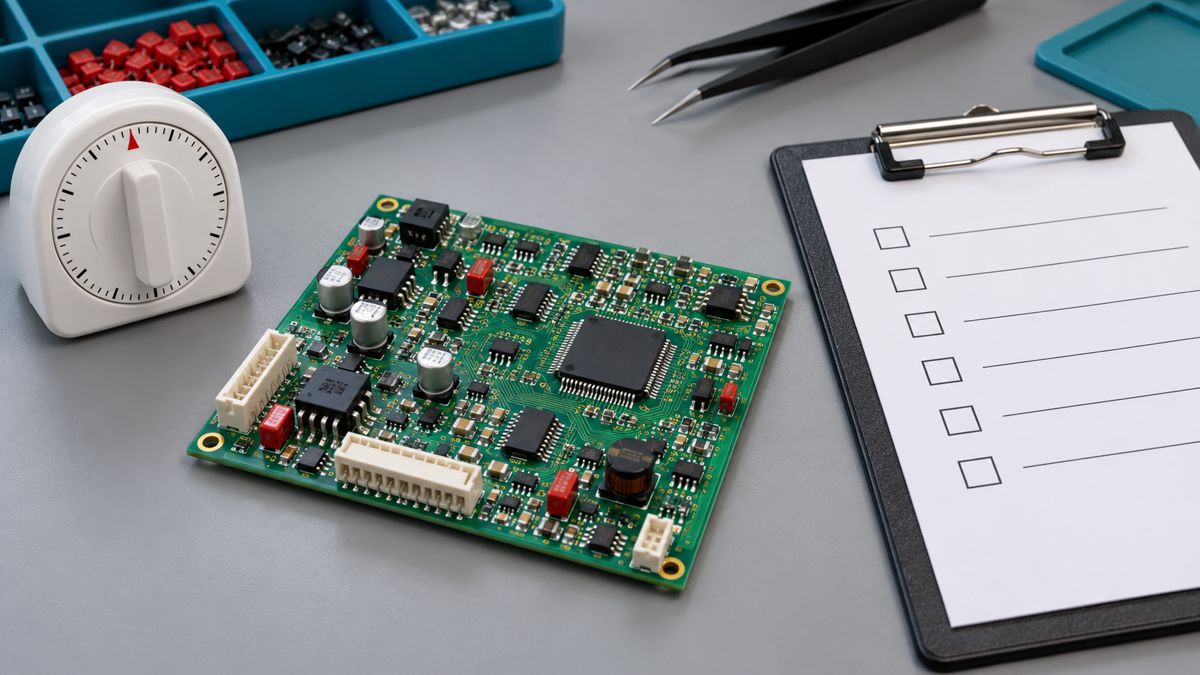
No. Touch-dry or tack-free describes a surface condition. Dry-to-handle concerns an intermediate handling operation. A specified cure schedule or time to optimum properties addresses a later material state. These terms may be defined differently across suppliers, so the comparison preserves the labels used in each document.
A Reddit discussion about acrylic coating captures the practical confusion: the user found both a short touch-dry time and a much longer full-cure time and did not know which governed reassembly. For planning, select the milestone required by the next operation. A safe transfer between fixtures is not the same requirement as enclosing the board, applying electrical power or exposing it to moisture.
Do not collapse these milestones into a single “ready” label. On the work order, specify both the coating process completion condition and the test or service condition that follows it.
What Product Parameters Must Match the Cure-Time Table?
The following parameters identify the examples closely enough to prevent common substitutions. Film thickness is the manufacturer’s recommended film value, not a universal target for every coating. The listed schedules are process guidance, not guaranteed timing tolerances for an uncontrolled board.
| Product/document checked | Relevant published parameters | What to verify before using the time |
|---|---|---|
| 419D Liquid, v4.0, 31 July 2025 | Acrylic; film 25–75 µm; minimum recoat interval 3 min | Liquid formulation and number of coats; do not transfer the schedule to an unidentified aerosol |
| HumiSeal 1C49, document 14617 | Moisture-curing silicone; thickness 50–200 µm | Ambient moisture and the heat-route moisture provision; optimum properties are a separate endpoint |
| 422B Liquid, v5.1, 19 December 2025 | Acrylic-silicone blend; film 25–75 µm | Exact blend identity; a generic “silicone” label does not select a schedule |
| 4223F Liquid, v6.0, 31 August 2026 | Polyurethane; film 25–75 µm | Resolve the handling-time inconsistency with the supplier before approving an early handling limit |
| 4225, v4.4, 6 May 2024 | A:B = 2:1 by volume; film 25–50 µm; working life 4 h at 22°C | Mix ratio and pot life are not cure time. Manual-spray instructions specify 7 h pre-dry before heat; dip instructions specify 15 min |
| 4200UV, v2.1, 17 October 2025 | Film 50–125 µm; tested UV bandwidth 320–500 nm | Measured dose at the coating and shadow geometry, not merely lamp wattage |
For the epoxy example, the application method changes the preparation before the oven hold. Do not quote “40 minutes” as the complete manual-spray turnaround. For the polyurethane example, the current cure instructions supersede an older generic assumption that ambient curing is impossible, but the conflicting handling entries still require clarification.
If the coating is pooled around components or applied outside its specified thickness, the table is not a validated schedule for that build. See the separate conformal coating thickness guide for measurement planning; thickness problems should not be hidden by simply extending a timer.
How Many Seconds Does UV Conformal Coating Need?
For 4200UV at 25°C, the cited TDS lists a tack-free dose of 3.6 J/cm² at irradiances of 0.5 and 1.0 W/cm². Under constant, uniform irradiance, the calculation exposure time = dose ÷ irradiance gives 7.2 and 3.6 seconds respectively. These are calculated nominal exposure times, not independently validated conveyor settings.
Measure the actual exposure at the coating plane. A component can block light even when the surrounding board receives the intended dose. This product’s secondary moisture mechanism addresses those shadows; do not generalize that capability to every UV resin or assume an inspection flashlight supplies a curing dose.
Does Parylene Need Hours or Days to Cure?
No separate cure is required for the parylene process described by VSi Parylene. Unlike a liquid applied by brush or spray, parylene forms its film during vapor deposition. SCS describes the room-temperature deposition process.
Ask for total batch turnaround instead: preparation, masking, chamber cycle, unloading and finishing. A quoted deposition duration belongs to a specific equipment load and film requirement. It should not be inserted into a liquid-coating cure chart as a universal number.
Room-Temperature vs Heat vs UV Cure: Which Is Faster?
Compare the time until the required endpoint, not the shortest number on a product sheet. The fastest-looking stage may leave another stage unfinished.
| Route | Time comparison | Constraint that can change the decision |
|---|---|---|
| Room-temperature cure | Use the material’s ambient schedule from the first table | Rack capacity, environmental control and the required final properties |
| Heat-accelerated cure | Potentially shorter specified hold; add flash-off, heat-up and cool-down | Assembly thermal limits and equipment suitable for the coating’s vapors |
| UV / dual cure | Short exposed-area stage; shadow completion may control release | Light access, calibrated dose and any secondary cure conditions |
| Parylene deposition | No separate liquid cure; compare complete batch turnaround | Vacuum process, masking, loading and required film thickness |
A same-day-use discussion on Reddit asks whether an oven can replace an overnight wait. That is a reasonable scheduling question, but a coating’s allowed temperature is not proof that batteries, connectors, plastics and every other item on the assembly tolerate the same exposure. Follow the SDS, use qualified process equipment and do not use a food oven for solvent-bearing coatings.
How Do You Calculate the Wait Before Testing or Packing?
- Identify the material. Record the complete product code, liquid/aerosol format and applicable TDS revision.
- Select the endpoint. State whether the next operation needs handling, the recommended cure or optimum properties.
- Record the matching conditions. Include coating thickness, application method, temperature and any moisture or UV requirements.
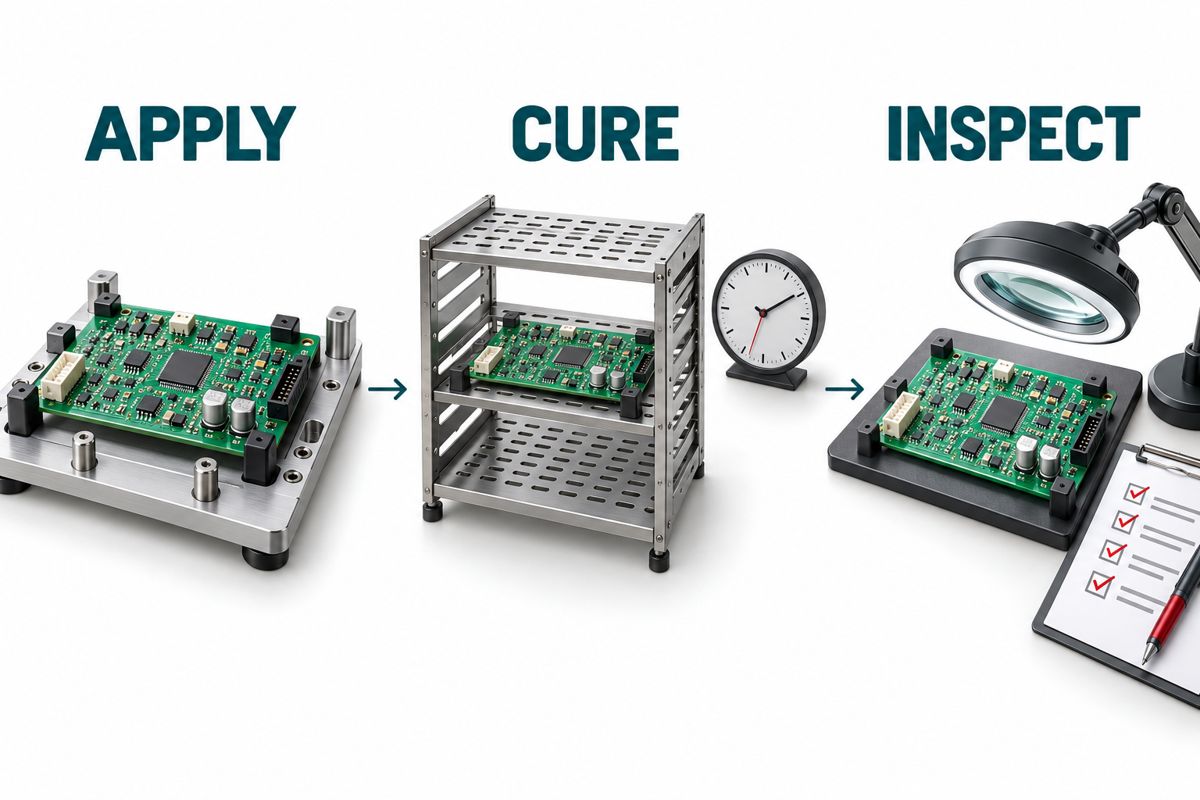
- Build the timeline. Add required pre-dry/flash-off, the qualified cure stage, cooling and any secondary cure or hold. Do not add mutually exclusive ambient and heat routes together.
- Confirm before release. Resolve contradictory instructions and out-of-range conditions with the material supplier; record the actual process and applicable acceptance checks.
Copy this planning line into the traveler: product/revision → thickness/method → required endpoint → chosen schedule → actual conditions → release decision. It makes the wait traceable without turning a generic internet time into a production specification.
For a PCB assembly project, supply the coating specification, board drawing, masking map, target thickness, component thermal restrictions and required testing endpoint. Contact PCBtry to confirm material availability, coating scope and the achievable production schedule. The product examples above are not a claim that every listed process is offered.
Conformal Coating Cure Time FAQ
Can I power the board once the coating feels dry?
Do not use touch alone as the release criterion. Complete the specified process and the applicable electrical-use checks; handling permission does not automatically authorize powered operation.
Is leaving conformal coating overnight always enough?
No. The first table includes schedules longer than one night and an optimum-properties endpoint much longer than handling. Identify the product before deciding when the wait ends.
Can I use a hotter oven to finish sooner?
Only use a documented, qualified route compatible with the complete assembly. Higher heat is not a universal shortcut. Check vapor controls, flash-off and component restrictions before changing the process.
Does a thicker coating need a longer wait?
A thicker or pooled film can change drying and cure behavior. Do not extrapolate a thin-film schedule into an unqualified thick layer; verify the film and ask for an appropriate schedule.
Will a UV inspection light cure ordinary conformal coating?
Fluorescence for inspection does not establish UV curing. Identify the chemistry and, for a UV-curable material, match its specified wavelength and measured dose.
Why can a coating still be unsuitable after the listed time?
The actual conditions may differ, the wrong milestone may have been selected, or application and compatibility issues may remain. Inspect the record rather than assuming the elapsed time proves performance.
How long should I wait before thermal cycling?
Use the conditioning endpoint required by the material and qualification plan, not merely its handling time. A Reddit cracking discussion illustrates this distinction, but community process settings are not a substitute for a qualified recipe.
Does a completed cure make the whole device waterproof?
No. Cure time does not establish enclosure sealing, connector protection or immersion suitability. Those require separate design and testing evidence.

0 Comments