




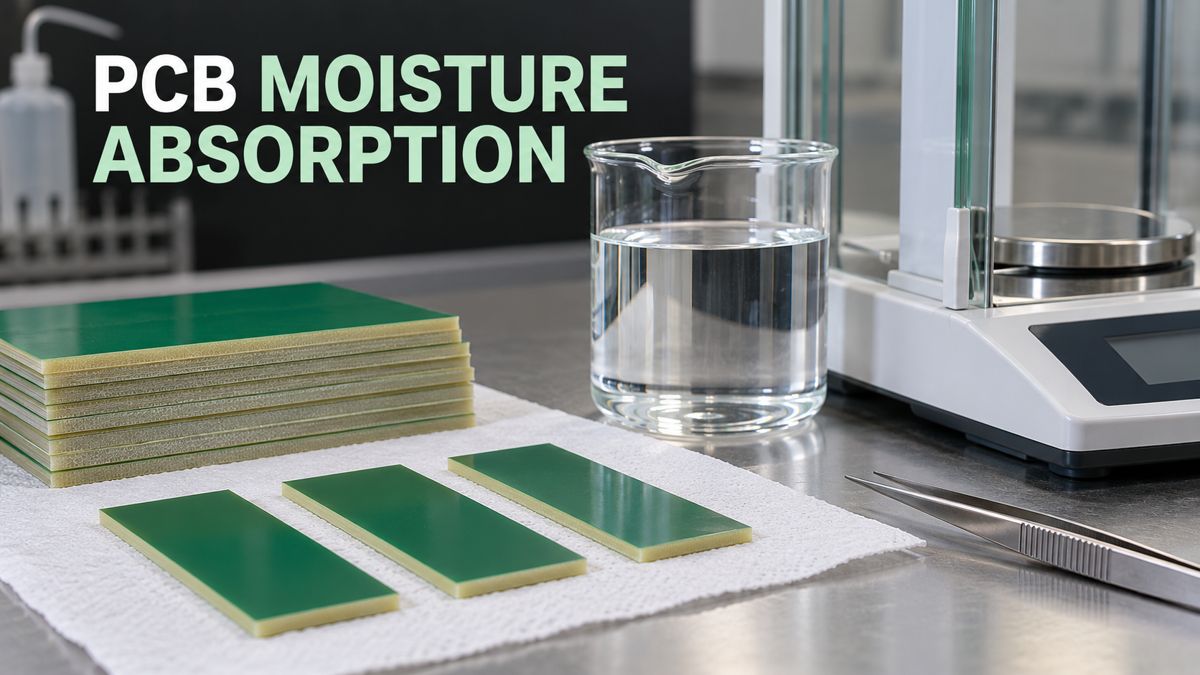
PCB moisture absorption is the increase in laminate mass after a defined water exposure, usually reported as a percentage of its conditioned mass. It is useful material information, but it is not a waterproof rating, a safe humidity limit, or a prediction of how many years a circuit will survive outdoors. Compare the test conditions first, then qualify the actual board construction for its environment.
What Does PCB Moisture Absorption Mean?
The number describes water taken up by a test specimen under specified conditions. It does not describe every board sold as FR4. Resin system, construction, sample thickness, preparation and exposure conditions belong beside the percentage whenever you compare materials.
Start by identifying the failure you are trying to prevent. A sensor that drifts, a connector that corrodes and a board that delaminates do not automatically need the same corrective action. Replacing the laminate without identifying the failure path can leave the original problem untouched.
For the broader resin, core and prepreg choices, use our PCB material selection guide. Here the narrower question is how to interpret moisture data without turning it into a claim it cannot support.
Humidity vs Water Immersion: Are the Results Comparable?
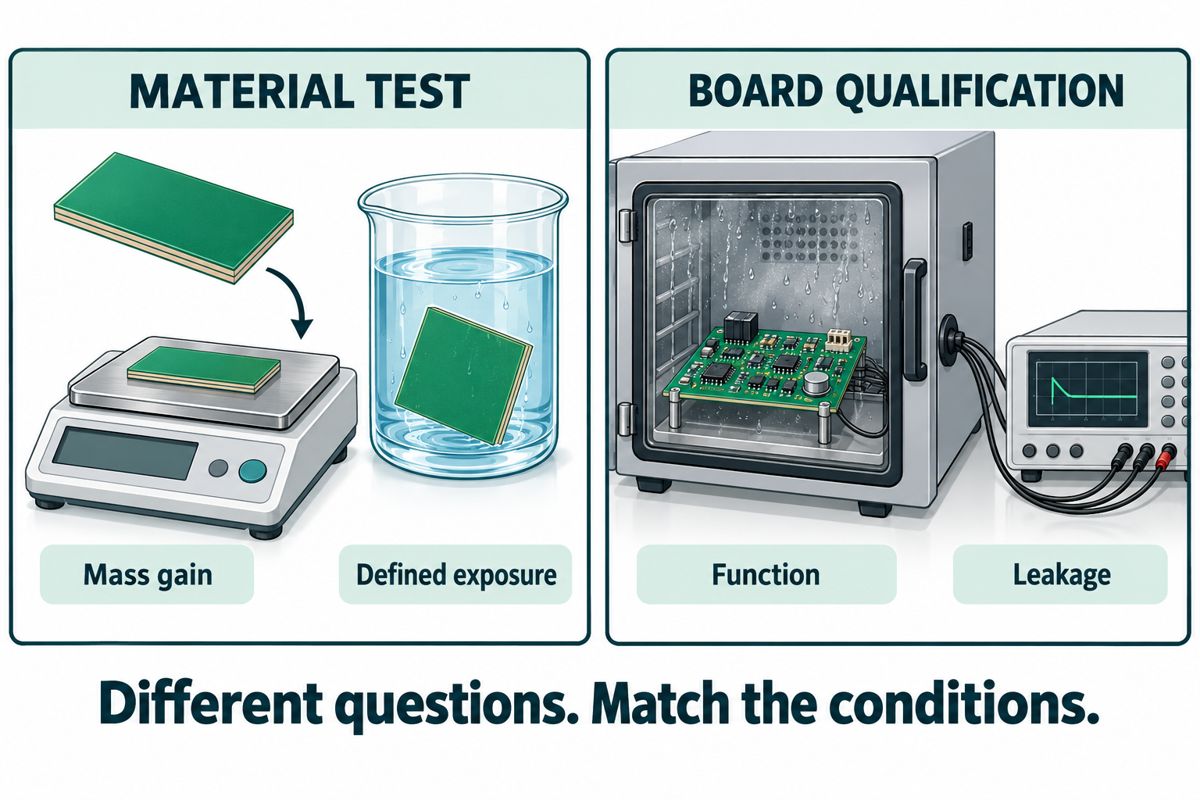
No. Humid air, a liquid bath and condensation are different exposure conditions. A percentage measured in one does not establish performance in the others.
| Exposure | Question to answer | Evidence to request |
|---|---|---|
| Humid air without condensation | Does the circuit remain within its electrical limits during exposure? | Defined temperature/RH/time, operating state and measurements during exposure |
| Water immersion | How much mass does the specified coupon gain in this bath? | Conditioning, bath temperature, duration, dimensions and mass records |
| Condensation cycles | Can intermittent surface water create leakage or functional faults? | Representative enclosure, cooling cycles, bias and recovery criteria |
| Wet soil or contaminated water | Does the whole protected assembly survive the actual contact? | Relevant chemistry, abrasion, interfaces, operating voltage and functional limits |
These are test-planning distinctions, not a universal qualification recipe. The product owner should approve conditions and acceptance limits. Do not choose a severe-looking chamber number simply because it is familiar; document which field exposure the test represents and what it cannot simulate.
FR4 vs Aluminum PCB: Does a Metal Core Solve Moisture Problems?
An aluminum base does not make the finished circuit waterproof. An insulated metal substrate still contains an insulating layer and interfaces that must be assessed, along with conductors, connectors and protective coatings. Ask for the complete construction rather than comparing bare aluminum with an entire glass-epoxy board.
Keep FR4 on the shortlist when its electrical, thermal and mechanical performance can be qualified for the application. Consider an aluminum-based construction when the design needs its thermal or mechanical attributes, then evaluate its dielectric system separately. Neither choice removes the need to control the actual exposure path.
This distinction addresses a community question about FR4 versus aluminum humidity absorption. The discussion also mixes substrate uptake with copper corrosion. Those observations are useful questions to investigate, not controlled comparative test results.
What Do 370HR and RO4350B Moisture Specifications Actually Say?
Use named grades and the exact document conditions. The following published figures illustrate why a smaller percentage alone is not a fair ranking.
| Material and document | Reported moisture value | Method and conditions | Decision limit |
|---|---|---|---|
| Isola 370HR, Rev E, June 26, 2024 | 0.15%, typical | IPC-TM-650 2.6.2.1A | Not a guaranteed maximum for every delivered board |
| Rogers RO4350B, linked RO4000 series PDF | 0.06%, reported in the PDF | ASTM D570; 48-hour immersion at 50°C; 0.060-inch specimen (1.524 mm) | Different exposure from the IPC method; not a direct percentage-only comparison |
Sources: Isola 370HR data sheet and Rogers RO4000 data sheet. Rogers’ online product tables can show a different value; resolve the applicable revision with the supplier rather than mixing documents. Neither moisture entry supplies a purchase tolerance here. Obtain an agreed maximum and test protocol if these are acceptance requirements.
370HR also lists a typical DSC Tg of 180°C. That thermal property is not an absorption limit or a continuous service-temperature approval. Likewise, a low-uptake RF material must still satisfy the proposed stackup, processing and electrical requirements. These are manufacturer material data, not a claim that PCBtry stocks either grade or provides a particular qualification service.
How Do You Read a Water Absorption Test Result?
Check the denominator and sample preparation before interpreting the result. IPC-TM-650 2.6.2.1A measures mass increase after a defined immersion protocol. It specifies removal of metal cladding and conditioning; weighing a populated circuit is not the same test.
- Record conditioned mass and specimen identity.
- Record the exposure method, duration and temperature.
- Follow the method’s surface-water removal and weighing timing.
- Calculate percentage gain as 100 × (wet mass − conditioned mass) / conditioned mass.
- Compare only against an agreed limit using the same method and preparation.
Arithmetic example, not a test result: a 10.0000 g conditioned coupon becoming 10.0150 g has gained 0.0150 g, or 0.15%. That calculation does not tell you whether a finished board will meet its leakage or sensor-accuracy requirement. A heavier copper fraction would also change the denominator if you incorrectly tested a different specimen.
The referenced method uses 24-hour immersion and laboratory conditioning. Its oven preparation is not an instruction to bake an assembled board. For fabrication or assembly drying, obtain a board-specific approved process that respects finishes, components and exposure history.
What Should a PCB Humidity Qualification Checklist Include?
Qualify the construction you will buy, not just the laminate name. Use this worksheet to keep material screening separate from product release.
| Record before testing | Measure or inspect | Release question |
|---|---|---|
| Grade, revision, stackup, thickness, copper and finish | Traceability to samples and production proposal | Are test samples representative of the purchase? |
| Exposure temperature, humidity/liquid, duration and cycles | Chamber or bath records and interruptions | Was the agreed exposure achieved? |
| Bias, circuit states and critical nodes | Leakage, insulation and functional performance where relevant | Did the circuit remain inside approved limits? |
| Coating, cut edges, holes, connectors and enclosure | Coverage, damage and ingress-sensitive interfaces | Was the whole protective system represented? |
| Recovery time and measurement timing | Wet-state and recovered-state readings separately | Did drying hide a temporary operational failure? |
| Material or coating substitution rules | Change impact and required requalification | Who approves the change before production? |
For a capacitive probe, define the allowable reading change before exposure. Include the protective finish in calibration and retest after representative handling. A coating that changes the reading can be acceptable if the design accounts for it; an unmeasured change cannot be assumed harmless. A soil-sensor discussion highlights both coating damage and sensing shifts, but does not establish a general service-life figure.
If a sample fails, preserve the state and evidence before drying, cleaning or reworking it. Record where the fault occurs and whether it recovers. Use that evidence to decide whether the next experiment should change the material, cleanliness, protection, geometry or enclosure. Changing all five at once makes the cause harder to isolate.
PCB Moisture Absorption FAQ
Does FR4 absorb water?
Yes, named glass-epoxy grades report measurable moisture uptake. The useful figure is the one for the specified grade and test conditions, not a single universal FR4 number. Ask for the method and document revision.
Do all FR4 boards have the same moisture absorption?
No. FR4 is not one resin formulation or one finished construction. Compare grade-specific data, then confirm that the actual laminate and bonding layers match the approved stackup. A generic substitution needs review.
Is an aluminum PCB waterproof?
No. Its insulating layer, interfaces and exposed circuitry still need evaluation. A metal base can address a thermal requirement without resolving condensation, connector leakage or long-term wet exposure.
Does conformal coating prevent all moisture uptake?
Do not assume complete exclusion. Performance depends on the coating system, coverage, interfaces and damage. Test the coated assembly under its intended exposure; a laminate data sheet cannot certify that protective system.
Does a lower absorption percentage mean longer life?
Not by itself. First align methods and conditions. Then examine the failure mode and circuit requirements. A lower coupon value does not measure corrosion, enclosure leakage or functional accuracy.
Why can a coated soil sensor give different readings?
The protective layer changes the sensing structure. Establish a baseline with the final coating, then measure drift during exposure and after handling. Do not infer a calibration correction from appearance alone.
Should I bake the board before using it?
Use an approved drying process only when the board’s handling and assembly requirements call for it. Drying is not permanent waterproofing, and the material-test conditioning procedure is not a safe recipe for every populated board.
What should I ask the supplier to provide?
Request grade and revision, test conditions, sample construction, typical-versus-guaranteed status, approved alternatives and relevant qualification evidence. Include your operating exposure and electrical limits so the answer addresses the application.
Request a PCB Material and Stackup Review
Send PCBtry your Gerber files, proposed stackup, finished thickness, candidate material data sheets, expected humidity or liquid contact, and the electrical performance that must be maintained. Include coating and enclosure details when they affect the board. Contact PCBtry for a project review to confirm manufacturability, material availability and which validation evidence must be agreed before ordering. Specific testing scope and acceptance limits require confirmation; material selection alone is not product qualification.


0 Comments