




What does correct solder paste storage actually control?
Correct solder paste storage controls the material’s condition before printing or dispensing. Use the temperature, shelf life and handling instructions for the exact product and container, keep its lot history, and bring refrigerated paste to the specified working condition before opening. Refrigeration does not make an opened jar last indefinitely.
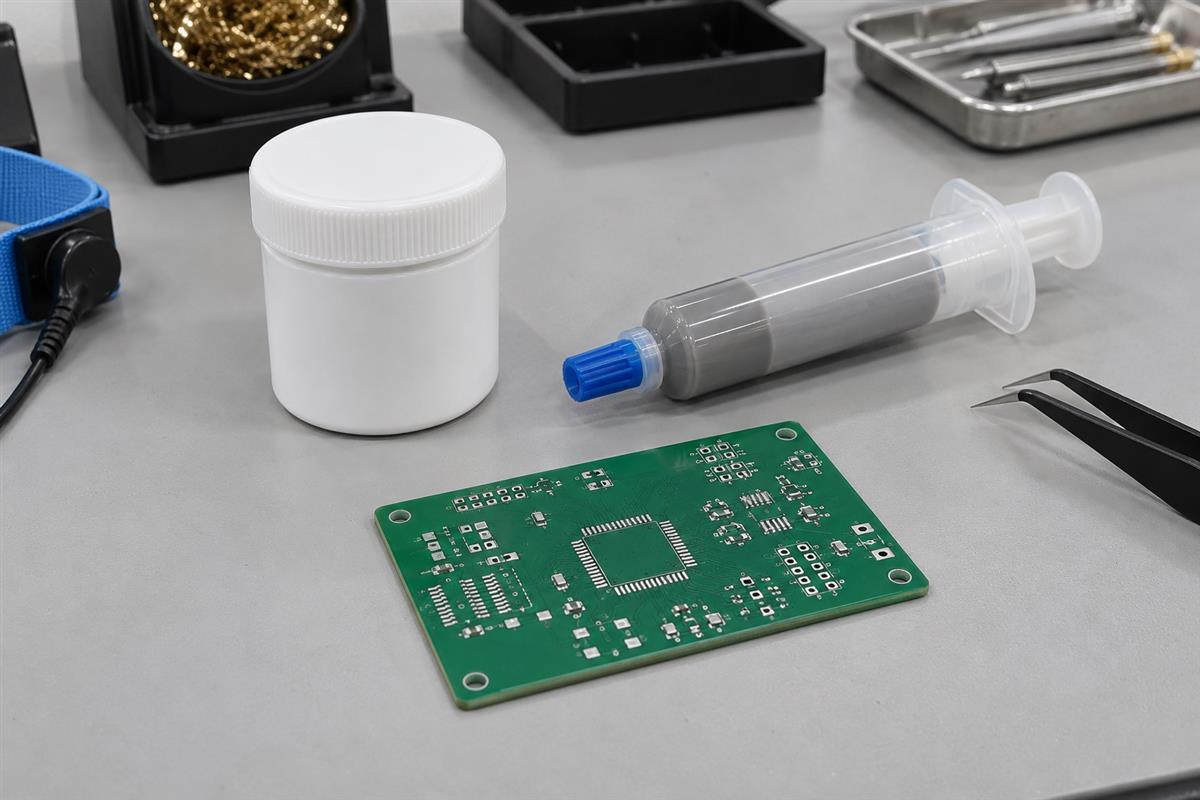
Solder paste is solder powder mixed with a flux vehicle. It is not the same as a jar of flux or solid solder wire. A paste that becomes softer after an additive has been mixed in has not necessarily regained its original printing, wetting or residue properties.
| Time limit | What it refers to | Do not confuse it with |
|---|---|---|
| Shelf life | Material life under the specified storage conditions and packaging state | Unlimited life after opening |
| Room-temperature allowance | Permitted time outside cold storage under stated conditions | A reset every time the jar returns to storage |
| Stencil life | Workable time during the specified printing process | Time allowed for unopened stock |
| Printed-paste working window | Permitted delay before placement/reflow under stated conditions | The date on the container |
Ask which limit applies to the material in front of you. An unopened refrigerated syringe, an opened jar and paste already printed on a board are different states. Record the transition between them rather than using one expiry date to describe the whole process.
Kester’s handling bulletin explicitly gives priority to each product’s technical bulletin. That is why a storage number from a different alloy, flux system or supplier should not become your acceptance limit.
How should you handle paste from receipt to printing?
Use a traceable handoff from receiving to storage, preparation and the printer. The goal is to know both what the product requires and what actually happened to this lot.
- Identify it on receipt. Record product code, alloy, powder type, lot, expiry and package condition. Match the delivered label to the purchase order and current technical data sheet.
- Review transport evidence. Record a supplied temperature indicator or logger result where applicable. A melted ice pack alone does not tell you the entire temperature history. Quarantine a questionable shipment and ask the supplier to assess the exposure.
- Store under the product’s conditions. Use identified storage with monitored temperature. Keep containers closed and segregated from food and unrelated materials; use the product safety data sheet for handling and disposal.
- Schedule warm-up before the job. Keep a refrigerated container sealed while it reaches its specified working condition. Do not accelerate preparation using an oven or hot plate.
- Prepare only as directed. Follow the product instructions for jar mixing or syringe handling. Do not improvise dilution, vigorous aeration or a mixing routine intended for a different package.
- Control use and leftovers. Log opening and printer times, protect unused material, and keep worked paste separate from fresh stock. Follow the exact product policy for unused material and any permitted return to storage.
Indium’s storage explanation identifies condensation as a reason to let cold paste reach room temperature before opening. It also explains why aging and exposure can affect flow and flux activity. Warm-up is therefore a material-control step, not merely a way to make dispensing easier.
Do not copy a universal “leave it out for one hour” instruction. Container size, starting temperature and the supplier’s procedure matter. For example, Indium’s MicroDispense product sheet specifies handling for its dispensing products. A syringe-specific allowance is not a qualification for an opened printing jar.
When arranging PCB assembly, agree who supplies the paste and who owns its storage record. Consigned materials should arrive with enough identity and handling information for the assembler to make a release decision.
What should you do when solder paste dries out or will not reflow?
Separate a suspected material problem from a heating or surface problem before changing the process. Stop using hardened, contaminated or untraceable paste on production boards while the cause is investigated.
A Reddit account of a dried-out jar describes paste becoming cracked and hard after long storage, followed by unsuccessful attempts to add flux and alcohol. It captures the temptation to save material cost, but it does not establish a qualified recovery procedure.
| Observation | Next check | Do not conclude |
|---|---|---|
| Paste is hard or crusted before use | Seal, opening history, expiry and supplier disposition | Extra solvent makes it equivalent to fresh paste |
| Paste prints poorly but looks normal | Material preparation, stencil cleanliness, apertures and printer setup | Storage must be the only cause |
| Paste remains granular during heating | Correct alloy and measured board-level thermal profile | The station display proves joint temperature |
| Solder balls or incomplete wetting appear | Paste history, surfaces, deposit condition and profile together | A photograph identifies one root cause |
| Fresh paste works in a controlled comparison | Repeat with recorded conditions and inspect the result | Every board from the suspect lot is automatically acceptable |
First record the symptom before adding flux, changing the profile or cleaning the board. Otherwise, several variables change at once and you lose the ability to learn from the comparison. Identify the alloy and read its process guidance; a hot-air setpoint is not a measurement of the pad or component temperature.
Then run a limited comparison using suitable fresh, traceable material and a verified process on an appropriate test vehicle. Keep substrate, deposits and heating conditions comparable. A better result supports a material-related hypothesis, but does not by itself identify whether age, contamination or handling caused the issue.
For customer builds, any extension beyond the approved material limits needs a documented disposition under the applicable quality requirements, not a claim that “it still melts.” If the approved process has no recovery route, replace the paste and dispose of the rejected material through the appropriate waste procedure.
A solder paste lot log you can reuse
A useful log links each container to its requirements, exposure and production use. Keep planned limits separate from observed values so that missing information is visible.
| Record field | Enter for each container | Hold trigger |
|---|---|---|
| Identity | Product, alloy, powder type, lot, container ID | Cannot match label to approved material |
| Supplier requirements | Data-sheet revision, storage limits and expiry basis | Using limits from a different product |
| Receipt/storage | Receipt time, transport concerns, storage location and temperature record | Exposure outside limits or unknown disposition |
| Preparation | Removal time, ready-to-use check, first opening | Opened cold or preparation history missing |
| Production exposure | Job, printer start/stop, ambient conditions and material additions | Unrecorded mixing or applicable time exceeded |
| Outcome | Print inspection, reflow review, disposition and approver | Defects unresolved or no authorized release |
Example of useful timekeeping: a container leaves storage at 08:00, is first opened at 11:30 and enters the printer at 12:00. At 14:00, the elapsed times are six hours since removal, two and a half hours since opening and two hours on the printer. Those are three different records. None establishes acceptability until compared with the limits for that product and process.
Use a container ID even when several jars share a lot number. One may remain sealed while another has been open all morning. A lot-only record cannot distinguish their exposure histories. Keep the record with the job traveler or equivalent production documentation.
How can small builds reduce waste without gambling on old paste?
Match the container size and supply schedule to actual consumption, rather than buying the lowest price per gram. A smaller approved package may reduce both waste and uncertainty.
Consider a planning example, not a supplier quotation: a 100 g package costs $40, but only 20 g is used before the remaining material must be discarded. The effective material cost is $2 per usable gram. A 25 g package costing $15, of which 20 g is used, costs $0.75 per usable gram. Include shipping, handling and qualification costs before making a purchasing decision.
Do not assume that buying a syringe instead of a jar preserves the same application. Confirm the formulation is suitable for your printing or dispensing method. Also avoid buying a long-life alternative solely for storage convenience if its alloy, residues or reflow conditions do not meet the assembly requirements.
For a repeat build, connect the paste record with the SMT printing and inspection process. Repeated shortages or dried leftovers are scheduling signals. A change in packaging or delivery frequency may be a better corrective action than repeated emergency material substitutions.
For help preparing an assembly review, send PCBtry the board revision and build information: BOM, placement file, fabrication data, quantity, specified alloy/flux restrictions, paste identity and lot history, defect photos, and available print/profile results. State whether the question is material disposition, print quality or reflow performance. These details help define the review; they do not guarantee that suspect paste can be salvaged.
Solder paste storage questions
Does every solder paste require refrigeration?
No single storage instruction covers every formulation. Use the current technical data sheet and container label. Do not refrigerate or freeze a product merely because another brand requires it.
Can expired paste still melt?
It may, but melting alone does not verify printing consistency, wetting or compliance with your material-control requirements. Separate an experiment from an approved production release.
Can I add IPA or flux to restore dry paste?
Not as an unapproved production fix. Changing the vehicle can change several material properties, and a softer texture is not a qualification result. Ask the manufacturer whether a defined recovery procedure exists for that exact product.
Can unused paste go back into cold storage?
Follow the product’s written policy and distinguish sealed containers from opened or worked material. Manufacturer guidance differs; do not assume a repeated cooling cycle resets any exposure allowance.
Does a melted shipping ice pack mean the paste is ruined?
Not by itself. Review the shipping conditions, packaging and any temperature evidence with the supplier. Neither accepting nor rejecting solely from the ice pack establishes the material’s actual exposure.
Why not heat the jar to speed up warm-up?
Forced heating can take the material outside its intended preparation conditions. Plan ahead and follow the supplier’s warm-up method while keeping the container sealed as required.
Is gray, dull solder proof of expired paste?
No. Appearance alone is not a storage diagnosis. Identify the alloy, inspect the joints against the applicable requirements and investigate the material and process records together.
What should I keep when a defect occurs?
Retain the container identity, handling log, board revision, defect location, photos and process settings or measurements. Preserve the suspect material separately where permitted, and record changes made during troubleshooting.



0 Comments