




What does PCB material preparation include?
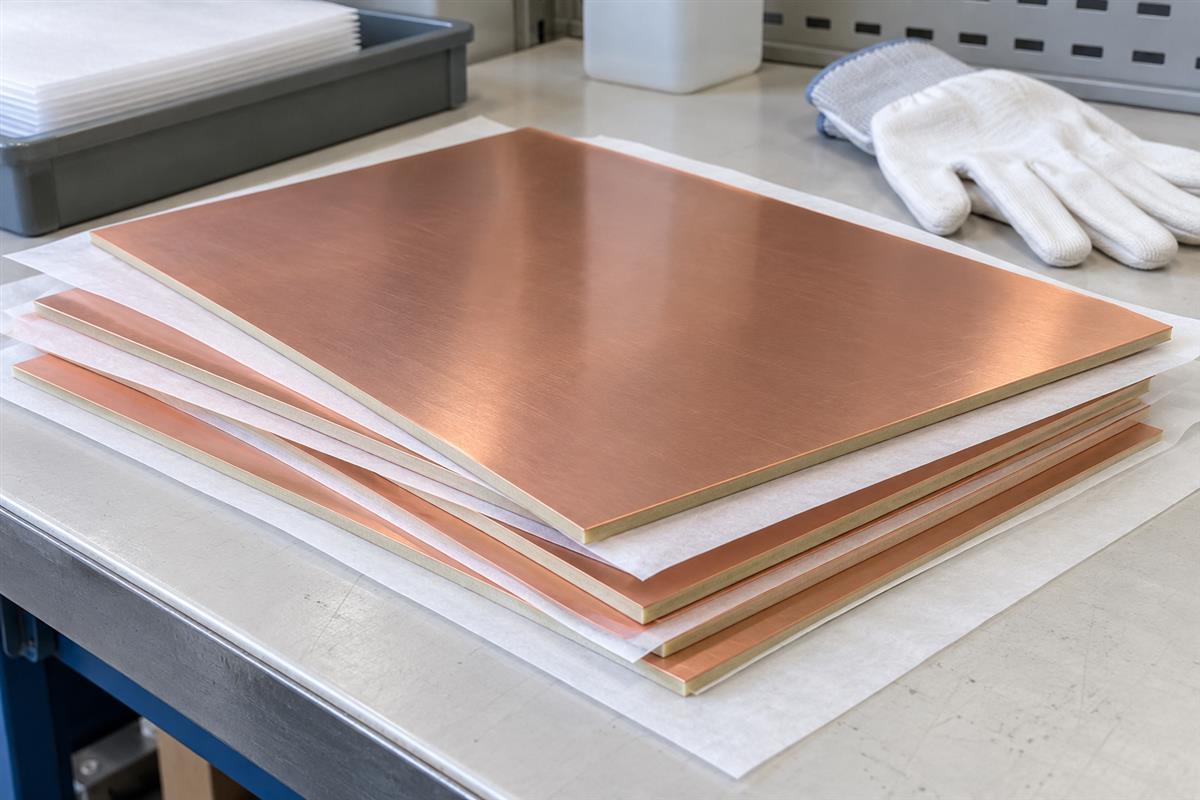
The PCB material preparation process turns received laminate, prepreg and copper foil into an identified, inspected and correctly sized material kit for fabrication. It includes receiving checks, controlled storage, any specified conditioning, cutting, protection and release to the next operation. Its purpose is to prevent the wrong or unsuitable material from entering a build before later processing makes the mistake expensive to discover.
This is bare-board material preparation, not component kitting for PCB assembly. It also stops short of prescribing an entire lamination cycle. The applicable material supplier’s processing guide and the fabricator’s qualified procedure determine the actual conditions.
| Material | Plain-language role | Preparation priority |
|---|---|---|
| Copper-clad laminate or core | Cured insulating sheet with copper bonded to one or both sides | Correct grade, construction, thickness, copper and undamaged surfaces |
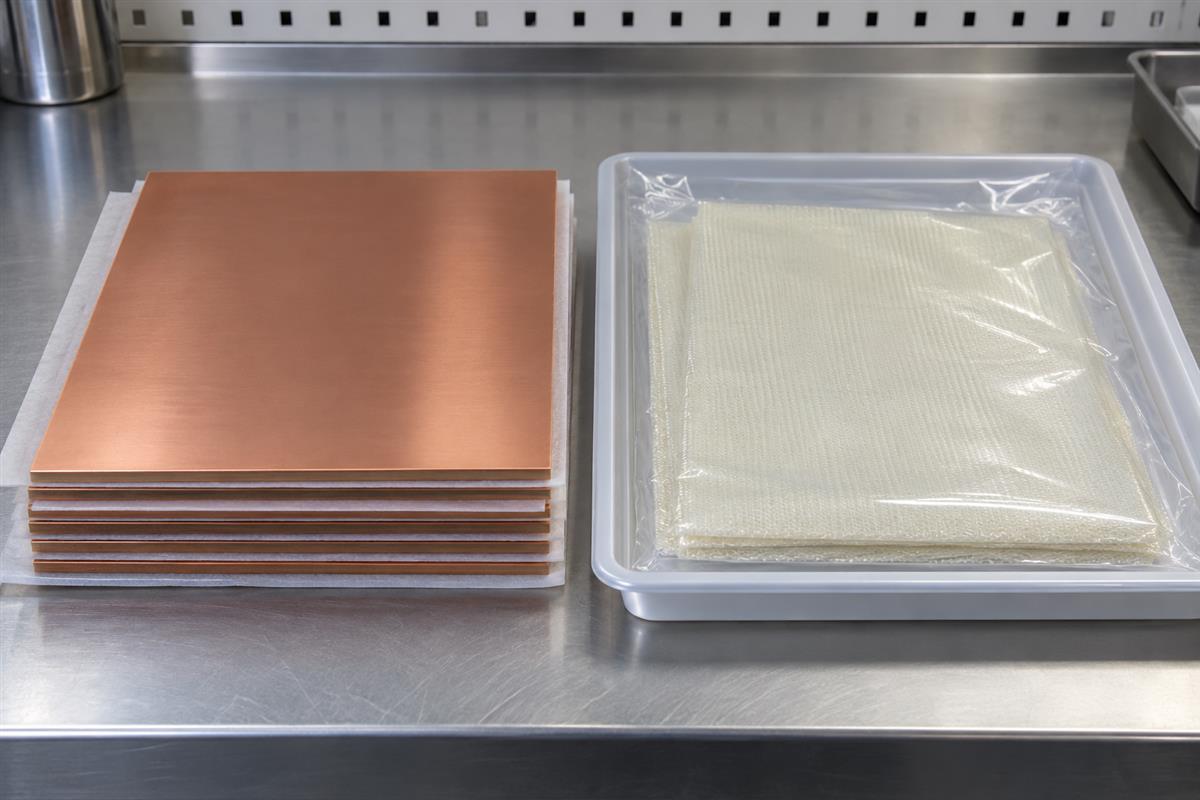
| Prepreg | Reinforcement carrying partially cured resin for bonding layers | Correct resin system and construction, controlled history and gentle handling |
| Copper foil | Separate conductor sheet used where the stackup requires it | Correct foil specification, side identification where relevant, protection from damage |
Two sheets can look alike and still differ in electrical or processing behavior. Color, gloss and a handheld thickness reading do not replace material identification. For material-selection questions, first establish the required copper-clad laminate specification, then prepare the approved material for the job.
How does the PCB material preparation process work?
Follow a continuous receiving-to-release route, with material identity preserved at every transfer. The useful output is not merely a stack of cut sheets; it is a kit that the next operator can match unambiguously to the approved job.
Step 1: Match the delivery to the order
Compare the supplier label, grade, construction, dimensions and lot identifier against the purchase specification. Check the required certificate or shipment documents. Record discrepancies before unpacking or mixing the delivery with accepted stock. An acceptable appearance does not resolve a mismatched product code.
Step 2: Inspect packaging and material condition
Check for damaged seals, water exposure, crushed corners and other handling damage. Where inspection requires opening, follow the relevant handling procedure. Segregate uncertain material so it cannot be issued automatically. Record the affected lot, quantity, photographs and the reason for the hold; do not silently discard a damaged wrapper and lose the evidence.
Step 3: Store under the product’s approved conditions
Assign a location and maintain the required environmental and time records. Preserve protective packaging and separation from unsuitable materials. Inventory rotation should consider both receipt order and the actual remaining qualified life; an older receipt is not automatically the next expiry. Use the supplier-defined limits rather than a generic rule for every item called FR-4.
Step 4: Prepare the material for opening and use
When material is transferred between different environments, follow the specified stabilization and opening procedure. Do not assume that a cold package is ready to open because its outer wrapper feels warm. If a procedure calls for conditioning or drying, identify the material and process stage first and record the approved recipe. Avoid adding a precautionary bake without approval.
Step 5: Cut and protect the required panels
Use suitable guarded equipment and a qualified cutting method for the material. Verify panel size, orientation requirements and edge condition. Prevent dirt and cutting debris from being trapped between sheets. Keep operators protected under the site’s equipment and dust-control procedures; this workflow is not a machine setup or chemical-cleaning instruction.
Step 6: Identify and release the kit
Transfer the source lot identity to the cut panels or their controlled container without marking a critical surface. Verify quantities, layer assignment and job revision against the traveler. Release only after required checks are complete. If the kit is split, its child containers must retain the same traceability, not depend on one label left on the original stack.
Why do storage and opening rules depend on the material?
Laminate, prepreg and foil are not interchangeable storage categories. Their condition and processing history can affect what should happen next, so a rule valid for one named product must not be copied to all materials.
For example, the Isola IS415 processing guide describes prepreg as fragile and calls for careful cutting and handling. It also instructs users to let packaged prepreg equilibrate before opening to avoid condensation. These are product-specific instructions, not a universal timer or shelf-life extension rule.
The Rogers RT/duroid 6035HTC guide emphasizes supported storage, protective packaging and prevention of handling damage for its laminate. A storage practice suitable for a cured laminate does not establish how an uncured bonding material should be managed.
Ask three questions when instructions appear to conflict: Are they for the same product? Are they for the same manufacturing stage? Are they the current approved instructions for this build? Storage, pre-lamination preparation and handling of finished boards are different contexts.
Do not use refrigeration, resealing or baking to reset an expired or unknown history on your own authority. Hold the material and obtain an approved disposition. A record showing why it remains usable is different from a guess that it probably looks fine.
What should the material-release check contain?
Check identity, condition, history and job fit together. A kit can be dimensionally correct yet contain the wrong resin system; it can have the correct labels yet be unsuitable because its handling history is unknown.
| Release check | Evidence to review | Hold condition |
|---|---|---|
| Material identity | Grade, construction and source lot matched to approved documents | Missing label or unexplained substitution |
| Time and environment | Required receipt, storage, opening and conditioning records | Expired allowance or missing history requiring disposition |
| Physical condition | Inspection against the agreed surface and edge requirements | Damage, contamination or uncertainty outside the acceptance rule |
| Kit-to-job match | Revision, layer assignment, size, orientation and quantity | Mixed revision, wrong construction or ambiguous allocation |
Here is a simple traceability example. Suppose source lot A supplies 40 cut panels and source lot B supplies 20. If 10 panels from A are moved to a second cart, the records should show A:30 on the first cart and A:10 on the second, with B:20 still identified separately. Writing only “60 panels available” loses the information needed to contain a later lot-specific problem. These quantities are illustrative, not a PCBtry production record.
Likewise, do not estimate finished dielectric thickness merely by adding a nominal prepreg sheet thickness to a core. The qualified stackup accounts for the construction and manufacturing process. Resolve stackup questions during PCB design and fabrication review rather than substituting apparently similar sheets at the preparation bench.
Record the release decision, reviewer and any restricted use. An approved deviation should identify its scope and affected quantity. It should not become a permanent informal exception that follows unrelated jobs.
What material information should a buyer provide?
Provide enough information to identify the intended construction and control changes, while letting the fabricator specify its qualified preparation method. A buyer needs evidence of material conformity, not an invented universal storage or press recipe.
| Buyer input | What to clarify | Useful supplier response |
|---|---|---|
| Material requirement | Named grade or agreed performance requirements and permitted equivalents | Proposed material with documented approval of any substitution |
| Stackup and copper | Layer construction, thickness requirements and copper specification | Manufacturable stackup and clarification of ambiguous values |
| Traceability | Which lot or certificate records must accompany or remain linked to the job | Agreed record scope and retention arrangements |
| Change authority | Who approves material changes and what evidence is required | Written approval route before altered material is used |
Send the fabrication files, stackup, material requirements, copper specification and required traceability records through PCBtry’s contact page. Ask which material details need clarification before the build is released. Avoid specifying an unsupported preparation recipe simply to make the RFQ look more detailed.
Frequently asked questions
Is material preparation the same as PCB assembly kitting?
No. This process concerns the substrate, bonding materials and conductors used to fabricate the bare board. Assembly kitting concerns components and other items used to populate it.
Can all FR-4 prepregs use one storage rule?
No. Use the applicable grade’s instructions and the approved manufacturing procedure. FR-4 is not a single resin formulation or a universal handling specification.
Should every laminate be baked before processing?
No. The need, conditions and process stage must come from a qualified procedure for the material. An unnecessary or incorrect bake is not a substitute for controlled storage.
Can a missing label be replaced by measuring thickness?
No. Thickness alone cannot establish resin system, construction or lot history. Hold the material until identity can be restored through reliable records.
What happens to leftover cut prepreg?
Manage it under the relevant supplier and factory instructions, preserving identity and exposure history. Do not mix leftovers into a new package and treat them as newly received material.
Are small scratches always acceptable?
No universal answer applies. Location, depth, the material and the agreed acceptance criteria matter. Inspect and disposition the condition before later operations conceal it.
Can an equivalent material be substituted without approval?
Only within an already agreed substitution policy that covers the proposed change. A similar headline property does not prove equivalence for every electrical, mechanical or processing requirement.
Which record is most useful if a later failure appears?
The link between the finished job and its material lots, together with relevant preparation and release records. Without that link, even a detailed supplier certificate may not identify the affected boards.



0 Comments