




Low-volume PCB assembly means producing a limited batch of populated circuit boards using a controlled assembly process. The useful question is not simply how many boards qualify as a small batch. It is whether the design files, components, setup work and acceptance tests are ready for that particular order.
A batch of 20 boards for firmware debugging needs a different release plan from 20 boards going directly into customer equipment. Before asking for a lower unit price, define what each delivered board must include and what evidence will show it is ready to use.
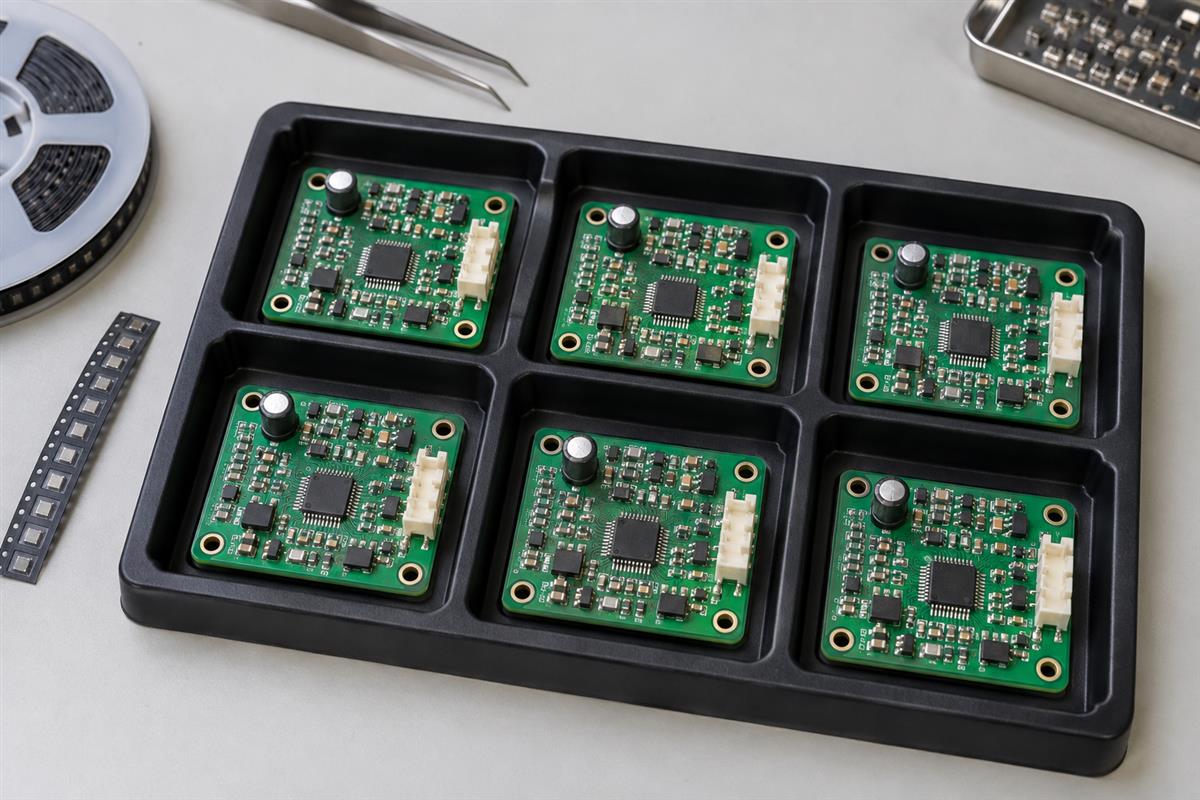
Define the Build Before Choosing the Quantity
Choose the batch size around the decision the boards must support, not around a supplier’s label for low volume. There is no single quantity boundary that makes every small order equivalent.
A prototype build checks an evolving design. A pilot build checks whether the intended design and manufacturing handoff can be repeated. A repeat small-production build supplies a stable product in limited quantities. The same assembly equipment may be used, but the required records, approval points and tolerance for design changes differ.
Write down who will use the boards, whether firmware is final, which tests are destructive, and whether any units must be retained for failure analysis. Separate the number you want assembled from the number of accepted units you need delivered. Do not assume that ordering exactly the delivery quantity automatically covers setup samples, engineering use or rejected units.
For example, a team needing 12 evaluation boards and three engineering boards should state both allocations. If a separate unit will undergo destructive testing, explain that before requesting a quote. The supplier can then confirm the build quantity and treatment of failures instead of discovering the shortage at dispatch.
Make the BOM and Placement Files Build-Ready
A build-ready order identifies exactly what goes on the board, where it goes, which revision is approved and who resolves discrepancies. A successful file upload does not establish any of those facts by itself.
The bill of materials, or BOM, is the component shopping and identification list. The component placement list, or CPL, supplies position, board side and rotation information. Gerber and drill files describe the bare board. An assembly drawing adds information that coordinates alone cannot communicate reliably, such as polarity, connector orientation and special assembly notes.
| Handoff item | What to include | Stop and resolve when |
|---|---|---|
| Design release | One revision identifier shared by the PCB fabrication data, BOM, CPL and assembly drawing | The board outline or component population differs between files |
| BOM | Reference designators, quantity per board, manufacturer, exact manufacturer part number, package and approved alternatives | A description such as “10 k resistor” is the only purchasing instruction |
| Placement data | Coordinates, units, board side, rotation and agreed origin convention | A populated SMT reference is missing, duplicated or on the wrong side |
| Population options | Explicit do-not-populate (DNP) positions and a separate configuration identifier for each variant | A missing part might mean either intentional omission or a sourcing problem |
| Programming and test | Firmware version, programming method, connections, operating sequence and pass/fail limits | The instruction is only “test all boards” |
| Mechanical additions | Connectors, heatsinks, fasteners, cables or enclosure work, with drawings where needed | The quoted scope stops at soldering but delivery requires a finished subassembly |
Cross-check every populated SMT reference between the BOM and CPL. Handle through-hole and manually installed parts according to the assembler’s agreed instructions rather than silently deleting them from the documentation. Check polarized parts against their actual pin-one or polarity markings; rotation conventions can differ between CAD exports and assembly software.
JLCPCB’s BOM/CPL preparation guidance, for example, specifically addresses reference-designator consistency, duplicate entries and coordinate units. Its import-format rules belong to that platform. Ask your chosen assembler for its accepted format instead of assuming one template works everywhere.
Resolve shortages before calling the kit complete
For each BOM line, record the required quantity, available quantity, source, expected receipt date and substitution approval status. A distributor showing stock is not the same as parts being received and accepted for your build.
If each board uses two identical regulators, 20 boards require 40 installed devices before any agreed handling allowance. A kit containing 38 cannot support 20 fully populated boards. Ask the assembler what extra quantity it needs for each packaging format; do not apply an invented universal attrition percentage.
A substitute must be reviewed for electrical characteristics, pinout, footprint, operating range and any firmware dependencies. Purchasing availability alone is not engineering approval. Record the approved manufacturer part number and applicable design revision so the decision can be reconstructed later.
With customer-supplied parts, agree on packaging, identification, usable quantity and responsibility for damaged or suspect material. JLCPCB’s consignment terms illustrate why surplus quantities and incoming-material responsibilities need explicit agreement; they are not PCBtry’s commercial terms.
Understand Setup Cost Before Comparing Unit Prices
Small-batch unit prices often look high because setup work is spread over few boards. Compare the complete order scope before concluding that one assembler is expensive.
Setup can include engineering review, stencil preparation, machine programming, feeder loading and test preparation. Recurring costs can include the bare PCB, components, assembly operations, programming, testing and packaging. The quotation should identify what is included, what is charged separately and what changes on a repeat order.
A simple fixed-cost example
For teaching only, suppose a build has a fixed setup cost of $300 and a recurring cost of $24 per assembled board. These are invented inputs, not a PCBtry quote or market-price estimate. Assume the design, scope and recurring rate stay unchanged, with shipping, tax, excess components and losses excluded.
Example order cost = fixed setup + quantity × recurring cost.
Example cost per board = recurring cost + fixed setup ÷ quantity.
| Quantity | Setup per board | Example order cost | Example cost per board |
|---|---|---|---|
| 10 | $30 | $540 | $54 |
| 30 | $10 | $1,020 | $34 |
| 100 | $3 | $2,700 | $27 |
The unit cost falls, but total cash committed rises. Ordering 100 boards is not a saving if the design changes after ten are tested. For delivery planning, also compare total cost against accepted usable units, not just boards started on the line.
Ask both suppliers to price the same revision, quantity, sourcing responsibility, assembly sides, through-hole work, programming and test scope. Check whether component minimum-order quantities leave surplus material, who owns it, and whether it can be used on the next release.
Design changes can affect this comparison. MacroFab’s assembly cost-design discussion highlights assembly complexity and component packaging as cost considerations. Treat simplification as an engineering review: do not remove required components or weaken performance margins merely to reduce placement count.
How Does a Low-Volume PCB Assembly Build Work?
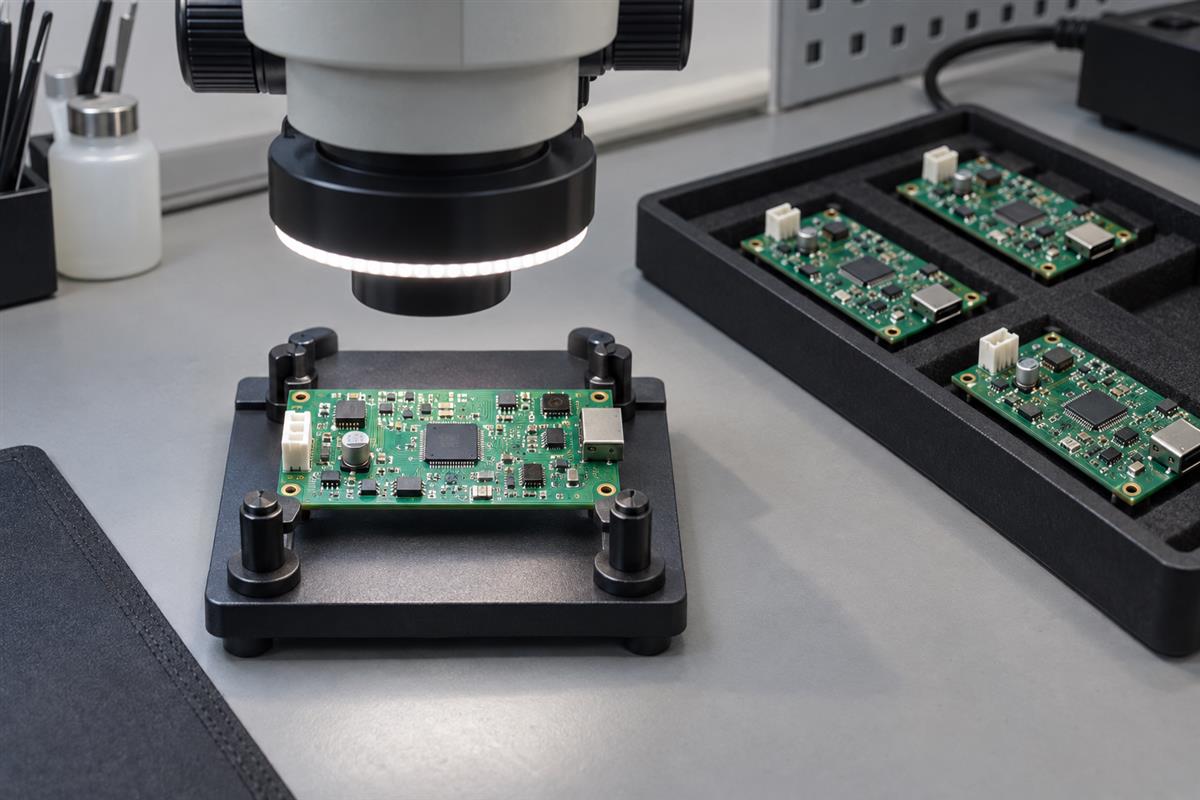
A controlled small-batch build moves from a frozen release through material readiness, setup, first-article approval, remaining assembly and documented acceptance. Agree on the hold points before production starts.
1. Release one consistent manufacturing package
Send the approved files together with a revision manifest listing filenames and revisions. Close design-for-manufacture and assembly questions in writing. If the BOM says revision B while the placement file belongs to revision A, stop: even correct files can produce the wrong board when combined. Keep a resolved-question list as the release evidence.
2. Confirm material and bare-board readiness
The assembler verifies the required parts and bare boards against the release. Resolve shortages, packaging issues, questionable component identification and unapproved alternatives before starting the affected operations. Request a kit-status list showing the remaining exceptions and their owners. An expected arrival date is a schedule dependency, not proof of readiness.
3. Prepare the assembly process
The manufacturing team sets up the stencil, placement program, feeders and suitable soldering process. Surface-mount parts are normally placed onto solder paste and reflowed; through-hole parts may require separate insertion and soldering operations. The exact route depends on the design. Confirm special handling and inspection needs rather than prescribing a universal reflow temperature or assuming all boards use one process.
4. Verify the first article and release the batch
The first article is an initial assembly checked against the approved package before a setup error is repeated across the remaining quantity. Review component identity, orientation, population options, soldering observations and the agreed electrical checks. A good-looking photograph alone does not verify every component value or hidden connection.
Specify who approves the first article, what report or images they receive, and whether production must wait for their response. If a connector is reversed, correct the program or instructions and verify the correction before release. Preserve the disposition, not simply a message saying “looks fine.”
5. Build the balance under the approved revision
After release, assemble the remaining boards using the controlled setup. Route deviations, substitutions and rework through the agreed approval process. A late BOM change must not quietly create two different configurations under one part number. Record affected units or lots and identify which revision they contain.
6. Test, reconcile and dispatch
Apply the agreed inspection and tests, separate accepted units from unresolved failures, and reconcile the shipped quantity with the order. Obtain the test results, revision identification, approved deviations and surplus-material disposition specified in the purchase order. Confirm ESD-appropriate packaging and any product-specific protection before shipment.
Agree on Testing and Delivery Acceptance
Acceptance should describe what was checked and what passed, not merely state that the batch was inspected. Different methods address different failure modes.
| Method | Useful evidence | What it does not establish by itself |
|---|---|---|
| Visual inspection or AOI | Observable placement and soldering conditions within the inspection setup’s coverage | Complete hidden-joint integrity, firmware correctness or application performance |
| X-ray inspection where appropriate | Selected hidden solder-joint features using the agreed inspection method | That the assembled circuit performs all required functions |
| Electrical tests such as flying probe or ICT | The connections and component properties actually covered by the test program and access | All operating conditions or complete product functionality |
| Programming and functional test | Correct programming and measured behavior under specified inputs, loads and limits | Untested modes, lifetime reliability or regulatory compliance |
For the detailed distinctions, see what circuit-card assembly tests catch and miss. A method listed in a supplier brochure is not automatically included in your quotation.
Turn “power-on test” into a reproducible instruction: identify the supply voltage and current limit from the approved design, firmware version, connections, startup sequence, expected outputs, load conditions and pass/fail limits. Specify whether every shipped unit or an agreed sample receives each check. Do not invent limits during inspection or assume a sampled result covers every unit.
Before accepting delivery, confirm:
- The received board revision and population option match the order.
- The accepted quantity, failed quantity and units held for investigation are separately identified.
- Required test records identify the applicable firmware and test revision.
- Approved substitutions and rework are recorded at the agreed traceability level.
- Known limitations are disclosed rather than hidden behind an overall “pass.”
- Surplus parts, tooling ownership and the repeat-order package are accounted for.
Low-Volume PCB Assembly FAQ
Is a prototype order the same as a low-volume production order?
No. Prototype describes the purpose of validating a design; low volume describes the scale of the order. A small production order may use a stable design and require release records for every shipment. State the intended use instead of assuming the quantity tells the assembler how to handle it.
Will I pay the same setup charge on a repeat order?
Not necessarily. Some engineering data or tooling may be reusable, while line setup and other activities may recur. A changed revision can require new work. Ask the quotation to distinguish reusable tooling, repeat setup and revision-dependent charges, including how long relevant materials or programs are retained.
Can I provide only the difficult-to-source components?
A mixed sourcing arrangement may be possible, subject to the assembler’s acceptance. Mark the sourcing owner for every BOM line and confirm quantities, packaging, receipt deadlines and surplus handling. Also agree who investigates a failed supplied component; dividing procurement does not remove the need for one controlled BOM.
What if a component becomes unavailable after quotation?
Request an updated availability and cost review before release. If an alternative is proposed, have engineering approve the exact part against the design requirements. Record any price, schedule and test changes. Do not treat a same-value description or apparently compatible footprint as sufficient substitution approval.
Can the BOM change after the first article is approved?
It can, but the change needs controlled review. Identify which units are already built, what files or programs change, and whether inspection or testing must be repeated. Ask for the cost and schedule impact before authorizing work. A revised BOM should not silently replace the released file.
Does passing assembly inspection prove product certification?
No. Assembly inspection and production testing do not replace product-level compliance assessment or qualification. Define the applicable requirements with qualified specialists and provide them before quotation. Small quantity does not automatically exempt a product from obligations associated with its intended market or use.
How should I ask for a realistic delivery date?
Ask which event starts the quoted clock: order acceptance, complete kit receipt, technical approval or first-article release. Request separate milestones for material readiness, assembly, testing and dispatch. Account for your own approval response time and shipping. A headline turnaround does not necessarily cover every dependency.
Should I buy extra boards to reduce the unit price?
Only after comparing the extra cash and revision risk with a likely repeat-build saving. If a design change is probable, a smaller validation batch may be preferable. Ask for comparable quantity breaks using the same test scope, and include excess-component purchases and storage responsibilities in the decision.
Prepare a Comparable Small-Batch Assembly RFQ
Send a request that lets the assembler quote the same deliverable you intend to accept. Use the following fields as a handoff checklist:
- Build: product identifier, board revision, population option, intended use and quantities.
- Files: fabrication data, BOM, CPL, assembly drawing and unresolved engineering questions.
- Supply: sourcing owner by BOM line, approved alternatives, supplied-part quantities and receipt dates.
- Quality: first-article hold point, approving contact, inspection coverage, test procedure and required records.
- Delivery: accepted-unit requirement, packaging, destination and requested milestones.
- Quotation: separate setup, recurring build, programming/test, tooling, surplus material and shipping charges.
Review PCBtry’s PCB assembly service scope, then send the release package for a small-batch assembly review. Ask for confirmation of component readiness, process suitability, first-article approval and test coverage before committing the order.


0 Comments