




The PCB laminate manufacturing process turns reinforcement, resin and copper foil into the copper-clad sheets used by a PCB fabricator. For a conventional glass-epoxy construction, the basic route is resin preparation, glass impregnation, partial curing into prepreg, layup with foil, controlled pressing and final inspection.
This happens before a board shop images circuit traces or drills the finished board design. Understanding that boundary helps you ask the right supplier for the right evidence when thickness, bonding or material identity is in question.
What is manufactured: prepreg, laminate or a multilayer PCB?
A laminate producer makes the starting material; a PCB fabricator turns that material into an electrical interconnect. Prepreg is an intermediate bonding material, while a cured copper-clad sheet can become a core in a later multilayer construction.
| Output | What it is | What it is not |
|---|---|---|
| Prepreg | Reinforcement carrying a partially cured resin system for a later bonding operation | A fully finished circuit layer |
| Copper-clad laminate | Cured insulating sheet bonded to copper foil on one or both sides | A board with the customer’s traces already patterned |
| Multilayer PCB | Fabricated interconnect combining patterned layers, dielectric bonding layers and other features | Simply several loose copper-clad sheets stacked together |
This guide focuses on glass-epoxy thermoset laminate. Do not apply the same resin-curing explanation to every substrate. For example, Rogers CuClad materials use woven fiberglass and PTFE. Ceramic and metal-backed constructions also require their own manufacturing descriptions.
If your question is which laminate grade to specify, use the separate copper-clad laminate specification guide. Here, the question is how the raw sheet is produced and what records connect that process to your PCB order.
How does the glass-epoxy laminate manufacturing process work?
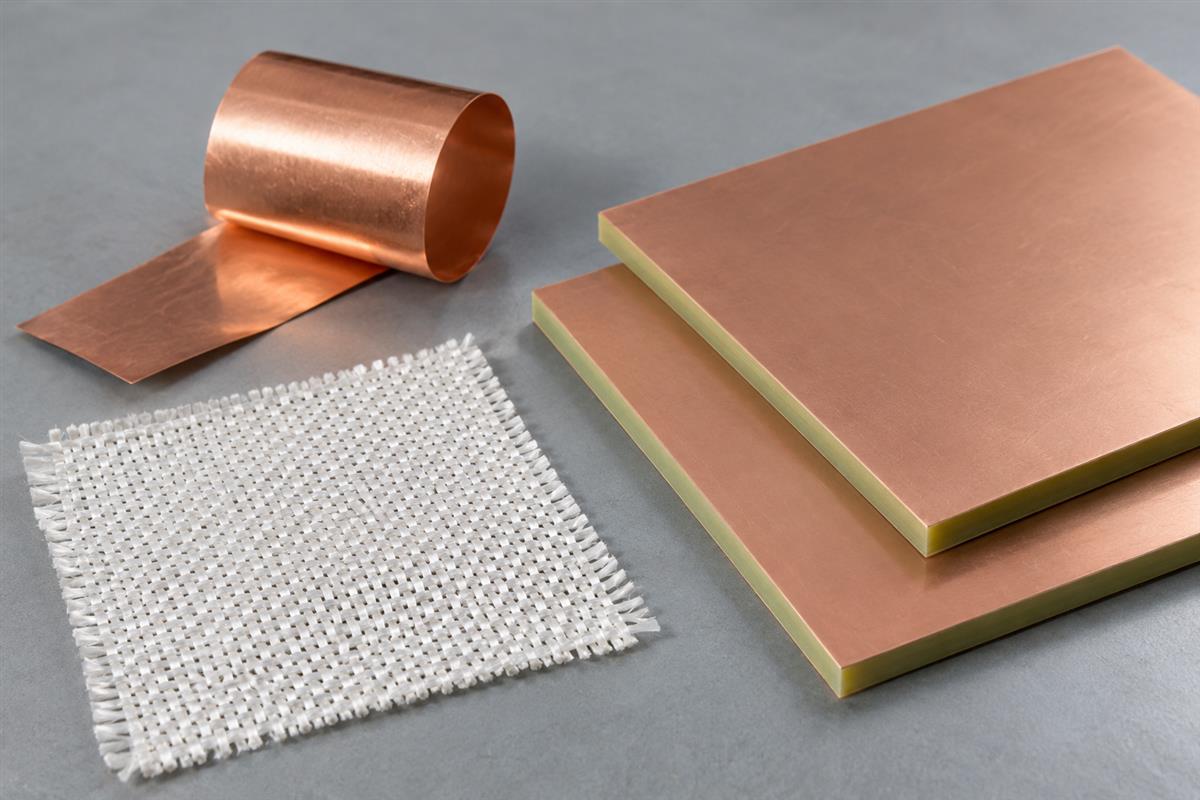
The process builds a controlled composite, then cures and verifies it. The important handoffs are material identity, prepreg consistency, layup correctness and cured-sheet acceptance. Exact temperatures, pressures and dwell times belong to the qualified material recipe, not a universal internet checklist.
Isola’s laminate and prepreg manufacturing presentation identifies the major stages and material building blocks. The sequence below is a learning framework, not instructions for running industrial equipment.
1. Prepare and identify the constituent materials
The input is the approved resin system, reinforcement and foil. The output is a traceable material set for production. Resin and glass provide the insulating composite; copper provides the conductive surface. The practical check is whether each incoming lot matches the approved construction. A material substitution without review can invalidate later comparisons, even if the finished sheet looks normal.
Ask for: the material designation and a link between incoming lots and the production batch. A purchase description that says only “FR-4” is not a complete batch identity.
2. Impregnate the glass and produce prepreg
Resin is introduced into the reinforcement and advanced to a partially cured state. The output can later flow and bond during a suitable press cycle. “B-stage” describes this intermediate condition; it does not mean the sheet is ready to use as a finished circuit substrate.
Control question: how does the producer verify consistency before releasing that prepreg? Request the relevant lot-release checks rather than a guessed temperature. Inconsistent material may complicate subsequent thickness and bonding results. Record the supplier’s disposition of a suspect lot before it moves forward.
3. Assemble the layup with copper foil
The input is the specified prepreg construction and foil; the output is a correctly assembled press package. Ply identity, count and foil selection must match the build instruction. Clean handling matters because material trapped inside a stack cannot simply be wiped off after pressing.
Check: compare the layup record with the approved construction, not with a generic photograph. If a sheet has a local blemish later, preserve its location and lot identity so production records can be investigated.
4. Press and complete the thermoset cure
The layup is consolidated under a controlled thermal and pressure cycle to form the bonded sheet. The output is cured laminate. The producer’s qualified cycle must suit that resin and construction; merely reaching a press setpoint does not document the whole cycle.
Ask for: confirmation that the batch ran under the approved recipe and that deviations were reviewed. Do not specify an arbitrary hotter or longer cycle as a cure for bonding problems. A recipe change requires the material producer’s technical assessment.
5. Finish, inspect and release the sheets
The pressed material is separated, finished to the required sheet format and checked against its release requirements. The output is an identified lot, not just a stack of visually similar panels. Packaging and labels must retain the connection to the material record.
Check: sheet dimensions, appearance, applicable material test evidence and the delivered lot label against the purchase requirement. A missing record is a documentation hold; an out-of-limit measurement is a technical nonconformance. Those need different corrective actions.
Isola also describes prepreg production and copper-clad layup in its historical public manufacturing disclosure. That explains the process boundary; it does not establish current lead time, equipment or availability for your order.
How should a laminate problem be investigated?
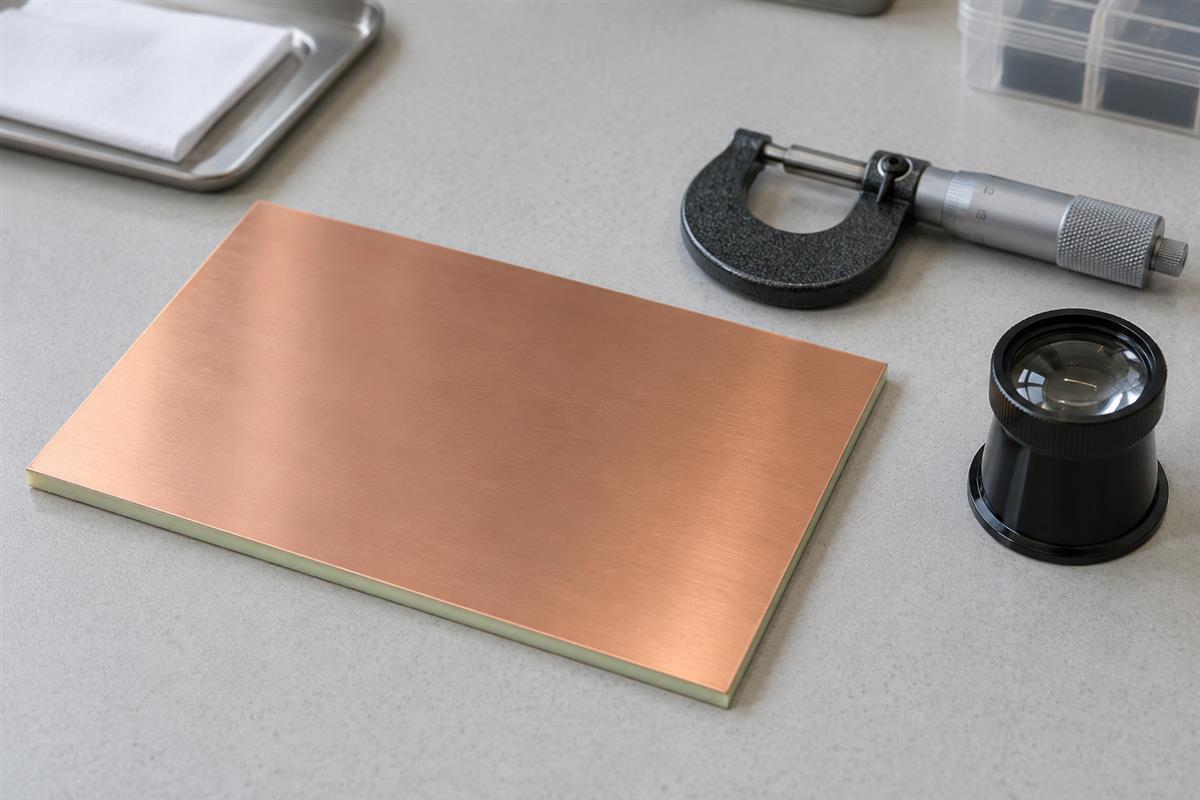
Start with the observed defect, the measurement method and the affected lot. Do not diagnose a process cause solely from a symptom. The table below is a proposed investigation aid, not a claim that every defect has one cause.
| Observation | First evidence to obtain | What not to conclude yet |
|---|---|---|
| Thickness outside the agreed limit | Measurement locations, whether copper is included, instrument method, lot and construction | That press pressure alone caused the result |
| Local copper lift or weak bonding | Location, condition before/after processing, bond-test evidence and handling history | That all sheets from the supplier are defective |
| Visible inclusion or surface mark | Images with location reference, affected quantity and stage first detected | That a surface photo proves internal contamination |
| Electrical material data differs from expectation | Exact grade, construction, test frequency, conditioning and method | That values from different methods are directly interchangeable |
| Wrong or missing lot label | Shipment record, packaging identity and producer traceability link | That appearance establishes the material grade |
Keep the original observation separate from your hypothesis. “Three received sheets exceeded the drawing limit at the recorded points” is an observation. “The press ran incorrectly” is a hypothesis until the process record supports it. That distinction makes supplier conversations faster and avoids corrective action aimed at the wrong operation.
Illustrative acceptance example: suppose an agreed purchase requirement is a 0.20 mm dielectric thickness with a ±0.02 mm limit, explicitly excluding copper. The acceptable range is 0.18–0.22 mm. A properly measured 0.23 mm dielectric result exceeds that example limit. However, a 0.23 mm reading including both copper faces is not the same measurement and cannot be rejected on that basis alone. These are invented teaching numbers, not an industry tolerance recommendation.
What evidence should accompany a material release?
Request evidence tied to the purchased grade and lot, with acceptance limits distinguished from typical properties. A material data sheet explains a product; it does not automatically document that a specific delivery passed every requested test.
| Document or field | Question it should answer | Buyer action |
|---|---|---|
| Manufacturer and grade | Which material was approved and supplied? | Match the order and approved stackup |
| Construction and thickness basis | Which build and dimension does the stated thickness describe? | Resolve copper-included versus dielectric-only wording |
| Lot identifier | Which delivery and production record does this sheet belong to? | Retain the link through cutting and board fabrication |
| Certificate or agreed test report | What conformity or measurements are actually documented? | Check scope, sampling and referenced requirement |
| Deviation approval | Was any material or requirement changed? | Approve or reject explicitly before use |
For example, the Rogers CuClad data sheet explicitly distinguishes typical properties from specification limits. Apply that reading discipline whenever comparing supplier documents: check the footnotes, conditions and the order’s agreed acceptance criteria before treating a table entry as a guaranteed minimum or maximum.
A certificate of conformity and a detailed lot test report may provide different levels of information. Ask what is available and necessary for the product, rather than demanding a document title without defining its purpose. Neither replaces your end-product qualification.
How does the laminate lot connect to the PCB fabrication order?
The handoff is complete when the board fabricator can connect the approved material, received lot and production job. A useful acceptance record follows that connection instead of stopping at the material brand name.
- Freeze the requirement: identify the board revision, approved material designation and stackup.
- Confirm supply: ask the fabricator to confirm the construction and availability; require approval for substitutions.
- Retain identity: agree how laminate lots remain linked after full sheets are cut into production panels.
- Define exceptions: establish who reviews missing certificates, questionable measurements or changed material.
- Close the record: retain the accepted material information with the board shipment and relevant inspection evidence.
The later PCB lamination process combines circuit layers into the board stack. Passing that operation is a separate issue from receiving conforming raw laminate; a defect investigation may need both sets of records.
For a fabrication review, send PCBtry your Gerber package, stackup and material requirements, along with quantity, required delivery and any traceability or test-report needs. Ask for confirmed construction and material exceptions before approving production. This does not imply that PCBtry manufactures raw laminate or can supply every requested material.
Frequently asked questions
Is laminate manufacture the same as PCB lamination?
No. Laminate manufacture produces starting sheets. Board lamination is a later fabrication operation that combines circuit layers and bonding materials. The operations are related, but their inputs, outputs and inspection records differ.
Why is prepreg only partially cured?
For a suitable thermoset system, it must retain the ability to flow and bond during a later qualified cycle. A fully cured laminate and a prepreg sheet therefore serve different roles. Follow the material supplier’s handling instructions.
Does all PCB laminate contain epoxy?
No. This process description is scoped to glass-epoxy material. Other systems, including PTFE-based and ceramic constructions, have different chemistry and processing requirements. Identify the material family before applying a process explanation.
Can two sheets with the same thickness be interchangeable?
Not necessarily. Material grade, reinforcement, copper, electrical properties and qualification requirements can differ. Thickness alone is not enough to authorize a substitution; check the approved construction and application requirements.
What temperature should a laminate press use?
There is no single correct temperature for every material. The approved recipe covers the complete cycle and the relevant construction. Obtain instructions from the material producer and qualified process documentation rather than copying a generic setting.
Can a photograph confirm the laminate grade?
No. A photograph can record a surface condition, packaging or label, but visual appearance does not prove resin chemistry or electrical performance. Use traceable documentation and the agreed tests.
Should every sheet have a full laboratory report?
That depends on the purchase agreement and product risk. Define the report scope and sampling before ordering. Do not assume a data sheet or conformity statement means every sheet underwent every listed test.
What should I send when reporting a suspected material defect?
Include the board and material lot identifiers, affected quantity, images, measurement method and conditions, drawing requirement, and the stage at which it was first observed. Preserve sample identity and ask the supplier to agree the investigation plan.



0 Comments