




When Bare PCBs Need Baking Before Assembly
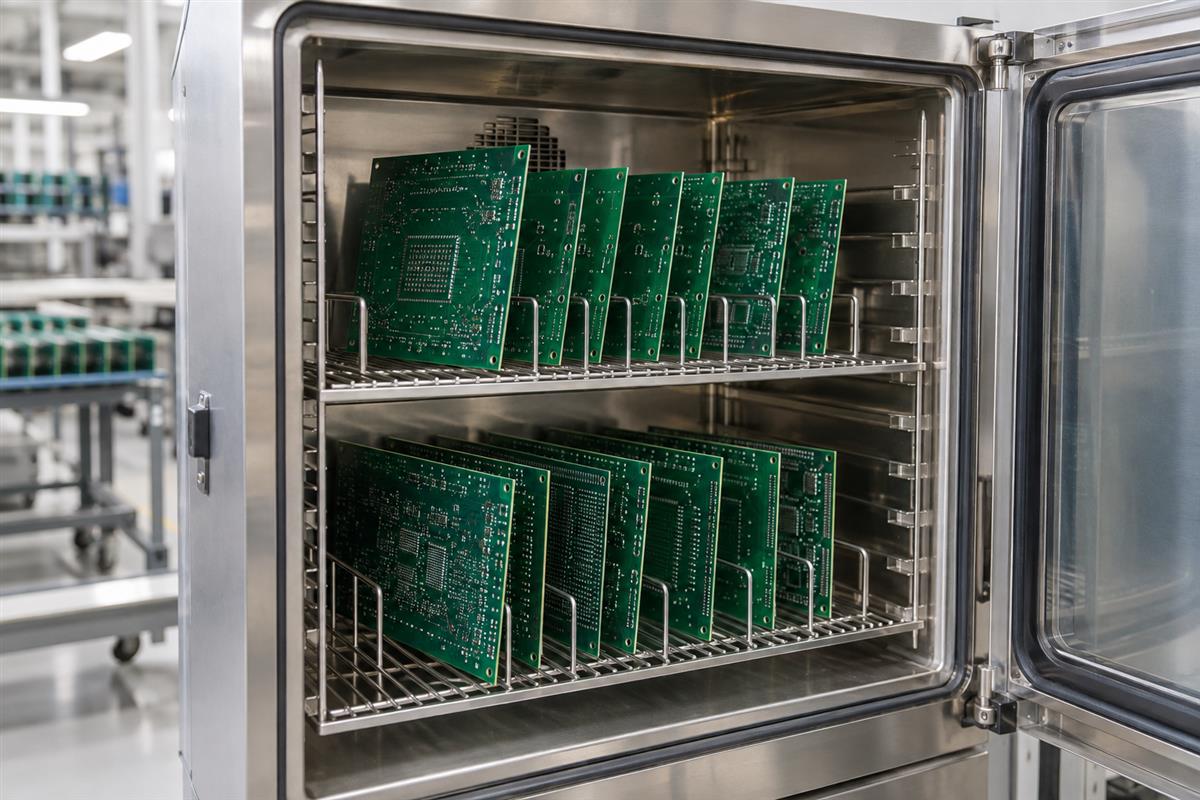
The PCB baking process is controlled drying of a printed circuit board before soldering or another approved operation. Start with the board’s material, finish and moisture-exposure history, approve a suitable drying cycle, then control storage and release. Do not choose a temperature and time from a generic chart and assume they are safe for every PCB.
This guide concerns bare boards, before components are installed. Baking an assembled board requires a separate review of connectors, batteries, displays, adhesives and every other temperature-sensitive item. A component’s moisture-sensitivity label is not a complete baking instruction for the PCB underneath it.
A board can look dry while moisture remains inside its laminate. Heating it rapidly during soldering can create damaging internal stress. The research paper Controlling Moisture in Printed Circuit Boards explains moisture entry during manufacture and storage, and links moisture to cracking and delamination. Baking addresses a moisture risk; it does not repair damaged laminate.
| Incoming condition | First action | Do not assume |
|---|---|---|
| Intact packaging and acceptable documented storage | Check the supplier’s assembly and storage instructions | Every shipment needs an extra bake |
| Open or damaged packaging, unknown exposure | Hold the lot and request a moisture disposition | A good-looking surface proves a dry board |
| Humidity indicator outside its specified acceptance condition | Record the reading immediately and investigate the package history | The card directly measures moisture inside the laminate |
| Flex, rigid-flex or another moisture-sensitive construction | Use construction-specific supplier instructions | A rigid-board recipe also suits adhesives and flexible materials |
| Blistering, separation or damaged solderable surfaces | Quarantine for engineering review | More heat will restore an acceptable board |
How to Select Temperature, Time and Atmosphere
The approved bake recipe must be compatible with the complete board construction and finish, not merely its nominal laminate temperature rating. More heat or more time is not automatically safer: moisture removal must be balanced against solderability and material damage.
NCAB’s flex and rigid-flex recommendations distinguish constructions and finishes. For example, the document gives a minimum of two hours at 120°C for its stated rigid-flex construction with an FR-4 section and polyimide core up to 1.0 mm thick, in the applicable HASL/lead-free HASL/ENIG section. That is a bounded supplier recommendation, not a universal recipe for a 1.0 mm PCB. Other constructions in the same document have different requirements.
| Input to approve | Why it changes the decision | What the work instruction should say |
|---|---|---|
| Material, thickness and construction | Different boards do not dry at the same rate or tolerate the same treatment | Exact eligible board family and revision |
| Surface finish and prior heat history | Additional heating can reduce solderability | Finish-specific restrictions and permitted repeat treatment |
| Measured exposure and storage history | The starting moisture condition affects the disposition | Trigger for baking, hold or further evaluation |
| Oven, atmosphere and loading | Equipment and loading affect the delivered process | Qualified equipment, loading pattern and environmental limits |
| Temperature, dwell and timing rule | Time in the room is not necessarily time at the required condition | Approved range, dwell start criterion and excursion response |
| Cooling and post-bake exposure | Boards can absorb moisture again | Transfer conditions, storage method and release deadline |
NCAB also warns that normal baking is not recommended for certain sensitive finishes, including immersion tin, immersion silver and OSP, within that guidance. Have the board supplier and assembly process owner approve the appropriate treatment; do not improvise a high-temperature air bake for such finishes.
Standards check: the official IPC revision table lists IPC-1601 as superseded by IPC-1602 and lists IPC-1602A, November 2024. Use the edition required by the purchase agreement and applicable process documentation. A public summary or table of contents does not replace the full standard, and this article does not reproduce its mandatory clauses.
The PCB Baking Process, from Lot Review to Release
Run baking as a traceable production operation with a defined entry condition and release decision. The following sequence is a practical control framework; the actual numeric settings must come from the approved board-specific instruction.
Step 1: Identify the lot and decide whether it needs treatment
Collect the part number, revision, lot, quantity, finish, construction, delivery date, package condition and exposure record. The purpose is to keep an unknown board from entering a known recipe. If identity or history is missing, hold the material for disposition. Record the reason for baking or the reason no bake is required; an undocumented assumption can follow the lot into assembly.
Step 2: Match the board to an approved recipe
Compare the incoming lot with the work instruction’s permitted materials, thicknesses, finishes and previous cycles. Confirm temperature, duration, atmosphere, cooling and release conditions. A recipe approved for a different finish is a mismatch, not a minor paperwork issue. Save the recipe revision and approving authority before loading.
Step 3: Prepare the equipment and load
Use suitable clean production equipment and compatible fixtures. Remove packaging and accessories that are not approved for the oven. Arrange boards in the qualified loading pattern with the required spacing; avoid casually stacking panels together. NCAB’s guidance specifically calls for a clean oven and ventilated fixtures with gaps between panels. Record oven identity and load arrangement so the treatment can be reproduced.
Step 4: Run and document the approved cycle
Verify the temperature measurement system and follow the instruction’s dwell-start rule. Log the delivered cycle, not just the operator’s intended setpoint. If the oven alarms, power fails or a parameter leaves its permitted range, identify the affected lot and obtain disposition. Do not silently extend time to compensate for an unassessed excursion.
Step 5: Cool, protect and transfer the boards
Use the approved cooling and transfer conditions, then move boards to assembly or qualified dry storage. Record the time and destination. Do not leave a completed lot exposed on a bench while assuming the earlier bake gives indefinite protection. NCAB’s packaging guidance emphasizes moisture-barrier protection and the importance of storage practices.
Step 6: Review the evidence and release the lot
Reconcile the lot quantity, cycle record, deviations, physical condition and remaining exposure allowance. The responsible person releases, holds or rejects the lot against the agreed criteria. Attach any specified solderability or other verification results. Transfer the release record with the boards so the assembly team does not need to guess what happened upstream.
Check Results Without Assuming the Board Is Dry
A completed timer proves elapsed time, not acceptable moisture content or solderability. The release decision should combine a qualified process with the checks specified for that board and lot.
| Evidence | What it can establish | What it cannot establish alone |
|---|---|---|
| Humidity indicator card | Package-humidity information interpreted using the card instructions | The moisture concentration inside every board |
| Oven cycle record | The recorded equipment treatment and any excursions | That an unqualified recipe was suitable |
| Visual inspection | Visible blistering, contamination or surface damage | Absence of all internal defects or retained moisture |
| Approved solderability evaluation | Performance of the sampled surfaces under the specified method | Automatic acceptance of every other board property |
| Validated moisture or mass-loss study | Evidence within the method’s sampling and measurement limits | A universal drying threshold for unrelated constructions |
For a new board family, ask the process owner how the recipe was validated, what representative loading was used and which acceptance criteria apply. Avoid inventing a universal weight-loss percentage. A mass change requires a suitable measurement method and interpretation; a kitchen scale and a single before/after reading do not qualify a production drying process.
Also separate moisture from other causes of failure. Delamination after soldering may need a broader investigation of material, fabrication and thermal history. Record observations rather than immediately blaming storage. The same separation between process evidence and product acceptance underpins effective PCBA quality control.
Prevent Repeat Baking and Prepare the Manufacturing Handoff
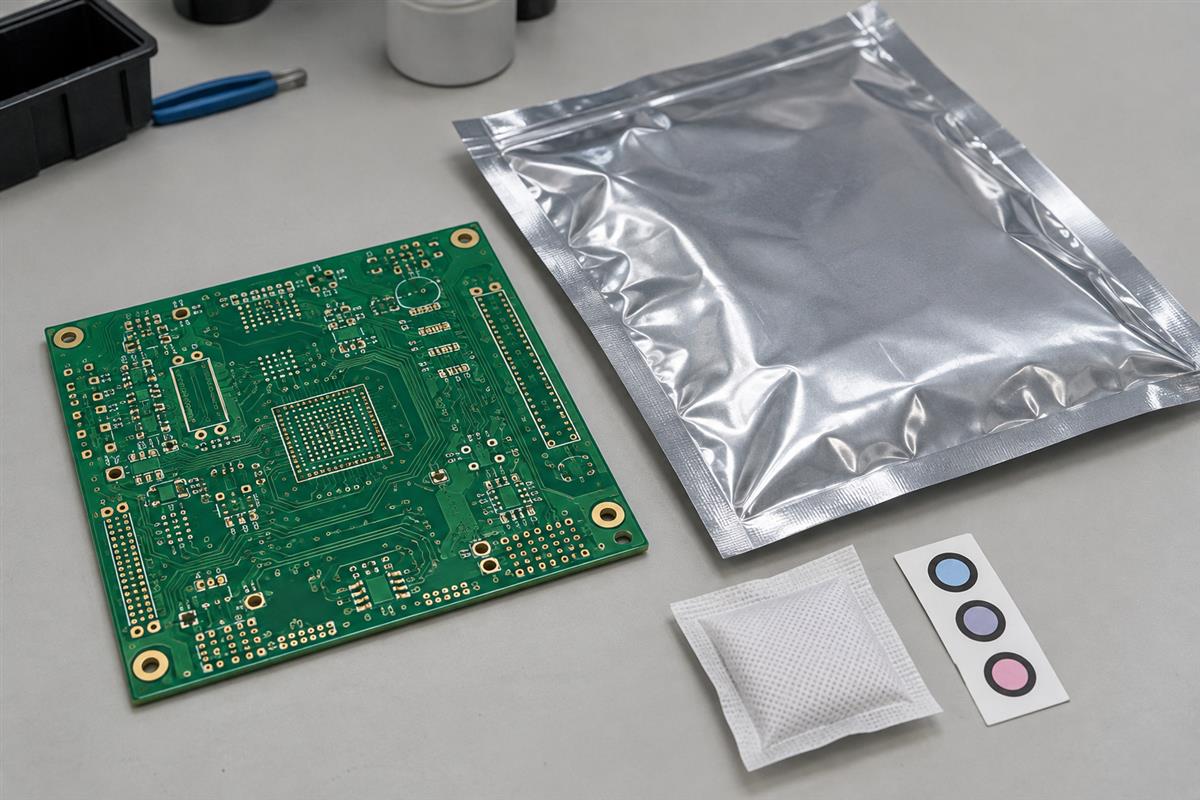
The best handoff preserves lot identity and the approved exposure allowance after drying. Plan the bake around real assembly capacity and keep dry storage available when schedules change. Repeated treatment should require approval, not become the default answer to every delay.
Illustrative tracking example: suppose your approved instruction permits eight hours of exposure under defined conditions. If a lot spends 1.5 hours at kitting and another 2 hours waiting for assembly, the logged total is 3.5 hours and the remaining allowance is 4.5 hours. Eight hours here is an example input, not a recommended floor life. Whether time in a particular dry cabinet pauses or changes the allowance must be stated in the approved procedure; do not reset the clock on your own.
Include these fields in the traveler or lot record:
- Part number, revision, lot and quantity.
- Material, thickness, finish and relevant construction notes.
- Storage/package observations and exposure history.
- Recipe revision, oven identity and cycle trace.
- Previous bake cycles and any deviations.
- Cooling, packing or dry-storage record.
- Post-bake exposure log, release status and approving person.
Before scheduling PCB assembly, make moisture handling part of the manufacturing handoff. Send the fabrication specification, material and finish details, storage history, intended soldering route and any supplier drying instructions through PCBtry’s contact page. Ask for a board-specific handling review and identify who will approve baking parameters and release evidence. Do not send only a photograph and expect a safe recipe to follow.
FAQ
Can I use a household oven to bake production PCBs?
Do not use food-preparation equipment for electronics processing. Production work needs suitable clean equipment, controlled conditions and traceable measurement. A household setting does not establish temperature uniformity, cleanliness or process qualification.
Does baking remove flux or ionic contamination?
No. Drying is not a substitute for a validated cleaning process. Contaminated boards need the appropriate cleaning and inspection disposition; heating alone does not demonstrate acceptable ionic cleanliness.
Can desiccant replace a bake that the supplier requires?
Not automatically. Desiccant supports the specified packaging environment, but it does not prove that an already exposed board has reached the required condition. Follow the approved drying or recovery instruction.
Should the board stay inside its shipping bag in the oven?
Only if an approved process explicitly permits that complete packaging arrangement. Otherwise remove bags, cards, labels and accessories that are not qualified for the treatment. A moisture-barrier bag is not automatically a bake fixture.
Is the oven display sufficient for the bake record?
It records a displayed condition, but the approved process must define how actual treatment is verified. Use qualified measurement and loading controls appropriate to the equipment; keep excursion and timing records rather than recording only the nominal setpoint.
What if a board has already been baked twice?
Check its cumulative treatment history against the approved limits. Do not prescribe a third cycle without reviewing material and finish risks. If the earlier conditions are unknown, treat that missing information as a disposition issue.
Does a component MSL label apply to the whole bare PCB?
No. Device handling and bare printed-board handling are different scopes. Once components are fitted, their limits also matter, and a bare-board bake instruction cannot be applied unchanged to the assembly.
Can a successful electrical test replace moisture control?
No. An electrical pass at one point does not establish moisture condition or future behavior during soldering. Keep electrical acceptance, moisture-process evidence and any required thermal or solderability evaluation as separate records.

0 Comments