




Which type of PCB board do you need to buy?
To find the right PCB boards for sale, first decide whether you need a general-purpose prototype board, an exact replacement for existing equipment, or a custom board manufactured from your design files. These are different purchases. A low-priced blank board cannot replace a populated machine controller, and a fabrication quote does not automatically include components or assembly.
A printed circuit board, or PCB, is the physical board that supports electrical connections. A PCB assembly, or PCBA, has components fitted to it. Sellers sometimes call both a “PCB board,” so the product name alone does not tell you what will arrive.
| Your job | What to buy | What identifies the correct item | Where to start |
|---|---|---|---|
| Build a simple hand-wired experiment | A stock prototyping board, such as perfboard or stripboard | Connection pattern, hole spacing, dimensions and material | An electronics distributor or prototyping-board supplier |
| Restore a machine or appliance | A compatible replacement assembly | Equipment model, assembly part number, revision and configuration | The equipment maker, its parts channel or a specialist replacement supplier |
| Produce your own circuit layout | A custom bare PCB | Released manufacturing files and board specifications | A PCB fabricator |
| Receive your own circuit with parts installed | A custom PCBA | PCB files, component list, placement information and agreed test scope | A PCB assembly provider |
A useful first question is: “Do I need a place to build a circuit, a replacement for a known product, or copies of my own design?” Answer that before comparing prices. For example, ordering ten empty custom boards when you need ten programmed controllers leaves component purchasing, assembly, software loading and testing unfinished.
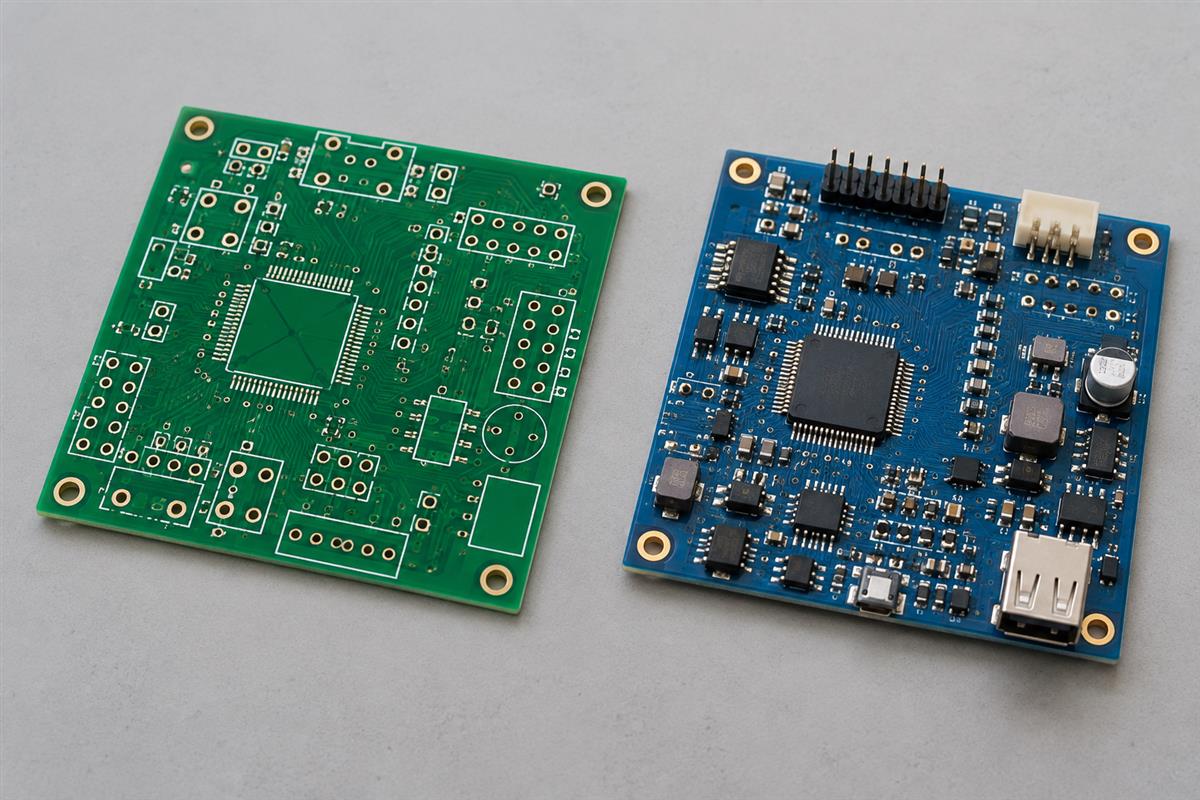
Where should you buy each type of board?
Choose a seller whose product and documentation match your purchase. Stock-board suppliers sell a defined item; replacement suppliers sell compatibility with a particular machine; fabricators and assemblers quote work against a design package.
- For a stock prototype board: search by board style, connection pattern and size. Look for clear photographs of both sides and a drawing or connection diagram. A general electronics distributor is often a more useful starting point than a custom fabrication enquiry.
- For an equipment replacement: start with the equipment manufacturer’s parts lookup or service documentation. Search using the assembly part number and equipment model, not just “green PCB” or the number printed on one chip. If the original is obsolete, ask a specialist supplier for a documented compatible replacement.
- For custom bare boards: approach a fabricator with manufacturing files and specifications. The item is made to order; a generic website photo is not the design you will receive.
- For custom assembled boards: use an assembly enquiry and identify who supplies the components, who programs programmable devices and who verifies operation. These responsibilities must be agreed, not assumed from a “turnkey” label.
A marketplace can contain all four categories, as well as scrap and untested boards. Filter by the actual item and condition before sorting by price. “New,” “used,” “repaired,” “untested” and “for parts” describe different risks. Ask whose warranty applies and what evidence supports the stated condition.
Do not treat a familiar manufacturer logo as proof of an authorized sales channel. Ask the original manufacturer to verify authorization where that matters. A third-party seller’s own warranty is not necessarily the manufacturer’s warranty.
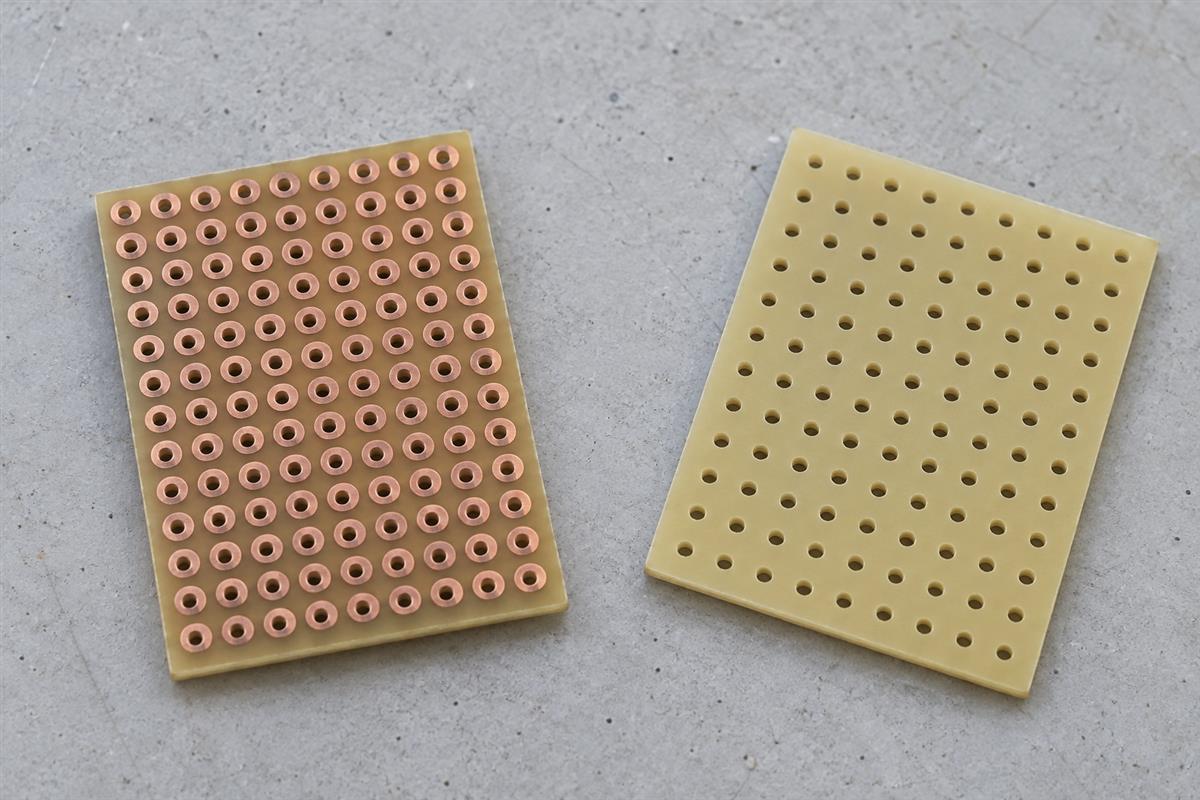
How do you check a stock prototype board before ordering?
Check the electrical connection pattern before you check the color or price. A board with a grid of holes may have isolated copper pads, long connected strips or groups of connected holes. Similar-looking boards can require very different wiring.
For example, Adafruit’s full-size Perma-Proto board uses groups of five connected holes and separate power buses. That is a specific product design, not a rule for every perforated board. With isolated-pad perfboard, adjacent holes are not automatically connected; you must create the required links.
- Read the copper-side view. Identify which pads are already connected and where isolation gaps occur. If there is no connection diagram, ask for one rather than guessing from the component-side photo.
- Compare dimensions with the actual parts. Check hole spacing, usable area, hole diameter and mounting-hole positions. A connector can have the right pin spacing but leads that do not fit the holes.
- Check the construction. Confirm the specified substrate, whether holes are plated through, the copper pattern on each side and the available solderable finish. Do not infer material or current capability from board color.
- Confirm the circuit is suitable for this construction. A hand-wired prototype is not automatically suitable for high current, controlled-impedance signals or safety-critical use. Those requirements may justify a properly engineered custom board instead.
Before adding components, compare the delivered board with its diagram. On an unpowered, empty board, a continuity meter can help confirm which pads are connected. It does not prove insulation safety, a current rating or suitability for a particular voltage. Never use resistance or continuity mode on powered equipment.
Also distinguish copper-clad laminate from a finished prototype board. Copper-clad stock is material used to make a circuit pattern; buying it does not give you a routed circuit. A “blank PCB” listing is ambiguous until its photographs and description settle this point.
How do you match a replacement board to existing equipment?
Match the replacement to the equipment’s documented requirements, not merely to its shape. The same board outline can support different component populations, firmware or model configurations. A matching connector does not establish matching electrical behavior.
The GE Appliances parts catalogue, for example, instructs buyers to check the appliance model for compatibility. Apply that discipline to your own equipment: use the manufacturer’s parts information and obtain written confirmation when a supplier proposes a substitute.
| Check | Evidence to obtain | Reason to stop the purchase |
|---|---|---|
| Equipment identity | Full model and any serial-range or regional variant requirements | The listing only says “fits many models” |
| Assembly identity | Assembly part number and approved replacement or supersession reference | Only a bare-board manufacturing number or chip marking matches |
| Revision and configuration | Accepted hardware revision and required firmware, setup or calibration | The seller cannot explain whether configuration is included |
| Mechanical and electrical fit | Correct connectors, mounting arrangement and documented ratings | Fit is claimed only from a similar photograph |
| Condition and test scope | New/used/repaired status and what was actually checked | “Tested” has no stated meaning or the item is sold as untested |
| Return and warranty terms | Written coverage, installation restrictions and claim procedure | Terms exclude the verification you need to establish compatibility |
Suppose the failed unit contains a board marked “AB-100 Rev C.” That marking alone may describe a PCB artwork revision rather than the complete service assembly. The orderable assembly could have a separate label. Send the equipment model and all relevant labels to the parts supplier; ask which identifier controls the replacement.
For discontinued equipment, distinguish a compatible replacement from a repair service or a reverse-engineering project. They have different evidence, costs and responsibilities. A photograph is useful for identification, but it does not reveal internal copper layers, all component values or the software needed to operate the equipment.
Keep diagnosis separate from buying. A non-working machine does not by itself prove that its circuit board is defective. Obtain an appropriate service diagnosis before ordering an expensive assembly. Installation in mains-powered, medical or safety-critical equipment belongs with qualified personnel following the manufacturer’s procedures; this buying checklist is not a repair procedure.
What exactly is included in a custom PCB order?
A custom bare-PCB order delivers the manufactured circuit board without fitted components. A PCBA order adds the agreed component sourcing and assembly work. Programming, functional testing, cables and enclosures still need an explicit scope, even when a supplier offers a combined service.
For custom fabrication, establish a released revision and provide the manufacturing package the supplier accepts, commonly Gerber and drill files plus a fabrication specification. For the detailed preparation sequence, use the guide to getting a PCB made. The buying decision here is about the deliverable, not about redoing the design process.
Assembly needs additional information. A bill of materials (BOM) identifies the parts; component placement data identifies where they go. Eurocircuits’ BOM and CPL guidance describes the placement list in terms of location, rotation and board side. Supply assembly notes for orientation, omitted parts and exceptions as needed.
| Requested deliverable | Clarify in the order | Do not assume |
|---|---|---|
| Bare custom PCBs | File revision, quantity, material, layer structure, thickness, finish and agreed inspection/testing | Components or functional operation are included |
| Assembled boards | BOM revision, placement data, sourcing responsibility and substitution approval | Every part can be changed to an equivalent without permission |
| Programmed boards | Authorized firmware version, loading method and verification responsibility | The assembler possesses your software or licenses |
| Function-tested assemblies | Test procedure, fixture responsibility, supply conditions and pass/fail limits | Visual inspection proves product function |
Consider two buyers each asking for “20 sensor boards.” One wants twenty bare PCBs to hand-assemble. The other wants twenty populated, programmed and tested modules. The quantity is identical, but the deliverables are not. A useful enquiry spells out which result is required and asks the supplier to list exclusions.
Keep drawings, BOM and placement data on the same revision. If engineering approves a change after the quotation, obtain a revised scope before production release. A manufacturability review can identify production constraints; it does not transfer responsibility for circuit performance to the factory.
PCBtry has a PCB assembly enquiry route for custom projects. Ask for a project-specific capability and scope review. Do not infer availability of an OEM replacement assembly, immediate stock or a particular lead time from the existence of an assembly service.
What should be confirmed before payment and on arrival?
Before payment, make sure the written order identifies the exact deliverable and how you will accept it. Price comparisons are only meaningful when condition, quantity, scope and delivery assumptions match.
Use this short order-confirmation checklist with the seller:
- Identity: catalogue item and specification, approved equipment replacement, or custom design revision.
- Quantity: individual boards or panels, permitted quantity variation if any, and included accessories.
- Scope: bare board, assembled, programmed or function-tested; components and services excluded.
- Changes: who must approve substitute parts, a different revision or altered manufacturing data.
- Schedule: what starts the lead-time clock, expected dispatch and the separate delivery estimate.
- Total charges: manufacturing or item cost, setup/tooling, testing, freight and applicable tax or import charges.
- Acceptance: required inspection/test evidence, damage reporting and a documented remedy for non-conforming goods.
When the shipment arrives, first compare the item labels, quantity and visible condition with the purchase order. Keep assemblies in appropriate protective packaging until they can be handled at an ESD-controlled workstation. Photograph shipping damage and contact the seller before modifying or attempting to repair the item.
For stock prototyping boards, verify dimensions and connection pattern. For replacement assemblies, confirm the supplied identity and configuration documents before installation. For custom boards, check the released revision and agreed inspection or test records. Acceptance of the shipment is not the same as validating a new circuit design.
Need a custom-board review? Send your manufacturing files, specifications, quantity and target delivery date to sales@pcbtry.com, or use the contact form. State “bare PCB” or “assembled PCBA” in the enquiry; for assembly, add the BOM, placement data and programming/test requirements. Ask the team to confirm feasibility, scope and exclusions before you approve production.
FAQ
Does a PCB listed for sale include electronic components?
Only if the description explicitly includes them. “Bare PCB” normally means no fitted parts. “PCBA” means an assembly, but accessories, programming and testing still need confirmation.
Can I buy one PCB?
Stock items may be sold singly. Custom orders can have minimum quantities or minimum charges determined by the supplier and build. Ask for the specific quantity you need; do not assume every process accepts a single-board order.
Is a prototype PCB the same as perfboard?
Not necessarily. The term may refer to a general-purpose hand-wiring board or the first manufactured batch of a custom design. Describe the physical item and files involved when requesting a price.
Can I order a replacement using only a photo?
A photo can help identify a candidate, but it is not sufficient compatibility evidence. Provide equipment identification and assembly labels, then verify the proposed replacement against the manufacturer’s information.
Can I get custom PCBs without design files?
You can request design services first. A sketch or schematic can describe the requirement, but manufacturing needs an agreed layout and production data. Treat design work as a separate scope rather than assuming it is included in a board price.
Is a used PCB assembly a safe replacement?
Its suitability depends on identity, condition, configuration, test evidence and the equipment’s requirements. “Used” alone proves neither suitability nor failure. Safety-critical equipment may impose replacement restrictions that a seller’s general warranty does not address.
Does PCB color tell me which board is better?
No. Solder-mask color is not proof of material grade, electrical capability or workmanship. Compare the documented specification and acceptance evidence instead.
Can a bare-board electrical test prove an assembled product works?
No. Checking board connections is different from verifying components, firmware and system behavior. If you need a working assembly, agree on a functional test and its pass/fail criteria before ordering.

0 Comments