



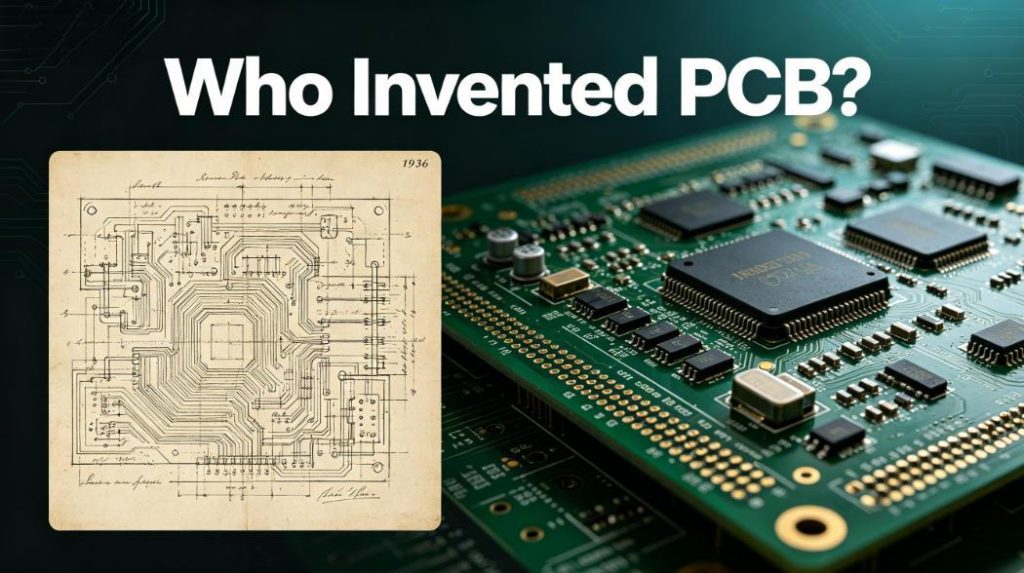
Who Invented PCB? The Straightforward Answer
Who invented PCB remains one of the most commonly asked historical questions within the electronics industry. Paul Eisler, an Austrian engineer, is officially recognized as the creator of the modern Printed Circuit Board, having developed the first functional PCB in 1936. Although early primitive circuit board patents existed before his work, Eisler designed the first practical board suitable for mass production in commercial electronic devices.
This article covers notable inventors, historical milestones, technical advancements, and real-world industrial applications to help industry professionals understand how PCBs revolutionized global electronics manufacturing.
Who Were the Early PCB Inventors Before Paul Eisler?
Prior to the creation of the modern PCB, several engineers filed foundational patents that established the basic framework of circuit board technology. These early prototypes lacked mature etching techniques but successfully proved the feasibility of layered conductive circuits.
Key Predecessor Inventors
- Albert Hanson (1903): A German inventor who patented the first layered foil conductor board featuring basic through-hole structures for telephone communication equipment.
- Charles Ducas (1925): An American engineer who patented conductive ink printing on insulated substrates, greatly simplifying manual circuit routing workflows.
Why Is Paul Eisler Known as the Father of PCB?
Paul Eisler earned the title “Father of PCB” for developing the first fully functional printed circuit board utilizing chemical etching technology in 1936. Unlike earlier conceptual patents, his finished design was integrated into a working radio prototype.
He pioneered the subtractive copper etching method still widely adopted in modern PCB manufacturing. This cost-effective and scalable technique eliminated messy manual wiring and significantly reduced electronic equipment failure rates.
What Is the Full PCB Invention Timeline? (Key Milestones)
Printed Circuit Board technology evolved over decades, transitioning from experimental patents to military-grade hardware and large-scale commercial manufacturing. The timeline below summarizes critical milestones for engineering reference.
| Year | Inventor/Organization | Critical PCB Technological Breakthrough |
| 1903 | Albert Hanson | First patented layered conductive circuit |
| 1925 | Charles Ducas | Conductive ink printing technology for circuits |
| 1936 | Paul Eisler | First practical etched PCB for radio devices |
| 1943 | U.S. Military | Mass PCB production for military proximity fuses |
| 1948 | U.S. Bureau of Standards | Official commercial approval for PCB manufacturing |
How Did WWII Accelerate PCB Invention & Adoption?
World War II rapidly boosted the industrial development of PCB technology. Military institutions required compact, vibration-resistant circuits for weapons and communication hardware.
Eisler’s PCB technology was secretly deployed for military proximity fuses. Strict wartime manufacturing standards refined etching precision, substrate durability, and mass batch production efficiency.
What Are the Most Common Misconceptions About PCB Inventors?
Many industry professionals mistakenly confuse early circuit patents with the invention of the modern PCB. Correcting these misconceptions prevents miscommunication during design, sourcing, and production workflows.
Common PCB Invention Myths
- Myth: Albert Hanson invented the modern PCB. Fact: He only proposed layered circuit concepts without mature etching technology.
- Myth: PCBs were commercially available in the 1930s. Fact: Public commercial PCB sales officially began in 1948.
Which Modern Industries Depend on Original PCB Invention Technology?
The etching and lamination techniques developed for early PCB prototypes remain the foundation of four high-demand modern industries. Customized PCB variants solve unique environmental and performance challenges for each sector.
Automotive Electronics
Heat-resistant rigid PCBs are widely used in ECUs and battery management systems. These circuit boards withstand intense vibration and temperature fluctuations to guarantee long-term vehicle reliability.
Medical Electronics
Flexible and rigid-flex PCBs are integrated into patient monitors and diagnostic equipment. They comply with strict biocompatibility standards and support miniaturized wearable medical devices.
Consumer Electronics
High-density multilayer HDI PCBs power smartphones and wireless earbuds. Compact high-density routing overcomes miniaturization limits and ensures stable high-speed signal transmission.
Industrial Automation
Heavy-duty multilayer PCBs are embedded in PLCs and industrial sensors. They suppress electrical noise and maintain consistent performance in harsh factory environments.
How Has PCB Invention Changed Modern Electronic Engineering?
The invention of the Printed Circuit Board eliminated unreliable manual point-to-point wiring entirely. Engineers gained standardized, repeatable circuit fabrication workflows for mass production.
For hardware designers and supply chain professionals, modern PCB production reduces prototype failure rates and shortens product development cycles.
What Core Manufacturing Technologies Came From Early PCB Inventions?
Nearly all mainstream modern PCB manufacturing processes originate from Paul Eisler’s subtractive etching method. These foundational techniques remain indispensable for commercial PCB fabrication.
Inherited Core Fabrication Techniques
- Copper layer etching and material stripping
- Insulating substrate lamination processing
- Compressed solder mask surface protection
What Pain Points Did Early PCB Inventions Solve for Engineers?
Before the PCB was invented, electronic devices relied entirely on hand-soldered discrete wiring. This outdated method caused frequent connection failures and complicated equipment maintenance.
Early PCB designs standardized circuit layouts, minimized human soldering errors, and simplified large-scale manufacturing for researchers and production teams.
How Will PCB Technology Evolve After These Historical Inventions?
Built on the original PCB invention framework, manufacturers continuously upgrade raw materials, layer counts, and machining precision. Advanced rigid-flex, ceramic, and high-frequency PCBs now serve aerospace and high-speed communication industries.
Future PCB development focuses on ultra-miniaturization, thermal resistance, and eco-friendly substrates to meet stringent global industrial compliance standards.
FAQ: Frequently Asked Questions About PCB Invention
Q: Who is the official inventor of the PCB?
A: Paul Eisler is universally acknowledged as the official inventor of the modern functional Printed Circuit Board.
Q: When was the very first PCB made?
A: The first fully functional PCB was fabricated in 1936 and installed inside a basic radio device.
Q: Did any other inventors contribute to PCB development?
A: Yes. Albert Hanson and Charles Ducas submitted early circuit patents that provided theoretical support for Eisler’s finalized PCB design.
Q: Why did the military adopt PCB technology so quickly?
A: Military hardware required compact, shock-resistant circuits. PCBs replaced fragile manual wiring to enhance battlefield equipment stability and durability.
Q: Is the original PCB manufacturing method still used today?
A: Yes. The subtractive copper etching method invented by Paul Eisler remains the dominant production process for mass-produced PCBs.
Q: What was the first commercial product using PCB?
A: Early consumer radios were the first commercial electronic devices equipped with standardized printed circuit boards.
Custom PCB Manufacturing Services From Thindry
Understanding who invented PCB helps engineers recognize the strict manufacturing standards behind every modern circuit board. High-quality PCB fabrication is essential for industrial, automotive, medical, and consumer electronic projects.
Thindry provides on-demand customization for all types of high-performance Printed Circuit Board. We also offer free DFM reports to optimize design structures and eliminate potential manufacturing defects.
If you need durable, industry-compliant PCBs for your upcoming projects, contact our professional team at sales@pcbtry.com to place your order.
0 Comments