



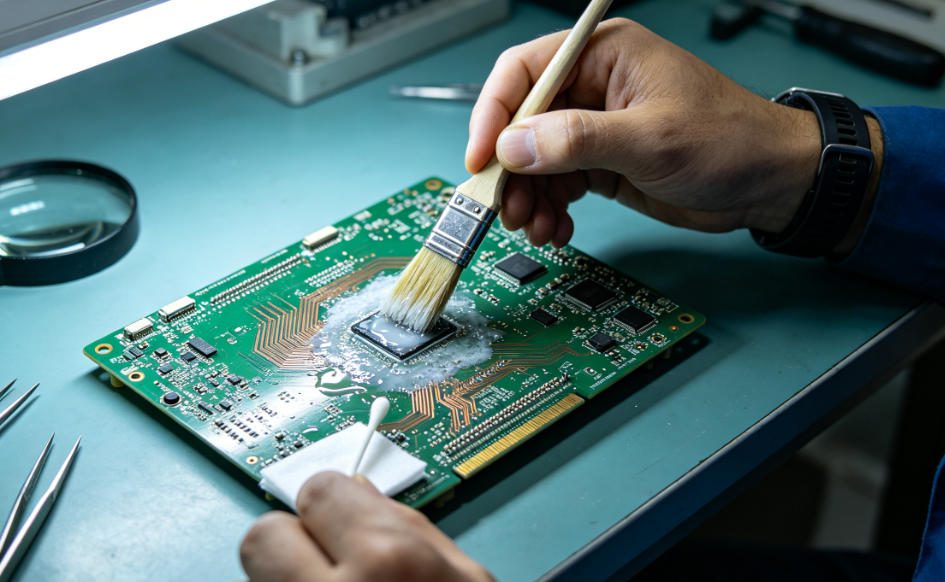
Cleaning flux off a PCB is critical for preventing circuit corrosion, electrical leakage, and premature board failure. This guide shares safe, actionable methods for how to clean flux off PCB units of all types, covering rosin-based, water-soluble, and no-clean flux residues. Whether you work with lab prototypes or mass-produced circuit boards, thorough flux removal safeguards long-term PCB stability and consistent electrical performance.
Why Is Flux Residue Harmful to PCBs?
Unremoved flux residue creates hidden functional and structural risks that worsen with long-term operation. Even faint, invisible contaminants can trigger corrosion, intermittent short circuits, and degraded signal integrity in high-precision electronics.
- Trace & Lead Corrosion: Acidic flux compounds gradually erode copper traces and component solder leads, causing permanent hardware damage.
- Parasitic Electrical Leakage: Ionic contaminants form unintended conductive paths, leading to unstable current flow and intermittent faults.
- Weak Surface Adhesion: Residue blocks proper bonding of conformal coatings, leaving circuits vulnerable to moisture, dust, and chemical erosion.
- High-Frequency Signal Degradation: Residue alters surface impedance, resulting in signal distortion and data loss for communication and high-speed devices.
What Are the Main Types of Flux & How to Clean Each?
Effective flux removal depends entirely on flux chemistry. Matching your cleaning solution and method to the specific flux type prevents component damage while delivering full residue elimination.
Rosin-Based Flux (Most Common Soldering Flux)
This thick, amber-colored residue resists plain water and requires solvent-based cleaning. Use 99% isopropyl alcohol or industrial-grade flux removers for best results.
- Apply solvent directly to residual flux and allow 1–2 minutes for full chemical dissolution.
- Gently agitate buildup with an ESD-safe soft brush, then wipe clean with lint-free microfiber cloths.
- Blow dry with oil-free compressed air to stop dissolved contaminants from re-depositing on sensitive areas.
Water-Soluble Flux
Water-activated ionic flux breaks down easily with heated deionized water and water-based cleaning agents. It is widely used in industrial high-volume assembly lines.
- Rinse contaminated PCB surfaces with 40–60°C deionized water to soften and loosen hardened flux.
- Use soft-bristle brushes for targeted cleaning around connectors and through-hole components.
- Complete drying with low-temperature heated air or industrial drying ovens to eliminate trapped moisture.
No-Clean Flux
Formed to leave minimal visible buildup, no-clean flux is only low-residue, not zero-residue. Critical industrial, automotive, and medical hardware still requires mandatory cleaning.
- Use mild, plastic-safe flux removers to avoid damaging sensitive plastics, solder masks, and lightweight components.
- Avoid strong corrosive solvents that may degrade surface finishes or thin circuit materials.
How to Clean Flux Off PCB: Step-by-Step Manual Method
Manual flux cleaning is ideal for small-batch production, prototype rework, and targeted repair tasks. It delivers precise control without large industrial equipment.
Essential Tools for Manual PCB Flux Cleaning
- 99% isopropyl alcohol or premium commercial flux remover
- ESD-compliant soft bristle cleaning brushes
- Lint-free, non-abrasive microfiber wipes
- ESD wrist straps and nitrile safety gloves
- Oil-free compressed air cans or blowers
- Magnifying lens for post-cleaning visual inspection
Standard Step-by-Step Cleaning Workflow
- Prep the Circuit Board: Fully power down and disconnect all external connections. Place the PCB on a static-dissipative work mat and ground yourself to prevent electrostatic discharge.
- Confirm Flux Category: Reference soldering material specifications to identify rosin, water-soluble, or no-clean flux formulas.
- Apply Cleaning Solution: Dab or spray solvent onto concentrated flux spots, and allow a 1–3 minute dwell time for heavy buildup.
- Gentle Mechanical Agitation: Brush residue in a single direction to avoid spreading contaminants across clean solder joints and traces.
- Wipe and Secondary Rinse: Remove dissolved flux with lint-free wipes; use deionized water rinsing for water-soluble flux types.
- Complete Drying Process: Clear excess solvent with compressed air, then allow extended air drying or low-heat forced drying.
- Final Visual Inspection: Examine tight spaces, BGA pads, and fine-pitch components under magnification to confirm full residue removal.
What Industrial Methods Work for Bulk Flux Removal?
High-volume manufacturing demands fast, repeatable, and uniform flux cleaning solutions. Industrial-grade processes optimize efficiency while meeting strict electronic cleanliness standards.
Ultrasonic Cleaning (Complex Multi-Layer PCBs)
High-frequency ultrasonic waves dissolve trapped flux from hidden gaps beneath BGAs, QFPs, and densely packed surface-mount components.
- Operation: Submerge assembled PCBs in a temperature-controlled cleaning solution tank for 3–5 minute cycles.
- Key Benefits: Deep cleaning for compact, high-density board designs; consistent results for mass production.
- Limitations: Not suitable for ultra-delicate components such as quartz crystals and fragile micro-connectors.
Inline Spray Cleaning (High-Speed SMT Production Lines)
Automated inline systems integrate washing, rinsing, and hot-air drying to match continuous SMT manufacturing workflows.
- Operation: PCBs pass through pressurized spray chambers with heated cleaning fluid, followed by deionized water rinsing and thermal drying.
- Key Benefits: Fully automated, time-efficient, and scalable for large daily production volumes.
- Limitations: Requires dedicated production space and fixed industrial equipment investment.
Vapor Degreasing (High-Reliability Electronic Boards)
Solvent vapor technology delivers residue-free cleaning for rosin and no-clean flux with zero water spotting or moisture retention.
- Operation: Heated solvent vapor condenses evenly across PCB surfaces, dissolving and carrying away organic flux contaminants.
- Key Benefits: Rapid evaporation, no residual moisture, and excellent penetration into narrow component gaps.
- Limitations: Requires proper workshop ventilation and safe handling of industrial solvent materials.
Which Cleaning Agents Are Safe for PCBs?
Selecting compatible cleaning chemicals prevents permanent board damage while maximizing flux dissolution performance. Harsh, untested solvents will damage solder masks, plastic housings, and sensitive chip packaging.
| Cleaning Agent | Best Application | Core Advantages | Main Limitations |
|---|---|---|---|
| 99% Isopropyl Alcohol | Rosin & no-clean flux removal | Cost-effective, widely accessible, safe for most standard components | Less effective against heavy water-soluble ionic flux |
| Premium Commercial Flux Remover | Stubborn, aged flux deposits | Fast-acting formula, engineered for electronic assembly use | Higher material cost compared to standard IPA |
| Deionized (DI) Water | Water-soluble industrial flux | Eco-friendly, zero volatile organic compounds | Requires strict drying protocols; ineffective for rosin flux |
| Semi-Aqueous Cleaners | Mixed flux type production batches | Dual solvent-water formula for universal cleaning | Longer processing cycles and wastewater management needs |
Critical Technical Note: Always perform a spot test on unobtrusive board areas before full cleaning. Avoid acetone for general use, as it permanently damages solder masks and plastic component bodies. 70% diluted isopropyl alcohol is not recommended for electronic cleaning due to high water content.
How Do Top Industries Benefit From Fully Clean PCBs? (4 Key Sectors)
Complete flux removal is a mandatory quality standard for high-reliability industry applications. Clean, residue-free PCBs resolve common field failure issues across core electronic sectors.
Consumer Electronics (Smartphones & Wearable Devices)
PCB Type: HDI high-density interconnect boards with micro fine-pitch SMT parts
Core Challenge: Miniaturized circuit layouts leave no tolerance for flux-induced short circuits
Practical Solution: Precision ultrasonic cleaning eliminates micro-residue in tight gaps to extend consumer device service life
Automotive Electronics (ECUs & Vehicle Sensors)
PCB Type: Rigid-flex and high-temperature resistant automotive-grade circuit boards
Core Challenge: Extreme temperature fluctuations and road vibration accelerate residue-based corrosion
Practical Solution: Ionic-free water-based cleaning meets AEC-Q100 automotive reliability certification requirements
Industrial Control (PLCs & Factory Automation Hardware)
PCB Type: Heavy-copper power PCBs for high-voltage industrial control systems
Core Challenge: High current loads amplify leakage risks from leftover flux contaminants
Practical Solution: Inline spray cleaning ensures full board cleanliness to prevent electrical arcing and unplanned equipment downtime
Medical Electronics (Diagnostic & Monitoring Equipment)
PCB Type: Regulatory-compliant high-reliability medical PCBA assemblies
Core Challenge: Contamination risks compromise device stability and medical industry certification standards
Practical Solution: Vapor degreasing and controlled ultrasonic cleaning comply with ISO 13485 medical manufacturing guidelines
What Are the Most Common Flux Cleaning Mistakes to Avoid?
Even experienced assembly technicians make preventable errors that damage PCBs or leave hidden flux contamination. Avoid these frequent mistakes to ensure safe, long-lasting cleaning results.
- Using Diluted 70% IPA: Excess water content leaves mineral deposits and weakens solvent power for organic flux.
- Overly Aggressive Scrubbing: Hard brushing scratches thin copper traces, lifts solder joints, and fractures miniature components.
- Incomplete Drying: Trapped moisture under chips and connectors causes long-term oxidation and hidden circuit faults.
- Low-Quality Wiping Materials: Cotton towels and standard swabs shed lint, creating new particulate contamination.
- Overlooking No-Clean Flux Risks: Low-residue flux still contains active chemicals that degrade high-performance electronics over time.
FAQ – Common Questions About Cleaning Flux Off PCBs
Is 70% IPA suitable for cleaning flux off PCB surfaces?
No. 70% isopropyl alcohol contains excessive water, which leaves mineral residues and cannot fully dissolve rosin-based soldering flux. 99% pure IPA remains the safest and most effective option for general workshop use.
Can acetone be used to remove hardened flux residue?
While acetone dissolves certain flux types, it is too harsh for standard PCB materials. It erodes solder mask ink, plastic connectors, and composite component housing, leading to irreversible cosmetic and functional damage.
Is no-clean flux truly maintenance-free after soldering?
Only basic low-voltage consumer gadgets can operate long-term with unremoved no-clean flux. All mission-critical hardware in automotive, medical, industrial, and aerospace fields requires full cleaning to maintain stability.
How can you remove trapped flux under BGA packaged components?
Manual cleaning cannot reach concealed areas beneath BGA balls. Ultrasonic cleaning or vapor degreasing are the only reliable methods to eliminate hidden flux residue in dense bottom-side component zones.
Should you clean flux residues on custom PCB prototypes?
Yes. Prototype testing often involves sensitive signal measurement and long-duration bench operation. Leftover flux causes unstable test readings, weak connections, and early-stage prototype failure.
How to Maintain Long-Term PCB Stability After Flux Cleaning
Professional cleaning is only one step in board longevity management. Standardized post-cleaning processes lock in cleanliness and protect circuits from environmental damage.
- Conformal Coating Application: Apply acrylic, silicone, or urethane conformal coatings to sealed cleaned PCBs against humidity and airborne pollutants.
- Static-Safe Storage Protocols: Store fully cleaned boards in anti-static shielding bags to avoid electrostatic damage during transit and inventory storage.
- Scheduled Routine Inspections: Periodically check high-humidity and high-temperature deployed units for secondary contamination or oxidation.
- Follow Global Industry Standards: Adhere to IPC-4406 flux classification rules and IPC-9850 cleanliness testing benchmarks for consistent quality control.
Why Choose Professional PCB Cleaning & Assembly Support?
DIY manual cleaning works for small-scale hobby projects, but professional processing delivers consistent, audit-ready results for commercial and industrial electronics. Specialized teams eliminate human error and hidden contamination risks.
- Specialized Technical Knowledge: Professional technicians match cleaning methods to unique board layouts, flux chemistries, and component sensitivity levels.
- Industrial-Grade Equipment: Full access to ultrasonic tanks, inline spray systems, and vapor degreasing stations for uniform large-batch processing.
- Multi-Stage Quality Inspection: Post-cleaning verification ensures full compliance with global electronic manufacturing and reliability standards.
- Application-Specific Customization: Tailored cleaning workflows for custom PCB designs, high-density layouts, and extreme operating condition hardware.
Get Premium PCB Solutions & Professional Flux Cleaning From Thindry
Effective methods to clean flux off PCB assemblies directly determine overall product lifespan and operational stability. At Thindry, we deliver precision-focused PCB manufacturing, assembly, and professional flux cleaning services for global industrial and commercial clients.
We support fully customized PCB manufacturing and provide free DFM reports to optimize your design structure, improve producibility, and reduce potential assembly contamination risks. Our solutions cover prototype development, small-batch customization, and large-scale mass production across all electronic industries.
If you need high-quality finished PCBs, professional PCBA assembly, and reliable flux cleaning support for your projects, feel free to connect with our team via email: sales@pcbtry.com
0 Comments