



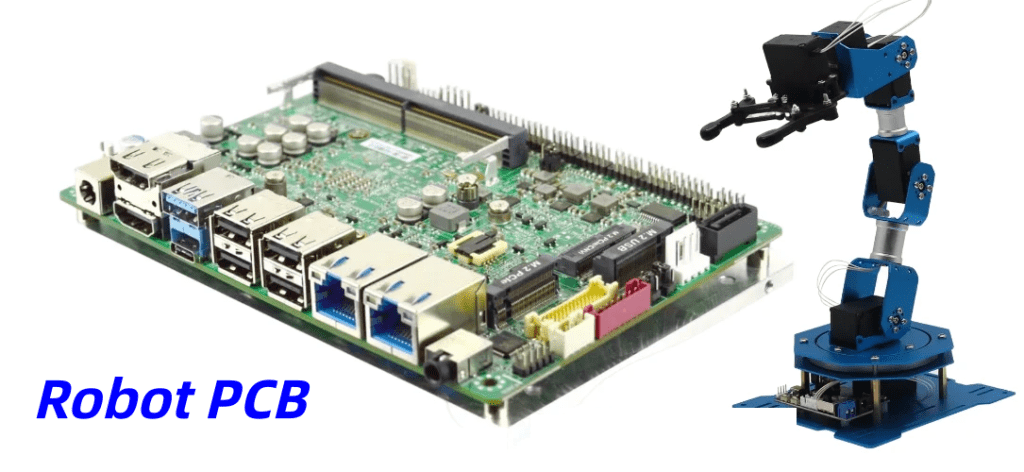
A robot pcb is not just a circuit board with components placed on it. It is the technical foundation that determines whether a robot can move smoothly, respond accurately, and operate safely over years of continuous use. As robotics expands into factories, hospitals, logistics centers, and service environments, robot pcb design has become a decisive factor for product reliability and lifecycle cost.
Many early robot failures are not caused by software bugs or mechanical wear. They are caused by PCB-level issues such as poor thermal paths, unstable power distribution, EMI interference, or material fatigue under vibration. Understanding how robot PCBs differ from ordinary electronics is the first step toward building reliable robotic systems.
What Is a Robot PCB and Why Is It Different From a Standard PCB?
A robot PCB is a printed circuit board specifically engineered to operate under motion, vibration, electrical noise, and thermal stress. Unlike consumer electronics PCBs, robot PCBs are designed for continuous operation, often in harsh or unpredictable environments.
The main differences lie in usage conditions:
- Robots move constantly
- Motors generate electrical noise
- Power loads change rapidly
- Downtime is expensive
As a result, robot PCBs must prioritize stability, redundancy, and durability over minimal cost or extreme miniaturization.
What Functions Does a Robot PCB Typically Perform?
A single robot may contain multiple PCBs, each responsible for a specific task. Understanding these functions helps clarify why robot PCB requirements are so diverse.
Control and Logic Functions
Robot PCBs often host:
- Microcontrollers or industrial processors
- Motion control algorithms
- Safety logic and fault handling
These boards must react in real time and cannot tolerate signal instability.
Power Distribution and Motor Driving
Power robot PCBs manage:
- Motor drivers
- High-current paths
- Voltage regulation
Any failure here can lead to overheating, shutdown, or mechanical damage.
Sensing and Feedback
Robots rely on sensors to interact with the world. Sensor PCBs handle:
- Encoders
- Force and torque sensors
- Vision modules
Signal integrity is critical for accurate feedback.
Communication and Networking
Modern robots communicate with:
- PLCs
- Industrial networks
- Cloud platforms
Communication PCBs must maintain data integrity in noisy environments.
What Types of Robot PCBs Are Commonly Used Today?
Different robots require different PCB architectures. Below are the most common robot PCB categories.
Control Robot PCBs
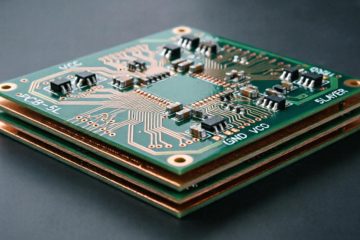
These boards focus on computation and decision-making. They often use multilayer stackups with clean reference planes to ensure signal stability.
Power Robot PCBs
Power PCBs handle high current and heat. Copper thickness, trace width, and thermal design dominate these boards.
Sensor Interface PCBs
These PCBs prioritize low noise and stable grounding to prevent false readings.
Communication Robot PCBs
Used for Ethernet, CAN, RS-485, or wireless modules, these boards focus on impedance control and EMI suppression.
What Are the Core Design Requirements for Robot PCB Manufacturing?
Mechanical Reliability Under Motion
Robot PCBs are constantly exposed to vibration and mechanical stress. Poor stackup balance or weak mounting areas can cause micro-cracks or solder joint fatigue.
Thermal Stability During Continuous Operation
Motors and power electronics generate heat continuously. Robot PCBs must dissipate this heat without warping or degrading material properties.
Electrical Noise Control
Motors, switching power supplies, and communication signals coexist on robot PCBs. Without proper isolation and grounding, EMI can cause unpredictable behavior.
Long Lifecycle Expectations
Robots are often designed for years of service. PCB materials, surface finishes, and assembly quality must support long-term reliability.
Which PCB Materials Are Best Suited for Robot PCB Applications?
Material selection is one of the most misunderstood aspects of robot PCB design. Cost alone should never drive this decision.
| Material | Typical Robot Use | Key Benefit | Limitation |
| Standard FR4 | Entry-level robots | Low cost | Limited thermal stability |
| High-Tg FR4 | Industrial robots | Better heat resistance | Slightly higher cost |
| Rogers / HF materials | Vision & RF modules | Signal integrity | Higher material cost |
| Aluminum PCB | Power sections | Excellent heat dissipation | Limited routing density |
| Rigid-Flex PCB | Moving joints | Mechanical reliability | Complex fabrication |
For most industrial robots, high-Tg FR4 combined with localized thermal solutions provides the best balance.
What Are Typical Robot PCB Stackups?
Stackup design directly affects signal integrity, EMI performance, and manufacturability.
2–4 Layer Robot PCBs
Used in simple robots with low integration requirements. Suitable for basic motor control or sensor boards.
6–8 Layer Robot PCBs
The most common choice for industrial robots. Allows:
- Dedicated power planes
- Clean ground references
- Better EMI control
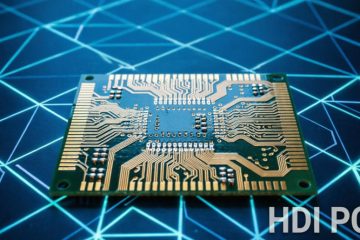
HDI Robot PCBs
Used in compact robots or robotic end-effectors where space is limited. Microvias and fine lines enable high density but increase manufacturing complexity.
How Do Robot PCBs Handle High Power and Heat?
Power Distribution Strategy
Robot PCBs often use:
- Heavy copper (2–6 oz)
- Wide copper pours
- Parallel vias for current sharing
These techniques reduce resistive loss and voltage drop.
Thermal Management Methods
Thermal challenges are addressed using:
- Dense thermal via arrays
- Aluminum or copper base layers
- Heat spreaders and copper inlays
Separation of Heat and Logic
Good robot PCB design physically separates power sections from sensitive control circuits to reduce thermal and electrical interference.
How Does Robot PCB Fabrication Differ From Robot PCBA?
Many engineers confuse fabrication with assembly. The difference matters greatly for robotics.
| Aspect | Robot PCB Fabrication | Robot PCBA |
| Bare board production | Yes | Yes |
| Component sourcing | No | Yes |
| SMT & THT assembly | No | Yes |
| Functional testing | No | Yes |
| Box build integration | No | Yes |
For robotics projects, one-stop PCBA reduces supplier coordination risk and shortens development cycles.
What Quality Standards Should a Robot PCB Manufacturer Follow?
Robot PCBs often overlap with automotive and aerospace quality expectations.
Key standards include:
- IPC-A-600 (PCB quality)
- IPC-A-610 (assembly quality)
- IPC Class 2 or Class 3
- ISO 9001
- IATF 16949 for industrial automation
- AS9100D for aerospace robotics
Traceability through MES systems is increasingly important for long-term support.
Why Choose Thindry Circuit as Your Robot PCB Manufacturer?
Choosing the right robot PCB manufacturer directly affects product reliability, development speed, and long-term maintenance cost. Robotics projects often involve mixed signals, high current, constant motion, and strict quality expectations. Thindry Circuit is built to support these realities, not just standard PCB production.
Thindry Circuit operates as a one-stop PCBA service provider, covering:
- Robot PCB fabrication (rigid, flex, rigid-flex, metal base)
- Component sourcing
- SMT & THT assembly
- Functional testing
- Box-build and final integration
This integrated model reduces communication gaps, shortens lead time, and improves overall product consistency. We are a long-term manufacturing partner that understands how robotics systems work—and how to build PCBs that perform reliably in real-world robotic applications.
Robot PCB FAQs
1. What does Thindry Circuit do?
Thindry Circuit provides PCB fabrication, PCBA, component sourcing, testing, and box-build services under one roof.
2. Do you support robot PCB prototypes?
Yes. Prototypes and small-quantity robot PCB orders are fully supported with no MOQ.
3. Can you manufacture high-current robot PCBs?
Yes. Heavy copper, copper inlay, and aluminum base robot PCBs are supported.
4. Do you offer quick-turn robot PCB production?
Yes. Fast prototyping and 1.5-week quick-turn PCBA are available.
5. Are your robot PCBs compliant with IPC Class 3?
Yes. IPC Class 3 and Class 3A are available upon request.
6. Can you ship robot PCBs internationally?
Yes. Robot PCBs can be delivered worldwide with stable logistics.
Your Robot PCB Partner Starts Here
If you are designing, prototyping, or scaling a robot pcb for industrial, medical, or service robotics, choosing the right manufacturing partner is critical. Thindry Circuit combines engineering insight, certified quality systems, and fast delivery to help your robot reach the market with confidence.
For robot pcb fabrication, assembly, or full turnkey PCBA services, contact us today!
0 Comments