




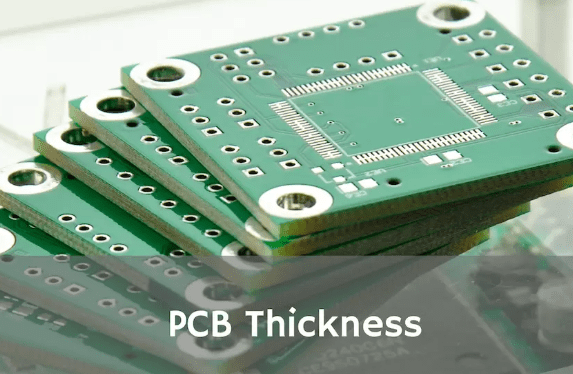
The thickness of any object refers to its total height from the bottom to the top surface. Like other mechanical parameters, thickness is crucial in product design. The thickness of a Printed Circuit Board (PCB) is equally critical in its design, manufacturing, and application. So, what is the thickness of a PCB? The distance from the outermost surface (typically the solder mask) to the outermost surface on the opposite side represents the total thickness of the PCB.
Since PCBs are manufactured by layering materials, their thickness can be broken down into the thicknesses of these individual layers. The board’s thickness primarily includes the core/laminates, dielectric layers, copper foil, solder mask, silkscreen, and surface finish layers. Modern PCBs are very compact, so their thickness usually falls within a few millimeters. Some internal layers can be extremely thin. Let’s explore the thickness of PCBs with common dimensions.
Importance of PCB Thickness
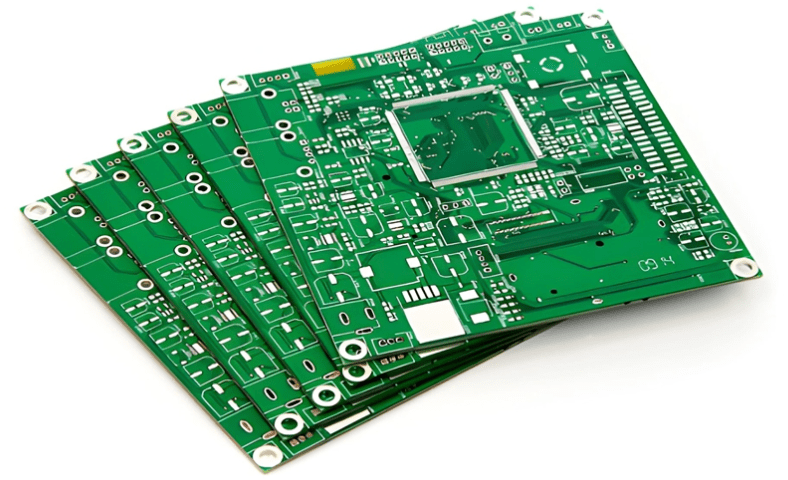
The thickness of any object determines its strength. A Printed Circuit Board (PCB) serves as the foundation for circuits and components, and also ensures the final product’s reliability; therefore, having the appropriate board thickness is essential. A board with suitable thickness fits better into connectors and can withstand stress and vibration. In multilayer boards, the inter-layer spacing determines their electrical performance, signal integrity, and impedance control.
One might ask, just how thick is a PCB board? Effective heat dissipation in a PCB board depends on its thickness and total surface area. Consequently, determining an appropriate PCB thickness value is vital for facilitating manufacturing and ensuring reliable performance. Exceeding the required thickness increases manufacturing costs, while insufficient thickness can render the board unusable.
Standard and Common Thicknesses
PCB designs vary from project to project. There is no single universal standard for PCB dimensions that every layout must follow. So, what is the thickness of a PCB? PCB thickness can range from a few millimeters to larger values. Over time, through continuous design and manufacturing, a common set of conventions has gradually been established between PCB designers and manufacturers to facilitate mutual understanding. The dimensions for substrates, copper foil, solder mask, silkscreen, PTH and SMD components, and other elements are now defined within certain ranges.
Depending on the layer stack-up, the most commonly used PCB thicknesses are 0.8mm, 1.0mm, 1.2mm, 1.6mm, 2.0mm, 2.4mm, 3.2mm, and so on. To ensure reliable manufacturing, fabrication tolerances need to be defined. A tolerance range of ±10% is commonly used in designs, while for some critical applications, the tolerance is tighter, at ±5%.
Factors Influencing PCB Thickness
1. Number of Layers
Typically, the overall thickness of a PCB depends directly on the number of layers. Each layer requires an appropriate dielectric layer separating it from others to maintain the PCB’s electrical integrity. So, in this context, how thick is the PCB exactly? In some applications, dielectric layers are made thinner to keep the overall thickness within the required limits. A common 4-layer PCB stack-up has a thickness of 1.6mm, a 6-layer board is 2.0mm, and so forth.
2. Substrate Selection and Copper Weight
In PCB manufacturing, there is a wide variety of material choices for cores, dielectrics, and prepregs. The material selection depends entirely on the circuit characteristics and product configuration. This leads to the question: PCB thickness depends on material choice. For any specific functional combination, all materials have specific dimensional parameters. Thus, the substrate influences the PCB’s overall thickness by contributing to the total build-up. Conductive paths are typically made using copper or other conductive materials. The size and grade of the copper determine the PCB’s current-carrying capacity. Higher copper content allows for greater current capacity.
3. Mechanical Enclosure Constraints
PCB dimensions are optimized for each configuration. To ensure rigidity, engineers often consider – how thick does a large circuit board need to be? If the board size is too large, it becomes prone to bending. To maintain the structural integrity of large boards, their thickness must be sufficient. To facilitate the mounting of heavy components and connectors, the PCB also needs to be thick enough. PCBs used outdoors experience continuous wear and tear. To avoid mechanical damage, thicker PCBs are often used. Similarly, during PCB fabrication and assembly, thicker boards are easier to handle, stack, and store as needed.
4. Heat Dissipation and Power Considerations
Thermal and electrical performance are among the key parameters for any PCB application. Therefore, a relevant question is: how thick should a PCB be for efficient heat dissipation? Thicker boards generally handle both aspects better. Excessively thin boards can sometimes fail during operation or fail to provide adequate thermal and electrical performance. For high-power boards, more copper is needed for traces, which also increases the PCB stack-up thickness.
5. Manufacturing Tolerances
Production equipment has specific limitations and tolerances at various stages. During lamination, drilling, routing, plating, and soldering, thin boards might get damaged. During panelization, overly thick boards might affect standard panel sizes. Therefore, designers must evaluate: within tolerance limits, what should the PCB thickness be? Attention to these tolerances is necessary throughout the design phase to ensure board integrity. Thus, achieving an exact thickness is impossible; tolerance limits must always be considered to ensure the PCB meets manufacturability requirements.
Relationship Between Layer Count and Thickness (Approximate)
This is a rough correspondence; actual values vary depending on core and prepreg (PP) materials:
| PCB Layers | Common Finished Thickness |
|---|---|
| Single/Double-Sided | 1.0mm, 1.2mm, 1.6mm |
| 4-Layer | 0.8mm, 1.0mm, 1.6mm, 2.0mm |
| 6-Layer | 1.0mm, 1.6mm |
| 8-Layer | 1.2mm, 1.6mm, 2.0mm |
| 10-Layer and above | Typically > 1.6mm, determined by design |
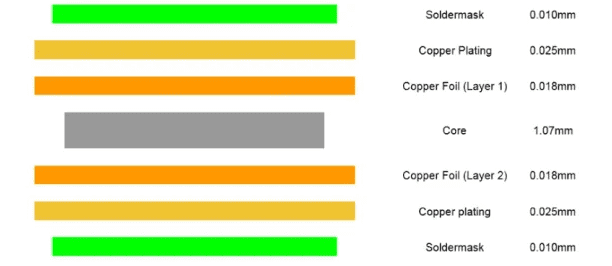
Key Tip: When submitting design files to a PCB manufacturer, it is usually not necessary to specify the final thickness. You only need to specify the types and quantities of core and prepreg materials in the stack-up design. The manufacturer will calculate the final thickness and produce accordingly.
Manufacturers’ “Standard” Dimensions (Panel Size)
To achieve the highest efficiency and lowest cost in production and assembly, PCB manufacturers typically have recommended “standard” panel sizes. Multiple identical or different small boards are arranged into a larger panel for production, which is later separated using V-Scoring or break-away tabs.
The most economical and commonly used panel sizes are:
- 100mm x 100mm
- 150mm x 100mm
- 200mm x 100mm
- 200mm x 150mm
Why are these sizes common?
Because these dimensions fit well within the processing range of production equipment (such as etching lines, exposure machines, pick-and-place machines), result in high material utilization, and can significantly reduce the unit price per board.
Size Limitations
PCB manufacturers have an upper limit to their production capability, usually expressed as the maximum processing size, for example, 500mm x 600mm. Designing boards larger than this requires special arrangements, and costs rise sharply.
Summary Table
| Item | Most Common/Standard Value | Other Common Values | Application Scenario/Notes |
|---|---|---|---|
| Thickness | 1.6mm | 0.8mm, 1.0mm, 1.2mm, 2.0mm | Universal standard, best cost-effectiveness |
| 0.4mm, 0.6mm | Ultra-thin devices (phones, wearables) | ||
| 3.2mm | High-reliability, high-power equipment | ||
| Size (Panel) | 100mm x 100mm | 150mm x 100mm, 200mm x 100mm | Most economical choice, suitable for small-batch prototyping and production |
| According to product design | Any size can be customized |
Recommendations for You:
- Beginners/General Design: If there are no special requirements, choosing a 1.6mm thickness and keeping the panel size within 100mm x 100mm is the most cost-effective option.
- Consult the Manufacturer: For complex or special designs, it’s best to consult your PCB manufacturer in advance to understand their most recommended thickness and size specifications for the best quotation and delivery time.
How to Determine PCB Thickness
Selecting the appropriate PCB thickness requires considering multiple parameters. The primary consideration is how the board will be mounted. Under such mounting conditions, what should the PCB thickness be? Furthermore, brackets, drills, protrusions from sockets and connectors, and the placement of components on the surface are crucial.
The total manufacturing cost needs consideration, while also balancing technical specifications against the budget. Maintaining electrical and signal integrity is also essential for achieving the desired PCB output. Large-sized boards with thicker traces often generate significant heat. Thicker boards help dissipate this heat effectively.
Depending on the product application, some users require flexible or rigid-flex circuits. Flexible circuits are thinner, while rigid-flex boards are thicker. Other parameters must also be considered when selecting the board type.
Summary
PCB thickness is one of the key parameters in PCB design and manufacturing. But in practical terms, what exactly is the thickness of a PCB?
Multilayer PCBs cover a wide range of thicknesses. Selecting the appropriate board thickness requires considering numerous factors such as layer count, materials, mechanical strength, thermal performance, enclosure compatibility, manufacturability, and cost. Clearly specifying the thickness and its tolerances helps ensure the manufacturability of the required PCB.
0 Comments