




Introduction
Learning how to convert watts to amps is a highly practical skill that enhances your ability to manage and troubleshoot electrical systems. This guide will focus on fundamental electrical units such as watts, amps, and volts, walk you through the primary conversion process, and explain its significance. We will also explore the application of these conversions in everyday activities and provide essential advice for maintaining electrical safety and maximizing energy efficiency.
In this comprehensive guide, we will dissect the intricacies of this crucial conversion process, clarifying why it is indispensable for those involved with alternative energy solutions. Before we delve into the “how” of conversion, let’s first understand the “what” and “why” of watts and amps, and the critical relationship between them, a relationship encapsulated by a simple yet powerful formula: Watts = Amps × Volts. Join us on this journey through the fundamentals of electricity as we demystify the process of converting watts to amps.

What are Watts, Amps, and Volts?
The first step in understanding basic electrical concepts is to grasp the definitions of watts, amps, and volts. Knowledge of these units is essential, especially when dealing with household appliances and other electrical applications.
What is a Watt?
A watt is the unit used to measure electrical power flow or current. The watt is a unit of power in the International System of Units (SI).
Watts measure the amount of electricity a device delivers or consumes over a given period. For example, if a light bulb is rated at 40 watts, it means it consumes 40 joules of energy per second it is lit.
By multiplying amps and volts, you obtain watts. This is how the amount of power consumption is determined. A higher wattage indicates a greater power output from the appliance.
What is a Volt?
A volt is the unit used to determine the magnitude of the force required to push the current flow. It measures voltage or electrical potential. Simply put, voltage is the amount of “pressure” needed to push the current through a circuit.
A higher voltage implies greater potential power. However, the combination of amps and volts determines the actual power output, ultimately expressed as wattage. An analogy is to imagine electric current as water flowing through a hose. The greater the amount of water flowing through the hose, the stronger the current is considered to be.
What is an Amp?
An amp (ampere) is the SI unit used to measure electric current. Amps represent the flow rate and quantity of electrons passing through a circuit per second. Extending the analogy, a wider hose corresponds to a higher amp rating, allowing more water, or current, to flow through it.
Formulas for Calculating Watts, Volts, and Amps
a) Watts = Amps × Volts
Example:
8 Amps × 300 Volts = 2400 Watts
10 Amps × 240 Volts = 2400 Watts
b) Amps = Watts / Volts
Example:
5000 Watts / 250 Volts = 20 Amps
2400 Watts / 240 Volts = 10 Amps
c) Volts = Watts / Amps
Example:
5000 Watts / 20 Amps = 250 Volts
2400 Watts / 10 Amps = 240 Volts
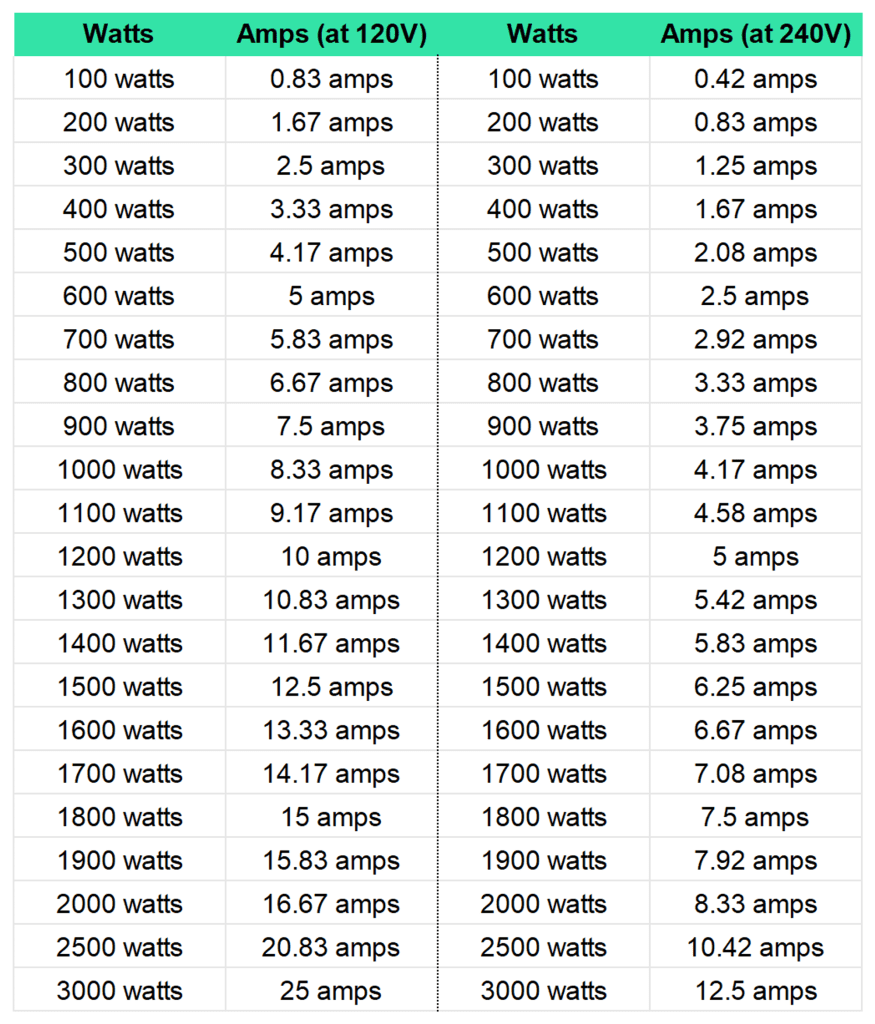
Watt to Amp Calculator: Quick Reference Conversion Table
Using the watt-to-amp calculator quick reference table shown below, you can swiftly perform the most common conversions for household appliances and equipment at typical voltage values:
The Difference Between AC and DC Power
A thorough understanding of the differences between Alternating Current (AC) and Direct Current (DC) is essential.
AC is characterized by the oscillating direction of current flow, typically represented as a sine wave. It is traditionally used in residential power distribution networks and common household power outlets.
DC maintains a constant, unidirectional flow, making it particularly suitable for a range of applications, including energy storage in batteries and power generation from solar cells.
The distinction between AC and DC is significant because it influences the process of converting watts to amps, which can vary depending on the specific type of current used.
Furthermore, it is important to note that the choice between AC and DC depends on specific application requirements. AC is suitable for transmitting electricity over long distances due to its ability to be transmitted with lower losses. DC is preferred in situations requiring a stable and constant energy supply.
Practical Reasons for Converting Watts to Amps
Converting amps to watts holds considerable practical significance, particularly in solar-powered systems, especially those designed for residential use.
Here are important reasons for knowing how to perform this conversion and use the calculations:
Ensuring Electrical Safety
A fundamental driver for performing amp-to-watt conversions is to ensure the safe and reliable operation of your solar-powered system, or any electrical system. This effort is crucial because it is necessary to determine the maximum current consumed by the system. This diligence is vital for confirming that the existing wiring infrastructure in your residence can effectively meet the system’s power demands without exceeding its capacity limits.
This precautionary measure mitigates the risk of potential electrical hazards. It ensures the smooth operation of the system, thereby minimizing the risk of adverse consequences, such as arcing or excessive heat buildup, which could ultimately lead to a fire outbreak. These safety protocols are essential, even if the frequency of such events is low, as they help protect your property and your family’s well-being.
Preventing Overloads
Amp-to-watt conversion plays a pivotal role in preventing power outlet overloads. Residential outlets are traditionally assigned different amp ratings, with most capable of handling a maximum range of 16 to 20 amps. In older homes, the amp rating of these outlets might be lower, sometimes as low as 12 amps.
By carefully assessing the current requirements of your equipment or system, you can effectively mitigate the risk of overloading power outlets. An overloaded outlet can lead to unexpected circuit breaker trips or, in more severe cases, pose a fire hazard. A deep understanding of the interaction between watts and amps equips homeowners with the knowledge needed to make informed decisions about the types of devices they can safely connect to an outlet, thereby proactively preventing potential electrical accidents.
Other Reasons
- Circuit and Fuse Sizing: When designing or modifying circuits, understanding the amperage requirements is crucial for properly sizing circuits and fuses. Oversized components can be inefficient and costly, while undersized ones can pose safety risks.
- Appliance Selection: Knowing the amperage of appliances helps in selecting the right appliances for your electrical system. If your circuits can only handle a specific amperage, this information is vital for choosing compatible appliances.
- Preventing Overheating: Overloading a circuit can lead to overheating and increased wear on electrical components. Accurate amp calculations help prevent these issues.
- Efficient Energy Management: For energy-conscious individuals or organizations, understanding the amperage of devices enables more efficient energy management, reducing electricity consumption and costs.
- Compliance with Electrical Codes: Electrical codes and regulations often specify maximum amp loads for different circuits and equipment. Understanding amperage is crucial for complying with these codes.
- Emergency Planning: In emergencies, such as power outages, knowing the amperage of your essential equipment can help you prioritize and manage your power needs.
- Preventing Fire Hazards: Overloading circuits or outlets increases the risk of electrical fires. By converting watts to amps, you can identify potential dangers and take preventive measures.
- Effective Use of Power Strips: Understanding the amp rating of power strips and surge protectors ensures they are not overloaded, preventing electrical accidents and maintaining their effectiveness.
- Solar System Sizing: Beyond residential solar systems, converting watts to amps is also crucial for capacity determination of solar installations in commercial and industrial settings. It ensures the system can effectively meet power demands.
- Generator Sizing: When planning backup power using generators, knowing the amperage of your equipment helps in sizing the generator appropriately to ensure it can handle the load.
Practical Applications of Watt-to-Amp Conversion in Daily Life
Here are some application scenarios where converting watts to amps is very useful in daily life:
- Managing Household Appliances: Understanding watt-to-amp conversion is critical when assessing the load appliances place on home circuits. For example, calculating the current draw of a 1500-watt space heater helps you ensure it won’t overload the circuit, especially when used with other devices. This awareness aids in efficiently distributing appliances across available circuits, preventing breaker trips or potential hazards.
- Electrical DIY Projects: For enthusiasts engaged in DIY electrical projects, such as building portable power stations or installing lighting systems, knowing how to convert watts and amps is fundamental. This helps in selecting appropriate wires and components that can safely carry the current. For instance, ensuring a 60-watt LED light strip is compatible with the chosen power supply and wiring prevents overheating or damage.
- Automotive Applications: In an automotive context, especially when adding aftermarket accessories like sound systems or lighting, understanding the conversion method allows car owners to ensure these additions do not exceed the vehicle’s electrical system capacity. For example, knowing the current consumed by a 200-watt amplifier helps in selecting the correct wiring and avoids battery drain or electrical fires.
- Optimizing Renewable Energy Use: For those incorporating renewable energy like solar power into their homes or using it during outdoor trips, understanding watt-to-amp conversion is invaluable. This conversion helps users efficiently manage the output of portable power stations or solar generators. For instance, knowing the specific amperage corresponding to a 300-watt solar generator allows users to effectively plan capacity usage, ensuring connected devices do not exceed safe operating limits. This guarantees optimal performance and longer lifespan for both the power source and the powered electronics, making renewable energy solutions more practical and convenient.
Tips for Electrical Safety and Efficient Usage
Here are some valuable tips for ensuring electrical safety and optimizing energy use:
- Calculate Current Load: To prevent circuit overloads, calculate the total current load on each circuit, ensuring it does not exceed safe limits.
- Use Surge Protectors: Protect sensitive electronic devices from power surges that can cause damage.
- Regular Inspection: Periodically inspect wires, outlets, and appliances for damage or wear. Damaged wiring can cause fires.
- Avoid Overloading Power Strips: Never exceed the current rating of extension cords or power strips; this is a common cause of electrical fires.
- Unplug When Not in Use: Devices can consume standby power and pose a fire risk even when turned off; unplug them if not in use.
- Use Correct Wattage: For light fixtures and other devices, always use bulbs and components matching the recommended wattage to prevent electrical overloads.
- Safety First for DIY Electrical Work: If you are unsure about performing electrical work, consult a professional. Incorrect wiring can be extremely dangerous.
Frequently Asked Questions
1. How do I convert watts to amps for AC power?
To convert watts to amps for AC power, you need to know the Power Factor (PF) of the device or appliance. The power factor is a measure of how effectively the device uses AC power. It ranges from 0 to 1, with 1 indicating the highest efficiency.
The formula for converting AC watts to amps is:
Amps = Watts / (Volts × Power Factor)
For example, if you have a 100-watt TV operating at 120 volts with a power factor of 0.8, you calculate its amperage draw by dividing 100 by (120 × 0.8). The result is 1.04 amps.
2. How many watts are in an amp?
The formula for converting amps to watts is:
Watts = Amps × Volts
So, if a circuit carries 10 amps at 12 volts, you calculate its power in watts by multiplying 10 by 12. The result is 120 watts.
3. How many amps is 20 watts?
To find out how many amps 20 watts represents, you need to know the circuit’s voltage. The formula for converting watts to amps is:
Amps = Watts / Volts
For example, if a circuit has a power of 20 watts at 12 volts, you calculate the amperage by dividing 20 watts by 12 volts. The result is approximately 1.67 amps.
4. How many amps is 5000 watts?
The formula for converting watts to amps is Amps = Watts / Volts. For instance, if a circuit has a power of 5000 watts at 120 volts, you calculate the amperage by dividing 5000 by 120. The result is approximately 41.67 amps.
5. How many amps is 2000 watts?
Assuming a resistive load and an ideal power factor of 1, a device using 2000 watts operating at 120 volts would draw approximately 16.67 amps. (2000 Watts ÷ 120 Volts = 16.67 Amps)
6. What is the formula for converting watts to amps in a DC circuit?
In a DC circuit, the formula for converting watts to amps is: Current (A) = Power (W) / Voltage (V). This means you divide the power (watts) by the voltage (volts) to obtain the current (amps).
7. How do I calculate the current for an appliance at different voltages?
To calculate the current for an appliance at different voltages, you use the formula: Current (A) = Power (W) / Voltage (V). This means you need to adjust the appliance’s power requirement based on the power source’s voltage to find out how much current it will draw.
8. Can incorrect watt-to-amp conversion affect appliance performance?
Yes, incorrect watt-to-amp conversion can affect appliance performance. Using wrong values may lead to underpowering or overheating, potentially damaging the device or reducing its efficiency. Correct calculations ensure devices operate within their designed specifications.
Conclusion
In summary, mastering the skill of converting watts to amps is an immensely valuable asset for anyone working with electrical systems. Whether you are dealing with household appliances, renewable energy solutions, or industrial machinery, this knowledge empowers you to make informed decisions, ensuring electrical components operate safely and efficiently. By following the simple steps outlined in this guide, you can confidently bridge the gap between watts and amps and, in the process, gain a deeper understanding of the world of electricity.

0 Comments