




Introduction
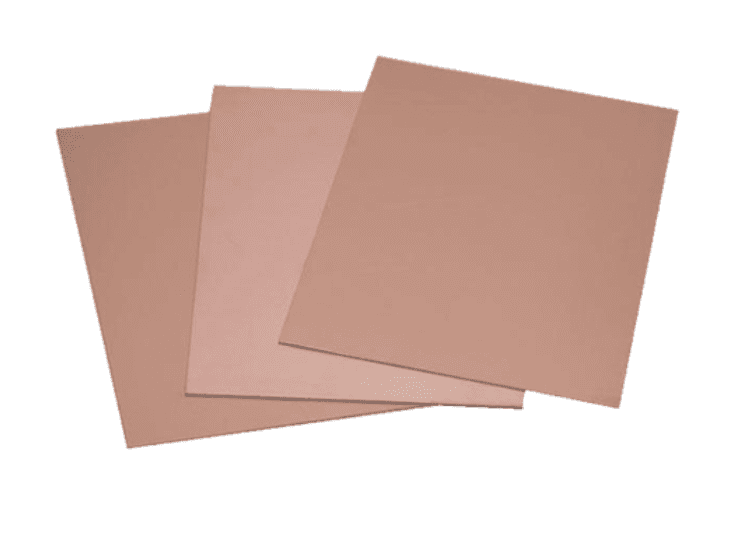
With the trend of electronic products moving towards miniaturization, lightweight design, multi-functionality, and high density, the integration level and component density on circuit boards are increasing, along with greater power consumption. This places higher demands on the heat dissipation performance of the PCB substrate. If the substrate’s heat dissipation performance is inadequate, it can lead to overheating of components on the circuit board, thereby affecting the overall reliability of the device. Consequently, the PCB substrate, specifically the Copper Clad Laminate, has become essential.
What is Copper Clad Laminate?
Copper-Clad Laminate (CCL), the substrate used in PCB manufacturing, is the most widely used and critical base material for PCBs. It is a composite material manufactured by impregnating electronic glass fiber or other reinforcing materials with resin and laminating a layer of copper foil onto one or both sides. CCL is extensively used in electronic products such as televisions, radios, computers, and mobile communication devices.
The various forms and functionalities of printed circuit boards are achieved by selectively processing the CCL through patterning, etching, drilling, and copper plating to create specific circuit layouts. The printed circuit board primarily functions to interconnect components, provide insulation, and offer mechanical support. It significantly influences signal transmission speed, energy loss, and characteristic impedance within the circuit. Therefore, the performance, quality, manufacturability, production level, cost, long-term reliability, and stability of the PCB are largely determined by the CCL.
Copper-Clad Laminate (CCL) Materials
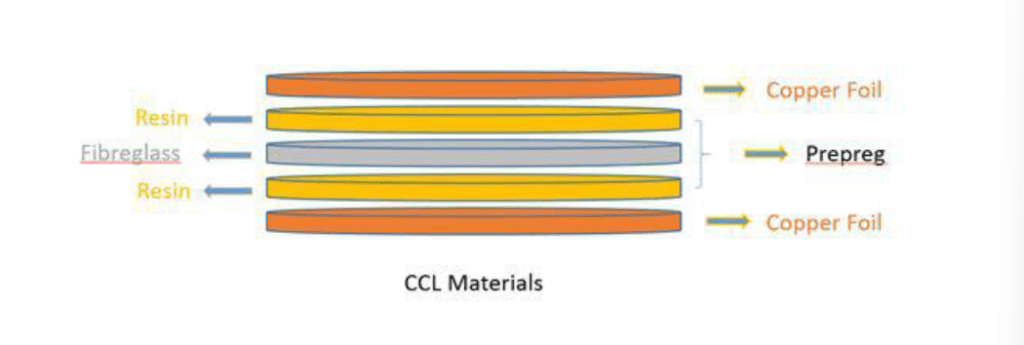
- Copper Foil: Copper foil is a cathodic electrolytic material, a thin, continuous layer of metal foil deposited on the PCB substrate. It adheres readily to the insulating layer, can form a protective printed solder mask, and possesses corrosion resistance, enabling the creation of the circuit pattern.
- Prepreg: Prepreg (pre-impregnated material) is glass fiber impregnated with resin. The resin is pre-dried but not fully cured (B-stage), allowing it to flow, bond, and fully encapsulate under heat and pressure. Thus, prepreg is a glass fiber reinforcement bonded by an adhesive layer (similar to FR-4 material). It is also considered a type of glass-fiber-reinforced material.Prepreg thickness varies among different manufacturers. Based on resin content, they are categorized into three types: “SR” (Standard Resin), “MR” (Medium Resin), and “HR” (High Resin). The optimal material is selected according to the required final thickness, layer stack-up, or impedance requirements. Therefore, the specific thicknesses mentioned are for reference only.
Types of Copper-Clad Laminates
Copper-Clad Laminate (CCL) is a material used for manufacturing Printed Circuit Boards (PCBs). It consists of an insulating layer (e.g., glass fiber or epoxy) coated with a thin layer of copper on one or both sides. Based on different characteristics, CCLs can be classified into the following types:
- By Mechanical Rigidity:
- Rigid CCL (RCCL): Typically used in devices like desktop computers and servers.
- Flexible CCL (FCCL): Primarily used in foldable or bendable devices such as smartphones and wearables due to their flexibility.
- By Insulating Material/Structure:
- Organic Resin-Based CCL: e.g., FR-4 (Glass Fiber Epoxy), CEM series (Composite Epoxy Material).
- Metal-Based CCL: Mainly used in LED lighting and automotive electronics due to excellent heat dissipation.
- Ceramic-Based CCL: Features very low dielectric loss and high frequency stability, often used in microwave and RF applications.
- By Thickness:
- Thick Board (0.8 – 3.2mm including Cu)
- Thin Board (<0.78mm, excluding Cu)
- By Reinforcing Material:
- Glass Fabric Base
- Paper Base – Composite Base (CME-1, CME-2)
- By Flame Retardant Rating:
According to UL standards (UL94, UL746E, etc.), flame retardant grades for rigid CCLs are classified into four categories: UL-94V0, UL-94V1, UL-94V2, and UL-94HB.
Other classification methods include categorization by reinforcing material (e.g., paper or glass fiber), insulating resin used (e.g., phenolic or epoxy), special functions (e.g., high temperature resistance or low dielectric constant), and Coefficient of Thermal Expansion (CTE).
What Makes an Excellent CCL?
To function effectively, Copper-Clad Laminate must meet performance requirements in the following aspects:
- Appearance: Due to unforeseen factors during production, copper foil may exhibit issues like dents, scratches, resin spots, wrinkles, pinholes, and bubbles. All these can lead to degraded performance of the CCL and ultimately the PCB. Therefore, high-quality CCL should have a smooth and uniform appearance.
- Dimensions: As CCL is the base material for PCBs, its dimensions must conform to PCB requirements. Dimensional parameters include length, width, diagonal deviation, and warpage, each of which must meet specific tolerances.
- Electrical Performance: This is a fundamental requirement for PCBs. Thus, all aspects affecting electrical performance must be carefully considered, including Dielectric Constant (Dk), Dissipation Factor (Df), Volume Resistivity, Surface Resistivity, Insulation Resistance, Arc Resistance, Dielectric Breakdown Voltage, Electric Strength, and Comparative Tracking Index (CTI).
- Physical Performance: Parameters for the physical performance of CCL include Dimensional Stability, Peel Strength (PS), Flexural Strength, Heat Resistance (including Thermal Stress, Td, T260, T288, T300), and Punching Quality.
- Chemical Performance: The chemical properties of CCL must meet requirements for Flammability, Chemical Resistance, Glass Transition Temperature (Tg), Z-axis Coefficient of Thermal Expansion (Z-CTE), and Dimensional Stability.
- Environmental Performance: Requirements such as Water Absorption must be satisfied.
Advantages of Copper-Clad Laminates
Copper-Clad Laminate (CCL) serves as a base material for Printed Circuit Boards (PCBs). Its advantages in PCB applications include:
- Conductivity: Copper possesses excellent electrical conductivity, reducing signal transmission resistance and enhancing the overall performance of electronic devices.
- Thermal Conductivity: Copper also has good thermal conductivity, helping to dissipate heat generated by components on the board, reducing the risk of overheating and improving device reliability.
- Mechanical Strength: The combination of copper and laminate provides mechanical strength to prevent bending and breakage, while maintaining flexibility if designed for such purposes.
- Etchability: Copper can be easily etched during PCB manufacturing to create intricate circuit patterns required by modern electronics.
- Cost-Effective Production: CCL is a relatively cost-effective material for mass production, as it is easy to work with in manufacturing processes like drilling and etching, reducing unit production costs.
- Compatibility with Soldering: Components are typically soldered to copper traces on the PCB, and the copper layer facilitates a easier and more reliable soldering process.
- Durability and Lifespan: PCBs based on CCL tend to have a long service life due to good corrosion resistance, making them suitable for harsh environments where other types of boards might fail prematurely.
- Dimensional Stability: CCL maintains stable dimensions even under varying temperature or humidity conditions—a crucial factor given that many electronic devices operate in diverse environmental conditions.
What is the Role of Copper-Clad Laminate?
Copper Clad Laminate (CCL) is the foundational material in Printed Circuit Board (PCB) production, serving several critical roles. Firstly, its copper layer, when etched into specific patterns, forms conductive pathways or “traces.” These traces facilitate communication between different PCB components. Secondly, the substrate layer of the CCL provides mechanical support and structural integrity for all mounted components.
Furthermore, due to copper’s excellent thermal conductivity, it aids in dissipating heat from various electronic components during operation, preventing overheating and potential damage. The insulating substrate also provides electrical insulation by isolating copper traces on different layers, preventing short circuits between them. Finally, the surface of these boards is compatible with soldering processes commonly used to mount electronic components onto them.
Where Can Copper-Clad Laminates Be Applied?
Copper-Clad Laminates (CCL) are primarily used as the substrate for Printed Circuit Boards (PCBs), which are found in almost all electronic equipment. Below are specific application examples for CCL:
- Consumer Electronics: Mobile phones, computers, televisions, gaming consoles, and other household appliances all contain PCBs made from CCL.
- Industrial Equipment: Machinery controls, power equipment, and automation systems often utilize PCBs to manage electrical functions.
- Automotive Industry: Modern vehicles use numerous PCBs for engine control units (ECUs), infotainment systems, navigation systems, and safety features like airbags and anti-lock braking systems (ABS).
- Aerospace and Defense: Avionics systems in aircraft or spacecraft rely heavily on high-specification PCBs; defense applications may include communication or radar equipment.
- Medical Devices: Advanced medical equipment like imaging devices (MRI machines), heart monitors, and powered wheelchairs also extensively use PCBs.
- Telecommunications: Network hardware such as routers, switches, and servers contain multiple complex, multi-layer PCBs.
- LED Lighting Systems: Metal Core PCBs (MCPCBs), often using specific CCL types, are commonly used in LED lighting systems due to their superior heat dissipation capabilities.
- Wearable Technology: Flexible CCLs (FCCL) are used here due to the need for flexibility, e.g., in smartwatches, fitness bands.
The type of CCL used depends on the specific application’s requirements—some may demand higher heat resistance or mechanical strength than others.
Copper-Clad Laminate Manufacturing Process
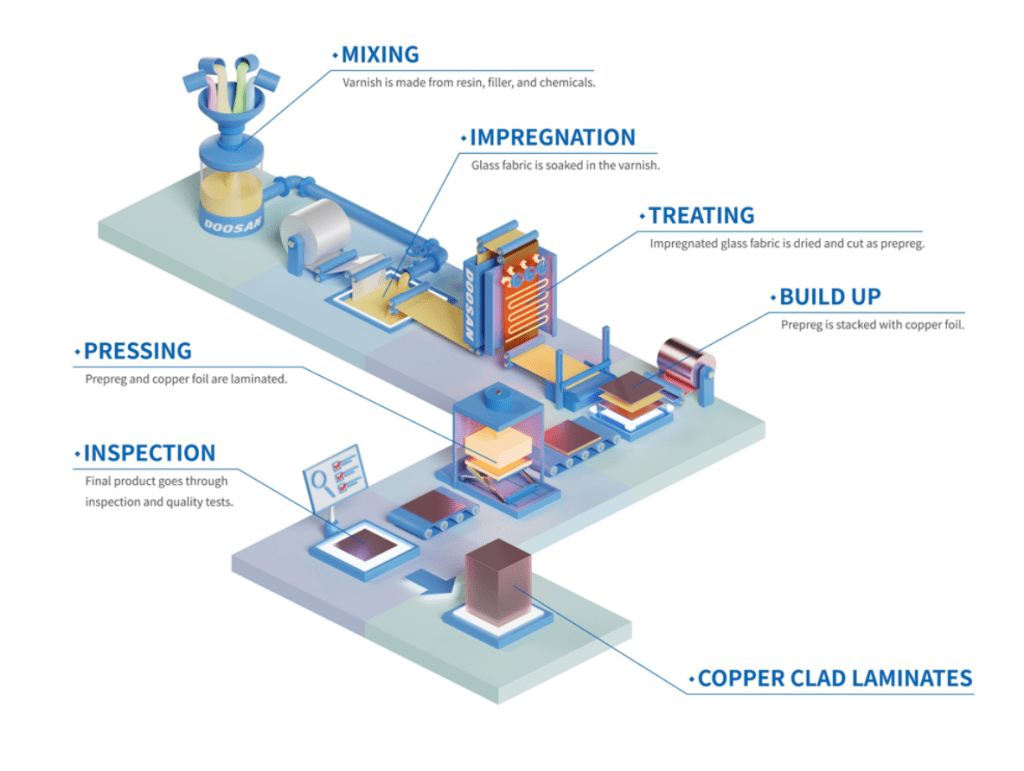
The manufacturing process for Copper-Clad Laminate (CCL) typically involves the following steps:
- Insulation Material Preparation: The insulating material, typically a glass fiber fabric like that used for FR-4, is prepared according to the required dimensions.
- Impregnation: The insulating material is impregnated with resin. This step involves soaking the glass fiber in a specific resin solution (e.g., epoxy). After saturation, excess resin is removed, leaving a uniformly impregnated sheet.
- Drying and Curing (B-staging): After impregnation, the material is dried and partially cured (B-stage). This makes it rigid but still capable of bonding under heat and pressure.
- Lamination with Copper Foil: Under high temperature and pressure, a layer of copper foil is laminated onto one or both sides of this prepared substrate. The heat causes further curing of the resin, causing it to solidify while bonding firmly with the copper, forming a single, unified structure.
- Cooling and Finishing: The laminated assembly is cooled. Any excess material is trimmed off. Quality checks are performed, such as visual inspection for defects or measurement of thickness.
- Cutting: Finally, the large panels can be cut into smaller sizes according to market demands.
Summary
Copper-Clad Laminate is an indispensable foundational material for the modern electronics industry. Nearly all electronic products we encounter—from smartphones, computers, and televisions to automotive electronics and aerospace equipment—contain printed circuit boards inside them, which are manufactured by processing CCL through a series of steps including patterning, etching, drilling, and plating. It can be said that without Copper-Clad Laminates, there would be no modern, diverse world of electronics.
0 Comments