




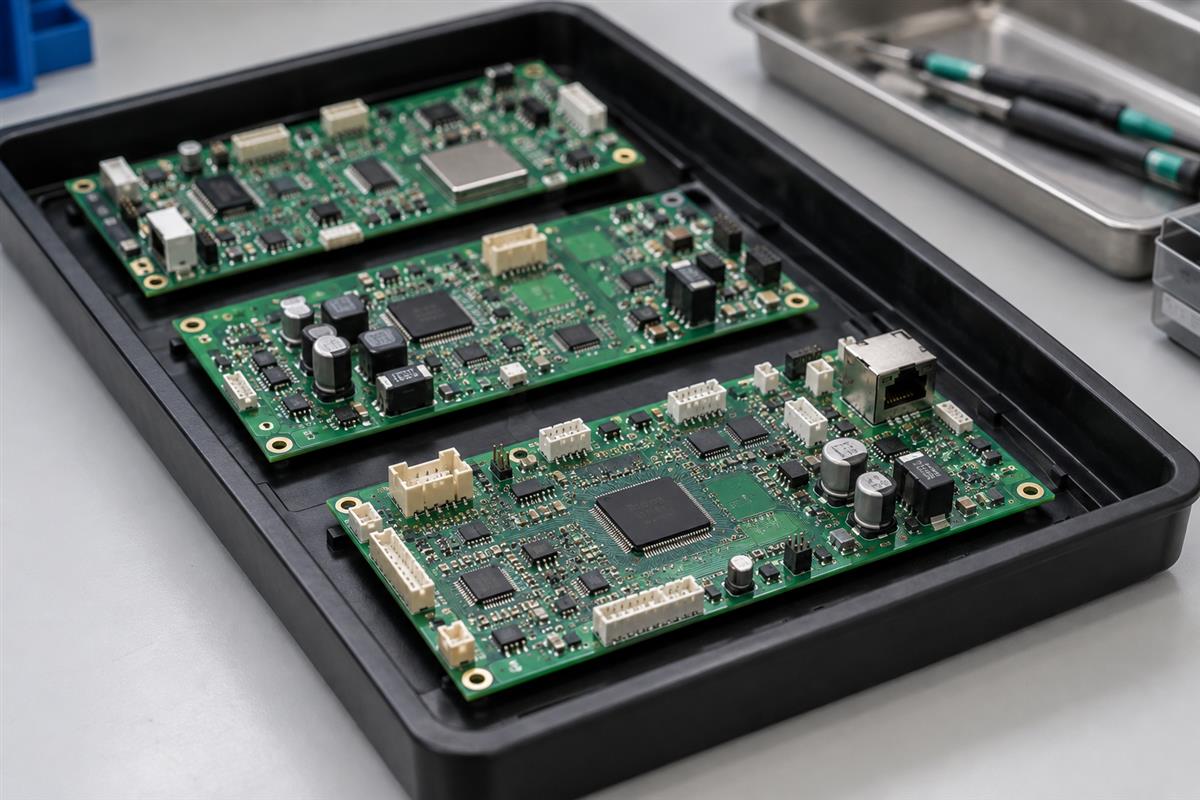
EMS PCB assembly means outsourcing an agreed electronics manufacturing scope to a service provider. That scope may cover bare-board fabrication, component sourcing, assembly, programming, testing and delivery. It does not automatically include product design, every test method, enclosure integration or lifetime repair support.
The useful question is not simply “Do you offer full service?” It is: What exactly will be delivered, who approves each decision, and what evidence will demonstrate acceptance? Resolve those points before comparing unit prices. Otherwise, two quotes for the same board may describe different products and different responsibilities.
Define the Deliverable Before Calling the Job Full Service
Start by describing the physical item and its accepted state. “100 assembled boards, programmed with an identified firmware release and tested to an agreed procedure” is clearer than “100 complete PCBs.” Add the packaging and records you require.
A PCB is the circuit board itself; a PCBA is the board with components assembled. An EMS engagement can extend beyond PCBA, but a board assembly order is not automatically a finished-product order. Cables, enclosures, labels, calibration, final system tests and shipping configuration need their own scope decisions.
Similarly, manufacturing review is not necessarily design ownership. A supplier may identify a land-pattern problem or suggest a more manufacturable feature without taking responsibility for the circuit’s intended performance. Identify who owns design decisions and who can approve a deviation from the released drawings.
For a first inquiry to PCBtry, use its PCB assembly service contact route to discuss the actual package and quantities. Request written confirmation of the included operations, exclusions and acceptance deliverables. Do not infer project-specific coverage from a general service label.
Use a Responsibility Matrix to Close the Gaps
Assign a provider, an approver and an output to each important activity. The provider performs the work; the approver accepts the decision or result. They are not always the same person.
The following matrix is a starting point for discussion, not a statement of PCBtry’s contractual terms. Replace the suggested roles with named project contacts and agreed documents. An empty approval cell is a question to close, not permission for either party to assume responsibility.
| Activity | Responsibility to agree | Evidence or output to request |
|---|---|---|
| Design release | Product owner supplies the approved design; identify who approves supplier questions | File manifest, revision identifier and closed query list |
| Bare PCB procurement | Who buys the board and approves construction or finish changes? | Approved fabrication specification and board revision |
| Component sourcing | Who purchases each BOM line and approves alternate parts or sources? | Approved part numbers, source requirements and substitution record |
| Assembly | Who defines assembly instructions and resolves manufacturability concerns? | Agreed drawings, special-process notes and acceptance basis |
| Firmware and programming | Who releases the image, provides programming access and manages credentials? | Identified firmware release, programming instructions and result record |
| Test development | Who supplies fixtures, software, loads and approved limits? | Accepted test procedure, fixture readiness evidence and result format |
| Nonconforming units | Who investigates, approves disposition and authorizes any product change? | Failure description, repair/rework record and required retest result |
| Delivery and remaining material | Who releases shipment and decides what happens to excess parts and tooling? | Lot identification, agreed shipment records and material reconciliation |
For example, “supplier performs functional testing” leaves an important gap if nobody has agreed to develop the test program. The matrix should identify whether the customer supplies a working procedure or the supplier quotes development. It should also establish how the fixture and procedure will be accepted before production relies on them.
Make Sourcing and Substitutions Explicit
Sourcing responsibilities determine which files, materials and decisions must arrive before assembly can start. They also determine who handles shortages and remaining inventory.
- Turnkey sourcing: the supplier purchases the agreed items. You still need to approve part specifications, permitted alternates and any restricted sources.
- Consigned material: you provide the agreed components or boards. Confirm quantities, packaging, identification, acceptable condition and shortage handling before dispatch.
- Mixed sourcing: each BOM line needs an explicit owner. “We will supply the expensive parts” is not a sufficiently precise purchasing instruction.
The BOM, or bill of materials, identifies the parts used in the assembly. Include manufacturer part numbers, quantities, reference designators and no-fit positions. A permitted alternate is a reviewed option, not any part with a similar description.
Consider a missing voltage regulator. Another device may share the package and nominal output voltage yet differ in pinout, stability requirements or startup behavior. The manufacturing team should raise the shortage, provide the proposed alternative and obtain the required engineering decision before purchasing or fitting it. Do not turn a delivery-date problem into an undocumented design change.
Component source matters too. Texas Instruments’ anti-counterfeit guidance recommends purchasing TI parts through TI or authorized distributors and warns that counterfeit markings can resemble genuine ones. Treat a photograph of a label as identification evidence, not proof of authenticity. Specify the source and traceability evidence your project requires.
Before approving a purchase commitment, also clarify minimum purchase quantities, allowed process allowance, supplier packaging constraints and ownership of unused stock. These are project-specific commercial decisions; they should be visible before the assembly quote is treated as a total budget.
Write Acceptance Requirements That Can Be Demonstrated
A useful acceptance requirement says what will be inspected or measured, against which criteria, for which product configuration, and what record will be retained. “High quality” and “100% tested” do not answer those questions.
Separate Workmanship from Product Function
IPC distinguishes soldering process and material requirements in J-STD-001 from post-assembly acceptance criteria in IPC-A-610. Its official standards announcement explains their complementary roles. Specify the applicable document, revision, class and any project-specific requirements through the agreed quality documentation; do not rely on the phrase “IPC quality.”
Passing a workmanship assessment does not demonstrate every operating function. Likewise, a board that powers up can still have a workmanship defect. Keep those acceptance questions separate.
Define the Test, Not Just the Equipment Name
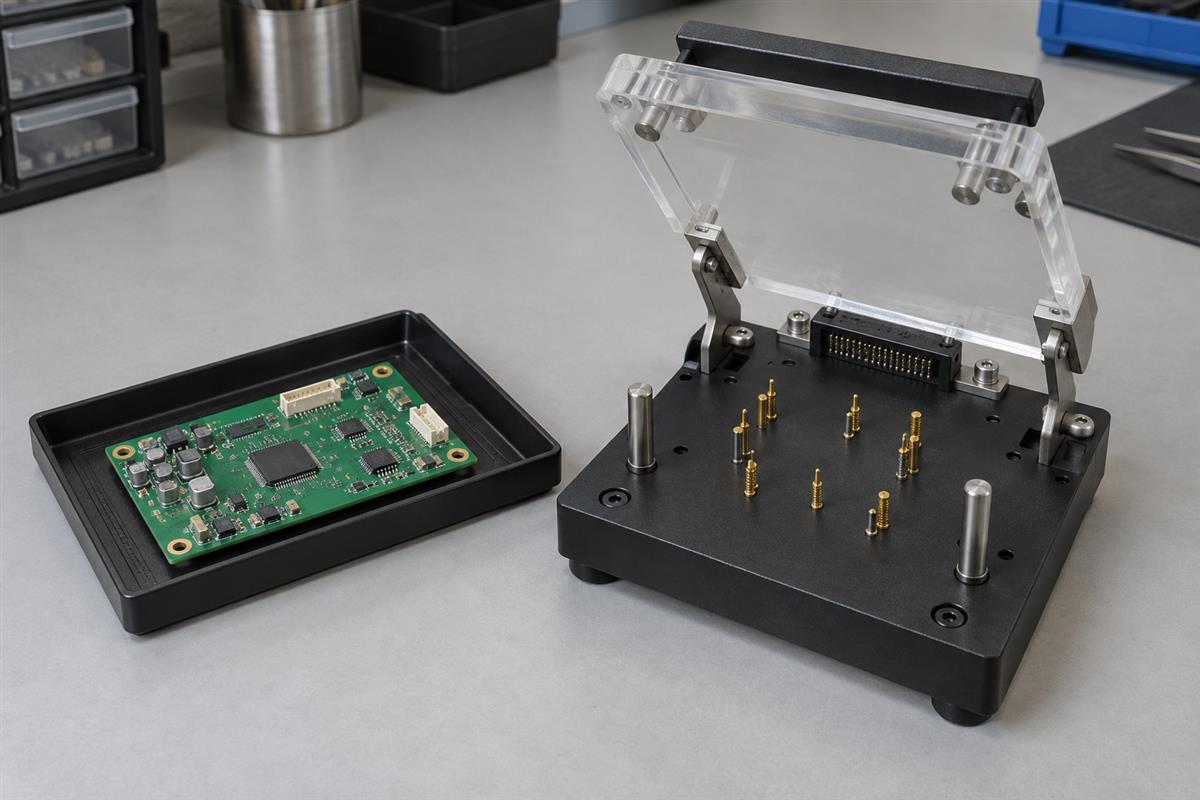
In-circuit testing checks accessible electrical characteristics and assembly-related faults. Functional testing exercises defined behavior under specified conditions. Keysight’s ICT system guidance distinguishes these purposes. Actual coverage depends on the design, access and implemented test program.
For a functional test, identify the power source and limits, connected loads or simulated inputs, firmware revision, test sequence, acceptance limits, and result fields. If the board has a communication interface, say which transaction or response demonstrates a pass. A test that checks only that a power indicator lights is not evidence that the communication interface works.
Keep development work visible: fixtures, cables, instruments, software licenses and maintenance may need separate agreement. Qualification testing, environmental testing and production screening are also distinct scope items. Do not assume every unit will receive every test mentioned on a supplier website.
Where traceability matters, ask for records that link the result to a board or lot and the relevant test configuration. Retests should not erase the original failure history. Agree who reviews failures and which conditions permit shipment after rework.
Compare Quotes on the Same Delivery Basis
Compare the cost of the same accepted deliverable, not the assembly labor line in isolation. Separate one-time engineering and tooling from recurring board, component, assembly and test charges. Then list exclusions and assumptions.
The example below is invented to demonstrate the calculation; it is not PCBtry pricing or a market benchmark. Assume the same 100-unit build, materials, test coverage and delivery basis once all listed items are included.
| Illustrative quote item | Offer A | Offer B |
|---|---|---|
| 100 assembled units | $20 each = $2,000 | $24 each = $2,400 |
| Agreed test fixture | $500 additional | Included |
| Agreed functional test | $2 each = $200 additional | Included |
| Total for this defined scope | $2,700 | $2,400 |
The apparent $20 offer becomes $27 per delivered unit for this first build, while the $24 offer remains $24. On a later unchanged build, Offer A might not incur the same fixture charge, so the comparison can change. Confirm reuse, maintenance and revision assumptions rather than mechanically dividing a one-time charge across every future order.
Use the same discipline for schedule. Ask what starts the committed lead time: purchase-order receipt, final engineering approval, complete material availability, or another agreed event. Identify long-lead parts and open technical questions separately from assembly time. A short assembly cycle does not eliminate a component shortage.
Approve the Program Without Losing Revision Control
Keep approval tied to an identified product configuration. A successful sample does not authorize later unreviewed changes to the board, component list, firmware or test limits.
- Release one coherent package. Include fabrication data, BOM, placement data, assembly drawings and applicable programming/test requirements. List the active revisions so the supplier does not have to choose between conflicting files.
- Close the quotation assumptions. Confirm included operations, sourcing ownership, acceptance requirements, one-time work, exclusions and delivery records. Assign owners to anything still open.
- Agree the initial-build approval. Define the quantity, review evidence and authority needed before proceeding. Approval should refer to the evaluated configuration and conditions, not simply “sample looks good.”
- Control changes. Identify affected documents, materials, orders and lots. Record the decision on obsolete inventory, partially built units, firmware and test changes.
- Reconcile the shipment. Check quantity, revision, required results, unresolved exceptions and any remaining customer-owned material against the agreed deliverables.
A Practical Shipment Evidence Checklist
- Product identifier, assembly revision and lot or serial identification.
- Required inspection and test records linked to the delivered configuration.
- Firmware/programming identification when applicable.
- Approved deviations and any required rework/retest records.
- Packaging, labeling and shipment quantities matching the order.
- Agreed disposition of spare boards, excess components and reusable tooling.
To discuss an EMS PCB assembly project with PCBtry, send the released files, build quantities, sourcing split, required test coverage and intended delivery format. Mark unresolved design or test-development tasks explicitly. Email sales@pcbtry.com or use the contact page and ask for the proposed scope, exclusions and clarification list with the quotation.
Questions to Resolve Before an EMS Order
Does EMS mean the supplier will design my product?
Not automatically. Design work, manufacturing review and assembly are different activities. Agree the design deliverables and approval authority if development is included.
Is turnkey assembly always the least expensive option?
No universal answer applies. Compare the complete sourcing and delivery scope, purchasing constraints, engineering charges and your own handling effort. A low assembly labor price alone does not establish the best overall offer.
Can I provide only the most critical components?
A mixed-sourcing arrangement can be discussed. Identify the owner of every BOM line and how shortages, damaged material and unused stock will be handled.
Does a supplier’s certification prove my product is approved?
No. Confirm the certificate’s scope and relevance separately from product-specific requirements. A supplier certificate is not a substitute for the product’s required evaluation or acceptance evidence.
Who owns the test fixture?
That must be agreed. Define ownership, storage, maintenance, access to software and what happens at project transfer or completion. Paying a tooling charge alone may not answer all of these questions.
What happens if a component becomes unavailable?
Use the agreed shortage and substitution process. Review the proposed part and source, cost and schedule impact, required validation and affected revision before authorizing the change.
Does a functional-test pass guarantee lifetime reliability?
No. It demonstrates the tested behavior under the defined conditions. Reliability expectations require suitable design, process controls and any separately specified qualification or screening work.
What should I send with the first inquiry?
Send the current fabrication files, BOM, placement data, assembly notes, quantities and intended sourcing model. Add programming, testing and mechanical integration requirements where relevant, and identify what is not yet ready.


0 Comments