




A high Tg PCB uses a laminate whose resin has a relatively high glass transition temperature. That helps describe how the material behaves when heated, but it does not tell you the board’s maximum continuous operating temperature. To choose a material, read Tg alongside thermal decomposition, expansion, short-term heat resistance and long-term ratings, then check the actual board construction and thermal history.
The useful question is not simply “Is Tg 170 or 180?” It is: “Can this specified material, in this board, survive our assembly process and service conditions?” The following checks turn a temperature label into a requirement that an engineer and a PCB supplier can review.
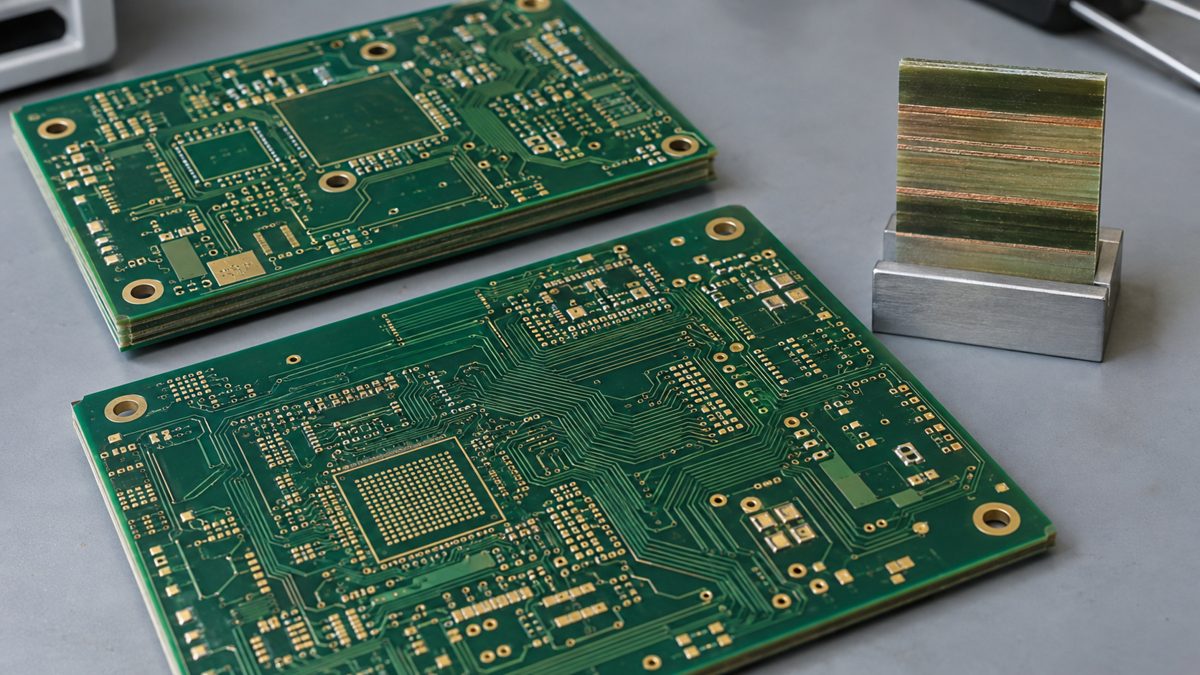
What Does High Tg Mean in a PCB?
Tg is the temperature region where the cured resin changes from a relatively rigid, glassy state to a softer, more compliant state. This is not the same as the PCB melting. Think of Tg as a change in the material’s mechanical behavior, not a temperature at which an otherwise safe board suddenly becomes liquid.
The glass reinforcement and copper still form part of the board. However, changes in the resin’s stiffness and expansion affect how the laminate and copper structures interact. That matters especially when a board is heated and cooled repeatedly.
Suppliers often describe FR-4 grades around Tg 170°C and above as high Tg, but the label is not a complete specification. Require the actual laminate grade, the reported value and its measurement method. “High Tg FR-4 or equivalent” leaves too much room for materials that share one number but behave differently elsewhere.
A practical distinction: a board may temporarily pass above its Tg during an approved soldering process without being automatically rejected. Conversely, operation below Tg does not prove acceptable lifetime. Duration, cycling, humidity, electrical stress, construction and other material limits still matter.
Which Temperature Ratings Must You Read Together?
Read each thermal property as an answer to a different question. A value expressed in degrees is not necessarily an allowable operating temperature, and a time-to-delamination result is not an oven recipe.
| Property | What to look for | What it does not establish |
|---|---|---|
| Tg: glass transition | The reported value and method, such as DSC, TMA or DMA | Continuous-use temperature, melting point or finished-board lifetime |
| Td: decomposition temperature | The test method and mass-loss criterion, commonly 5% | A safe temperature at which to run the product |
| T260 / T288 | Time before delamination at the named test temperature; check specimen preparation and method | Permission to hold an assembled PCB at that temperature for that duration |
| Z-axis CTE and expansion | Expansion below and above Tg, plus total expansion over the stated range | Automatic plated-hole reliability in every stack-up |
| Long-term rating, such as RTI | The recognized material, relevant property, thickness and rating conditions | A blanket operating approval for the entire PCB assembly |
| Thermal conductivity | Direction, units and measurement conditions | Heat-flow performance of the complete board, enclosure and cooling system |
The NCAB material FAQ explains why Tg, Td, delamination time and expansion must be considered together. Two laminates with the same Tg need not have the same expansion behavior. Do not select between them by comparing the largest temperature number alone.
A real datasheet example: three numbers, three meanings
The Isola 370HR datasheet lists Tg of 180°C by DSC, Td of 340°C at 5% weight loss and RTI of 130°C. These values describe different tests. They do not mean that a finished board can operate continuously at 180°C, much less at 340°C. This is a reading example, not a recommendation that this grade is suitable for every application or available for every PCBtry order.
When comparing candidates, first put the same property beside the same property. Then check whether the methods and conditions match. Panasonic’s Tg measurement explanation notes that DMA tends to give higher Tg values than DSC or TMA. A higher number obtained by a different method is not, by itself, evidence of a better laminate. Do not apply a guessed conversion factor.
Why soldering temperature is a separate number
Indium lists SAC305’s melting range as 217–220°C. A reflow peak is a different process parameter; “260°C is the melting point of lead-free solder” is not a valid specification. Select and verify the profile against the chosen paste, components, laminate and assembly requirements, not against Tg alone.
When Does a Higher Tg Help, and When Will It Not?
A higher Tg can be useful when the change in resin behavior is relevant to the board’s thermal exposure. It cannot, on its own, solve overheating, poor layout, unsuitable vias or uncontrolled assembly. Decide what failure you are trying to prevent before selecting a material.
| Situation | Why Tg may matter | What else must be checked |
|---|---|---|
| Several assembly or rework heat cycles | The resin repeatedly crosses temperature regions with different behavior | Measured profiles, cumulative exposure, moisture handling, Td, expansion and representative-board results |
| Long plated holes in a thick multilayer board | Through-thickness movement contributes to stress on copper interconnections | Stack-up, hole geometry, plating, expansion over the full range and a suitable reliability test |
| A power component makes a local hot spot | The nearby laminate’s conditions may differ from ambient temperature | Measured local temperature, heat path, copper, thermal interfaces and cooling; higher Tg is not a heatsink |
| Long periods in a hot enclosure | Material behavior matters, but the exposure is not a short soldering event | Long-term material ratings, component limits, operating duty and required lifetime evidence |
| High-speed or RF performance is the concern | The selected resin system may affect several properties | Dk/Df at relevant conditions, construction and impedance requirements; high Tg is not a low-loss category |
If the real problem is excessive component temperature, investigate heat generation and heat removal first. A material that tolerates a hotter environment does not necessarily reduce the temperature. Likewise, a passing electrical test immediately after reflow does not answer whether an interconnection will remain reliable after the required service cycles.
For a manufacturing enquiry, use the high Tg PCB service page as a starting point, but request confirmation against your actual stack-up and qualification needs. A general capability description is not approval of a particular design.
How Do You Specify a Board’s Thermal Requirements?
Specify the exposure and the acceptance evidence, not just a minimum Tg. The following sequence helps separate temperatures measured during use from temperatures introduced during manufacturing.
- Define the operating condition. State ambient conditions, expected local board hot spots, duration, duty cycle and required service life. Identify where temperatures were measured or, for an early design, mark them as estimates that need verification.
- Define the assembly history. List planned soldering passes, any other thermal processes and the allowed rework route. Ask for measured board profiles and the limits used to approve them. The PCB reflow profile and inspection guide explains the difference between an oven setting and a product measurement.
- Identify the material and construction. Provide the layer stack-up, thickness, copper requirements, holes and finish. Specify the approved laminate grade or the complete criteria for selecting one, including relevant thermal, electrical and recognition requirements.
- Agree on verification before the build. Define representative samples, conditioning, thermal exposures, measurements and acceptance limits with the responsible engineer and supplier. Do not wait for a failure to decide what a passing result should mean.
- Control changes. Require approval before changing laminate grade, construction or a relevant process. Record which changes require new evidence rather than assuming that an unchanged Tg number makes a substitution equivalent.
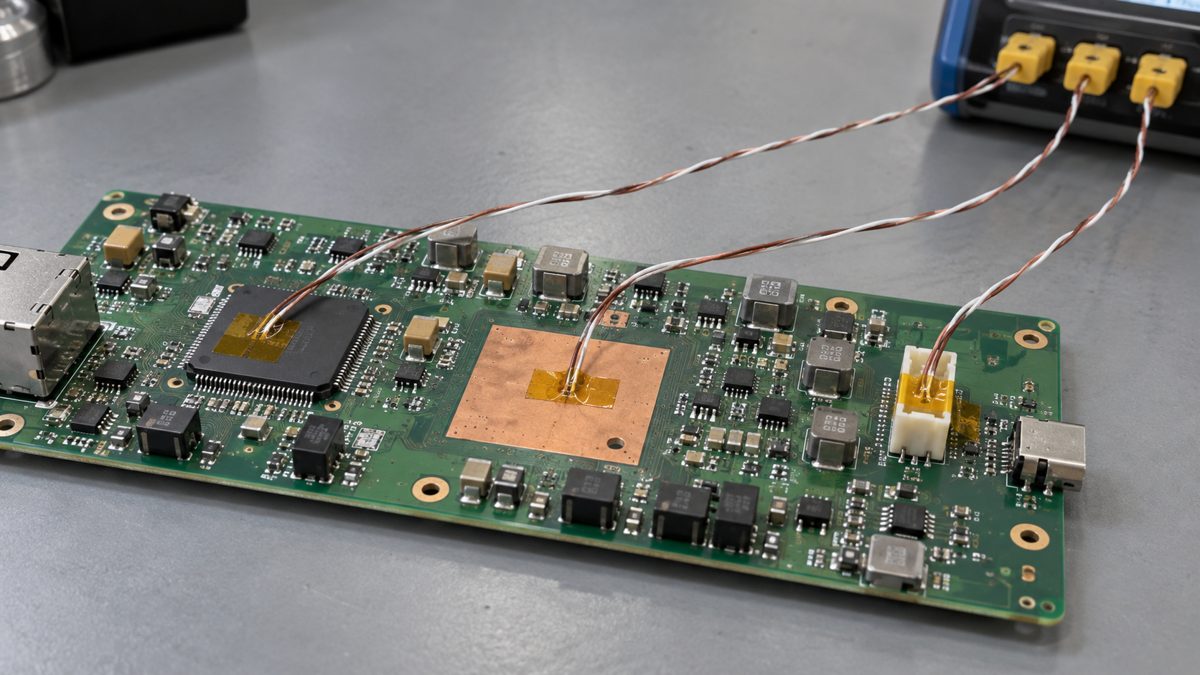
Worked planning example
Suppose a hypothetical controller has a measured board hot spot of 105°C during one defined operating test, requires two reflow passes and permits one controlled repair. A proposed laminate has a datasheet Tg of 180°C.
Subtracting 105 from 180 gives 75°C, but that subtraction is not a certified safety margin. It says nothing about the product’s lifetime, untested operating states, moisture, the repair profile or component limits. Nor does it show that the proposed stack-up will survive the intended cycles.
A useful next action is to write: “Confirm the exact material and rating conditions; verify hot spots under the defined worst-case operating states; approve both assembly passes and the permitted repair; and agree on post-exposure checks for representative boards.” The temperatures in this example are illustrative inputs, not recommended limits.
Copyable requirement fields: board revision; stack-up revision; laminate manufacturer and grade; Tg value and method; other required properties; operating temperature locations and duty; assembly and repair exposures; storage/handling requirements; verification plan; acceptance criteria; and substitution approval owner.
What Evidence Should You Check Before Production?
Check that the material identity, process evidence and finished-board verification refer to the same approved build. A datasheet describes a material; it is not proof that the ordered material was used or that a particular assembly passed its qualification.
| Evidence to request | What to confirm | When to pause release |
|---|---|---|
| Material specification and traceability | Grade, revision, permitted alternatives and the record connecting material to the build | Only “high Tg equivalent” is identified, or an unapproved substitution appears |
| Datasheet and applicable recognition information | Methods, conditions, thickness and properties relevant to the requirements | Values are copied without a source or incomparable methods are treated as identical |
| Approved stack-up and fabrication notes | Construction, hole requirements, finish and agreed inspection basis match the released files | The quotation and production package describe different constructions |
| Assembly and handling records | Measured thermal exposure, allowed rework and material-specific handling instructions | Only oven setpoints are available, or exposure history is unknown |
| Representative-board verification | Agreed electrical, dimensional and reliability checks before and after relevant exposure | Tests omit the identified failure risk or acceptance criteria were never agreed |
Choose tests for the risk. For example, a concern about interconnection durability may call for resistance monitoring and an agreed cross-section or reliability assessment after conditioning. A room-temperature continuity check alone answers a much narrower question. The engineer should define the applicable test method, sampling and acceptance limits; there is no universal test recipe for every high Tg board.
Keep a nonconforming result separate from an explanation. If a sample delaminates or shows unstable resistance, record the symptom and exposure history, investigate the cause, and verify corrective action before release. Changing to a larger Tg number without that investigation can leave the actual process or design problem unresolved.
High Tg PCB Questions
How much more does a high Tg PCB cost?
There is no reliable universal percentage. Compare quotations using the same construction, quantity, finish, inspection and delivery requirements, with the exact material grade stated. Ask the supplier to identify the material change and any qualification work separately. Otherwise, a price difference may include changes unrelated to Tg.
Can I identify high Tg material from the board color?
No. Solder-mask color, surface appearance and a photograph do not establish the laminate’s Tg. Use the approved material specification and build traceability. If identity is disputed, arrange an appropriate verification method rather than relying on visual similarity or a seller’s general label.
Does lead-free reflow always require the highest Tg available?
No. Select a material and construction qualified for the actual process. The highest Tg on a comparison sheet does not automatically give the best expansion, moisture behavior, electrical properties or manufacturing fit. Review the entire thermal exposure and relevant material evidence instead of buying a number.
Can I compare a DMA Tg directly with a DSC Tg?
Not as if they were interchangeable measurements. Check the test method and its conditions, and ask for comparable data when the difference affects selection. Do not accept or reject a proposed replacement solely because its differently measured Tg is a few degrees higher.
Is another laminate with the same Tg an acceptable substitute?
Only after the relevant requirements have been compared and the substitution has been approved. Review expansion, thermal endurance, electrical properties, construction compatibility and any applicable recognition conditions. Record what evidence supports equivalence for this product, not just that both materials carry the same Tg label.
Does high Tg remove the need for moisture control?
No. Follow the specified storage, exposure and handling requirements for the laminate, finished board and components. Do not invent a universal bake schedule: material, finish, packaging and assembly constraints can differ. If handling history is unknown, resolve it with the responsible supplier or engineer before another heat cycle.
What is the maximum operating temperature of a high Tg PCB?
It cannot be determined from the words “high Tg” or the Tg value alone. Establish the limit for the actual product using material ratings, components, electrical and mechanical requirements, environment and lifetime evidence. A short process excursion and years of continuous operation are different qualification questions.
Are high Tg FR-4, polyimide and ceramic interchangeable?
No. They describe different material choices, with different construction and manufacturing implications. Do not treat “high Tg” as a category that makes their thermal, electrical or mechanical behavior equivalent. Start from the product requirements and compare specific systems that can actually meet the design and manufacturing constraints.
Prepare the material review before ordering. Send your Gerber or ODB++ data, stack-up, fabrication notes, proposed laminate grade, operating conditions and assembly history to PCBtry’s contact team or sales@pcbtry.com. Include the inspection and qualification evidence you need, and request written confirmation of the proposed material, substitutions and unresolved items before authorizing production.

0 Comments