



What Is High TG FR4 CCL? IPC Standard Definition & Classifications
High TG FR4 CCL (Copper Clad Laminate) is a high-performance rigid PCB substrate designed for high-reliability industrial, automotive, and multilayer printed circuit boards. Complying strictly with IPC-4101 international industry standards, this advanced FR4-based laminate features an elevated glass transition temperature (Tg), solving the core defect of standard and medium-TG FR4 substrates that soften and deform under continuous thermal cycling. In professional PCB manufacturing, high TG FR4 CCL maintains stable mechanical rigidity, insulation performance, and precise dimensional consistency throughout lamination, lead-free reflow soldering, and long-duration high-temperature field operation. For global electronic manufacturers aiming to reduce PCB delamination, warpage, and field failure rates, high TG FR4 CCL is the most cost-effective and reliable base material solution.
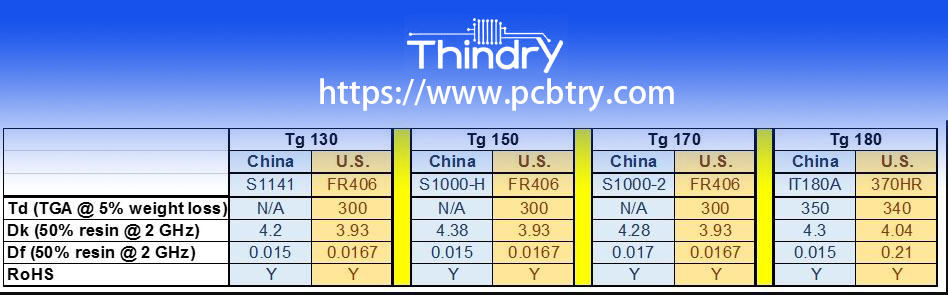
The glass transition temperature (Tg) refers to the threshold temperature where epoxy resin shifts from a rigid glassy state to a flexible rubber state. A higher Tg value directly improves thermal stability and anti-deformation capability. In commercial PCB manufacturing, FR4 CCL is categorized into three standardized grades based on industry-recognized Tg thresholds: standard TG (130℃), medium TG (150℃), and high TG (170℃ / 180℃). The Td thermal decomposition temperature and low CTE expansion coefficient further differentiate high TG FR4 from generic FR4 materials in high-end applications.
Standard 130℃ FR4 serves cost-sensitive consumer electronics with low heat output and simple operating conditions. Medium 150℃ TG FR4 balances performance and budget for general industrial circuit boards. In contrast, 170℃ and 180℃ high TG FR4 CCL is purpose-built for multilayer PCBs, high-frequency devices, and mission-critical electronics that demand long-term thermal stability. For modern high-density PCB designs, high TG FR4 has become an industry-standard substrate to avoid warpage, delamination, and thermal aging defects.
High TG FR4 vs Standard / Medium TG FR4: 12-Dimension PCB Material Comparison
Most PCB engineers and global sourcing teams face inconsistent material selection results due to one-dimensional parameter comparisons. Many public comparison articles only cover price and basic heat resistance, lacking factory-level practical reference value. To help international buyers eliminate over-specification cost waste and under-specification quality risks, we deliver a complete 12-dimensional technical comparison covering material properties, processing adaptability, durability, and project suitability.
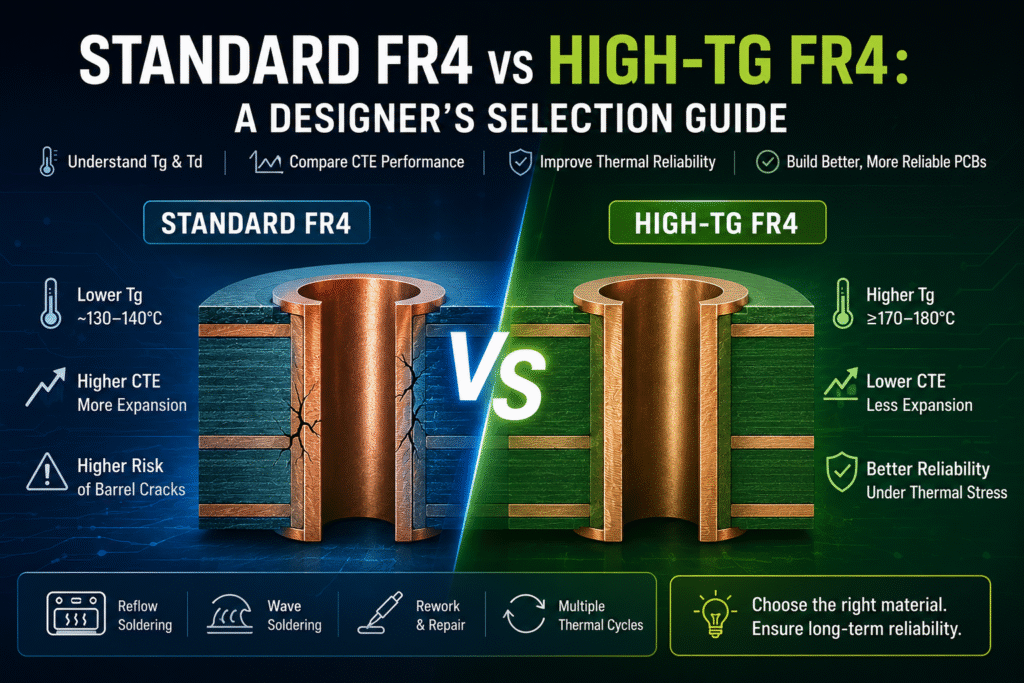
To deliver clear, engineer-friendly comparison data and help global buyers make fast, accurate material decisions, we organized the 12 core performance dimensions into the structured table below. This side-by-side evaluation covers standard TG, medium TG, and high TG FR4 CCL, highlighting critical differences for PCB production and project selection.
| Comparison Dimension | Standard TG FR4 (130℃) | Medium TG FR4 (150℃) | High TG FR4 (170℃/180℃) |
|---|---|---|---|
| 1. Glass Transition Temperature (Tg) | 130℃ basic thermal stability | 150℃ medium thermal resistance | 170℃ / 180℃ ultra-high thermal stability |
| 2. Thermal Decomposition Temperature (Td) | Low Td, easy resin aging | Moderate anti-decomposition performance | High Td, anti-pyrolysis & long-term aging resistance |
| 3. CTE Thermal Expansion Coefficient | High expansion, easy warpage | Medium expansion rate | Low CTE, minimal deformation after thermal cycling |
| 4. Continuous Heat Resistance | Suitable for short-cycle soldering only | Supports general repeated soldering | Stable after multiple lead-free reflow cycles |
| 5. Water Absorption Rate | Higher absorption, easy blistering | Ordinary moisture resistance | Ultra-low water absorption, anti-delamination |
| 6. Flame Retardancy | UL94 V-0, weak after aging | UL94 V-0 stable for general use | UL94 V-0, stable flame resistance after long-term aging |
| 7. Fine Processing Performance | Poor for fine circuits & multi-layers | Basic precision processing available | Excellent for ultra-fine drilling & high-layer lamination |
| 8. Dimensional Stability | Obvious shrinkage & expansion | General dimensional consistency | High precision for dense PCB layouts |
| 9. Operational Service Life | Shorter lifespan in heat environments | Medium durability | 30%–50% longer service life than standard FR4 |
| 10. PCB Layer Compatibility | 1–4 layers low-density PCB | 4–6 layers medium PCB | 6+ high-precision multilayer PCB |
| 11. Production & Sourcing Cost | Lowest cost, budget-friendly | Balanced cost & performance | Moderate premium with long-term reliability value |
| 12. Working Condition Adaptability | Consumer electronics, low-heat indoor use | General industrial & commercial devices | Automotive, server, new energy, high-reliability industry |
Based on decades of PCB substrate production and on-site processing verification, material selection must match actual project working conditions to balance quality and cost. Standard TG FR4 is exclusively suitable for low-budget, low-heat consumer electronic products. Medium TG FR4 serves conventional commercial and general industrial equipment. For high-density multilayer PCBs, high-temperature operating devices, and mission-critical electronic projects, high TG FR4 CCL delivers the lowest long-term failure rate, optimal processing yield, and superior overall cost-performance ratio, which is why it has become the mainstream high-end substrate in global precision PCB manufacturing.
High TG FR4 Core Parameters & Corresponding PCB Production Risks
Superior high TG FR4 performance relies on strict parameter compliance. Most PCB manufacturers only check basic specifications while ignoring the direct correlation between substandard parameters and mass production defects. Based on years of substrate manufacturing and PCB processing experience, we break down how each core parameter affects production yield and long-term product stability.
Critical Parameter Risk Analysis
Tg Value Compliance Risk: Qualified high TG FR4 requires a minimum 170℃ or 180℃ Tg rating. Materials with falsified or lower Tg values soften during lamination and reflow, causing board warpage, dimensional deviation, and circuit distortion in mass production.
Td Thermal Decomposition Risk: Insufficient Td resistance leads to gradual resin decomposition under continuous high-load operation. This hidden defect causes internal delamination, bubbling, and insulation failure after months of field operation.
CTE Mismatch Risk: High thermal expansion coefficients create inconsistent expansion rates between copper foil and substrate. This mismatch results in copper peeling, trace cracking, and multilayer layer offset after repeated thermal cycling.
Moisture Absorption & Insulation Risk: Excessive water absorption traps moisture inside the substrate. During high-temperature soldering, vapor expansion causes batch blistering and delamination. Degraded insulation resistance also triggers leakage current and short-circuit hazards in electronic devices.
In actual mass production, parameter inconsistency is the leading cause of low PCB yield, batch rework, and after-sales quality complaints. Many small and medium-sized PCB factories ignore incoming parameter testing, resulting in latent quality risks in finished products. Strict incoming parameter inspection and standardization of material selection can effectively eliminate production defects, reduce rework costs, and stabilize long-term product quality for high-volume electronic manufacturing projects worldwide.
Common High TG FR4 PCB Failures: Root Causes & Practical Fix Solutions
Even genuine high TG FR4 materials can produce defective PCBs due to improper storage, lamination parameters, soldering temperature control, and layer stacking design. Most supplier marketing content only highlights advantages without disclosing practical failure troubleshooting, leaving many overseas PCB factories facing repeated batch losses.
Failure 1: Interlayer Delamination
Root Cause: Substandard Tg/Td parameters, excessive moisture absorption, insufficient lamination pressure/temperature, and long-term humid storage.
Practical Solution: Adopt IPC-certified high TG FR4 substrates; implement pre-baking dehumidification before production; calibrate lamination temperature, pressure, and holding time to eliminate interlayer separation.
Failure 2: PCB Warpage & Thermal Distortion
Root Cause: High CTE deviation, asymmetric layer stacking, uneven heating during lamination, and unstable resin structure from low-grade materials.
Practical Solution: Select low-CTE high TG FR4; optimize symmetric multilayer layout; apply segmented temperature rise processing to avoid rapid thermal shock deformation.
Failure 3: Surface Blistering & Copper Peeling
Root Cause: Surface contamination, insufficient copper-substrate bonding strength, excessive soldering temperature, and counterfeit high TG materials with modified low-grade resin.
Practical Solution: Inspect surface cleanliness before use; verify material authenticity via DSC testing; control soldering temperature within standard ranges and avoid repeated thermal impact.
Failure 4: Insulation Degradation & Current Leakage
Root Cause: Unqualified insulation performance, residual processing impurities, and long-term high-temperature humid aging.
Practical Solution: Adopt UL and RoHS-certified substrates; implement post-production cleaning; avoid extreme working environments to extend PCB service life.
Most PCB failures related to high TG FR4 substrates stem from improper operation and management rather than unqualified genuine materials. Standardizing incoming material inspection, pre-production dehumidification, lamination parameter calibration, and storage management can eliminate over 95% of common batch defects. This standardized production management mechanism is widely adopted by top-tier global PCB manufacturers to stabilize mass production yield.
170℃ vs 180℃ High TG FR4: Exact PCB Project Selection Guide (No Overpaying)
170℃ and 180℃ are the two dominant high TG FR4 specifications in global PCB sourcing. Many overseas buyers and engineers face two typical mistakes: over-specifying 180℃ materials for ordinary projects leading to unnecessary cost waste, or under-specifying 170℃ materials for high-end projects causing batch product failure. This project-based selection guide helps users match materials accurately while balancing reliability and budget.
170℃ High TG FR4: Best for Mid-Reliability Industrial Projects
170℃ high TG FR4 provides stable thermal performance at a competitive price. It perfectly matches conventional industrial control boards, automotive auxiliary electronics, 6–8 layer multilayer PCBs, and high-temperature resistant consumer electronics. For projects with stable temperature cycles and medium reliability requirements, 170℃ high TG FR4 avoids redundant costs while fully meeting industrial production standards.
180℃ High TG FR4: Best for High-End Precision & Mission-Critical Projects
180℃ ultra-high TG FR4 features ultra-low thermal expansion and superior aging resistance. It is mandatory for automotive core electronic systems, new energy BMS boards, server motherboards, high-precision multilayer industrial PCBs, and medical electronic substrates. These scenarios involve long-duration high-temperature operation and frequent thermal cycling, where only 180℃ high TG materials can prevent long-term deformation and failure risks.
Cost & Risk Avoidance Principles
Global PCB sourcing data shows that unreasonable material matching is the main cause of project cost waste and quality accidents. Over-specifying 180℃ high TG FR4 for ordinary industrial projects will increase procurement costs by 20%–30% without practical performance improvement. Under-specifying 170℃ materials for high-end precision projects will lead to latent thermal deformation and aging failure risks, resulting in expensive after-sales losses. Accurate project-based material matching is the core principle for global engineers and buyers to achieve optimal cost-performance.
Industry-Specific PCB Applications of High TG FR4 CCL (High-Reliability Scenarios)
Global high-end electronic manufacturing industries have raised stricter requirements for PCB substrate thermal stability and service life. Standard low-TG FR4 substrates can no longer adapt to high-temperature, high-density, and long-cycle operating scenarios. As a high-performance substrate with excellent thermal resistance and dimensional stability, high TG FR4 CCL is widely applied in multiple high-premium, high-reliability industries worldwide, supporting customized PCB production for different industrial scenarios.
Automotive Electronics
Automotive electronic PCBs operate in complex high-temperature and high-vibration environments. High TG FR4 CCL is widely applied in vehicle body control systems, battery management systems (BMS), automotive sensor circuits, and new energy drive control boards. It resists engine compartment heat and long-term road vibration, ensuring stable and safe operation of automotive electronic systems.
Server & 5G Communication Equipment
Servers and communication base stations run continuously with high heat generation. High TG FR4 multilayer PCBs maintain stable structural and electrical performance under long-term thermal load, effectively preventing substrate deformation-induced circuit failure. It is the core substrate for high-end server motherboards, 5G base station PCBs, and network communication hardware.
Industrial Control & Automation
Industrial automation equipment requires long service life and ultra-low failure rates. High TG FR4 CCL is used for PLC control boards, servo drive PCBs, and automated system circuit boards, adapting to long-term high-load industrial working conditions and reducing equipment downtime risks.
New Energy & Medical Electronics
New energy energy storage and photovoltaic equipment demand high weather resistance, while medical electronics require extreme stability and safety. High TG FR4 substrates meet strict industry standards and are widely used in energy storage control boards, medical detection devices, and precision electronic instruments.
Global GEO Sourcing Guide: High TG FR4 CCL Supplier Selection by Country
Global high TG FR4 CCL procurement varies significantly in quality standards, pricing, lead time, and certification compliance across regions. Localized sourcing differences directly affect PCB batch quality and project profitability. This geo-targeted sourcing guide helps global buyers select reliable suppliers based on regional industrial characteristics and avoid cross-border procurement pitfalls.
China: Global Core High TG FR4 Production Hub
China owns the world’s most complete PCB substrate industrial chain, offering large-scale production capacity, stable batch consistency, and competitive pricing. Chinese manufacturers support customized thickness, copper weight, and Tg specification services, covering small-batch trial orders and mass bulk supply. All formal suppliers provide complete IPC, UL, and RoHS certification documents. Procurement tip: Verify DSC test reports to avoid falsely labeled high TG counterfeit materials.
Europe & North America: High-Standard Premium Supply
European and American suppliers focus on ultra-high-standard high TG FR4 products for aerospace, medical, and high-end automotive projects. Their products feature strict parameter consistency and full compliance with international industrial standards. The main drawbacks are higher pricing and longer lead times, suitable only for high-reliability premium projects.
Southeast Asia: Cost-Effective Conventional Grade Supply
Southeast Asian manufacturers mainly supply standard 170℃ high TG FR4 for consumer and ordinary industrial electronics. Pricing is competitive with fast delivery cycles. However, precision parameter control and batch stability lag behind Chinese and Western manufacturers, making them unsuitable for high-precision 180℃ multilayer PCB projects.
For cross-border GEO procurement, localized supplier advantages and regional industrial standards are core factors affecting project profitability. Buyers in the US, EU, Southeast Asia, and other core PCB manufacturing regions need to select suppliers based on local certification requirements, delivery cycles, and after-sales service capabilities. Always verify complete supplier certifications, official material test data, and batch consistency records before bulk orders, and confirm local tariff policies and logistics solutions to avoid cross-border procurement risks and quality disputes.
How to Verify Real High TG FR4 CCL (PCB Anti-Counterfeiting Inspection Guide)
Counterfeit high TG FR4 CCL is a critical industry pain point. Unscrupulous suppliers often label medium-TG resin materials as 170℃/180℃ high TG products, resulting in large-scale PCB blistering, delamination, and field failures after mass production. This professional inspection guide provides field-verified methods to identify fake high TG substrates.
Common Market Counterfeiting Tactics
Typical counterfeiting methods include mislabeling medium-TG materials, mixing low-grade resin to reduce costs, recycling unqualified substrates, and forging test reports. Counterfeit materials show no obvious visual differences but fail rapidly under high-temperature soldering and long-term thermal cycling.
On-Site Quick Inspection Methods
First, check substrate flatness, copper foil adhesion, and color uniformity; inferior materials present rough surfaces and weak copper bonding. Second, perform a 170℃/30-minute baking test: counterfeit high TG substrates soften, deform, or blister, while genuine high TG FR4 maintains stable rigidity.
Professional Instrument Verification Standard
DSC professional testing is the most authoritative verification method. Qualified high TG FR4 must meet standard Tg, Td, and CTE parameters. Any deviation from official IPC specifications confirms non-compliant counterfeit materials.
For global bulk procurement and long-term supplier cooperation, standardized quality control procedures are essential. Professional buyers require suppliers to provide official DSC test reports, IPC compliance certificates, UL and RoHS qualification files before ordering. Implement strict random sampling inspection for batch goods, and establish a long-term supplier quality evaluation mechanism to stabilize incoming material quality and avoid counterfeit high TG FR4 substrates.
FAQ: Frequently Asked Questions About High TG FR4 PCB Material
Q1: What is the core advantage of high TG FR4 compared to standard FR4?
A1: The primary advantage is superior thermal stability. High TG FR4 features higher Tg/Td values and lower CTE expansion, resisting deformation, delamination, and aging failure during repeated soldering and long-term high-temperature operation, greatly improving PCB yield and service life.
Q2: Is 180℃ high TG FR4 always better than 170℃?
A2: Not absolutely. 180℃ materials deliver stronger performance but higher costs. 170℃ high TG FR4 provides better cost performance for ordinary industrial and consumer projects, while 180℃ ultra-high TG is only necessary for high-end precision and high-reliability scenarios.
Q3: Why do high TG FR4 PCBs delaminate after reflow soldering?
A3: Common causes include unqualified substrate Tg/Td parameters, insufficient pre-baking dehumidification, unreasonable lamination temperature/pressure settings, and excessive soldering thermal shock. Standardized inspection and processing eliminate most delamination defects.
Q4: Can high TG FR4 be used for flexible PCB production?
A4: No. High TG FR4 is a rigid substrate material designed for rigid multilayer PCBs. Flexible PCB manufacturing requires dedicated flexible substrate materials.
Q5: Are qualified high TG FR4 materials UL and RoHS compliant?
A5: Yes. Formal high TG FR4 CCL products pass UL94 V-0 flame retardant certification and RoHS environmental compliance, meeting global electronic manufacturing safety and environmental standards.
Q6: What lifespan improvement does high TG FR4 provide?
A6: In high-temperature and high-vibration industrial environments, high TG FR4 PCBs achieve a 30%–50% longer service life than standard FR4 PCBs, with significantly lower field failure and rework rates.
Custom High TG FR4 CCL Solutions & Global PCB Material Supply Service
As a professional global manufacturer and cross-border supplier of high TG FR4 CCL substrates, we focus on providing standardized and customized PCB material solutions for global clients in automotive, new energy, industrial control, 5G communication, and medical electronic industries. With decades of substrate production experience, strict IPC/UL/RoHS compliant quality control systems, and stable batch production capacity, we deliver high-yield, high-reliability high TG FR4 substrates for global PCB manufacturers and electronic processing enterprises.
We support full-spec customization services, including customized Tg grades, substrate thickness, copper foil weight, and special surface treatments. We accommodate small-batch prototype orders and large-scale mass production with flexible delivery cycles to meet diverse global sourcing demands.
All customized and standardized high TG FR4 CCL products strictly comply with global industrial standards, with complete test reports and qualification files available for cross-border customs clearance and project certification. We provide one-stop cross-border services including professional material selection guidance, technical parameter matching, batch quality assurance, global multi-region logistics delivery, and full-cycle after-sales technical support, solving all procurement and technical problems for worldwide clients.
0 Comments