




What Is PCB Meaning in Keyboard Terminology
PCB meaning in keyboard refers to a Printed Circuit Board, the core internal circuit board that manages key signal transmission and electronic functions.
Understanding pcb meaning keyboard helps regular users, hardware designers and procurement buyers learn how keyboards work and resolve common hardware issues.
This board acts as the nerve center inside every keyboard, connecting switches, main control chips and lighting modules as a complete system.
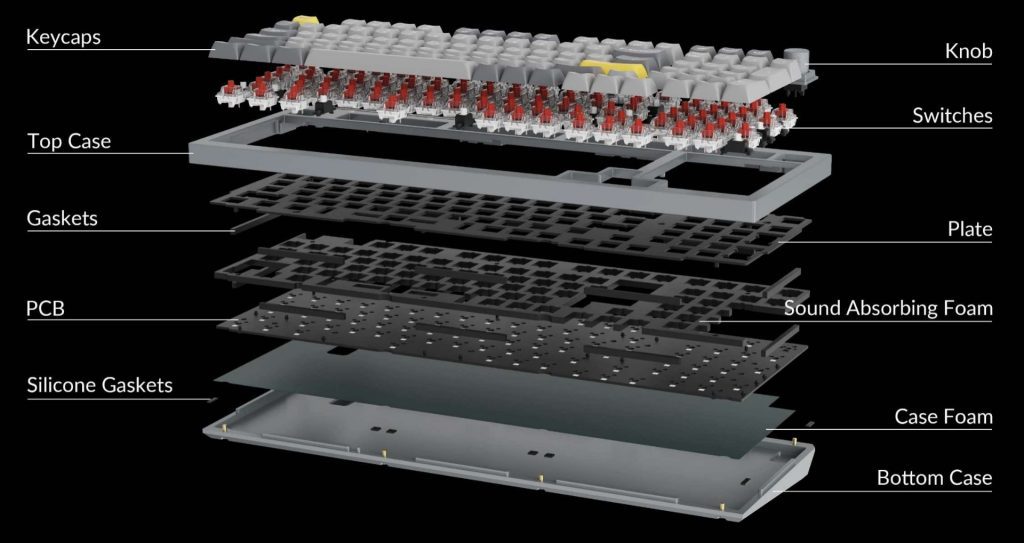
It directly determines keystroke response speed, operation stability and overall service life for both mechanical and membrane keyboards.
Why Is PCB a Must-Have Inside Every Keyboard
No keyboard can function properly without a well-built PCB. It transmits electrical signals from each keystroke to the main controller and connected devices.
Even premium switches and keycaps cannot deliver stable performance if the internal PCB suffers from poor design or low-grade materials.
Low-quality circuit boards frequently cause unresponsive keys, accidental double keystrokes and noticeable input lag in daily and gaming use.
What Core Functions Does a Keyboard PCB Perform
- Identify every keystroke and convert physical pressure into standard electrical signals
- Control RGB lighting effects and support personalized custom light modes
- Compatible with wired, Bluetooth and 2.4G wireless connection protocols
- Maintain a stable circuit matrix for simultaneous multi-key input without conflict
- Reserve standard interfaces for hot-swap sockets and subsequent firmware upgrades
What Are the Main Types Of Keyboard PCB
Membrane Keyboard PCB
It features a simple single-layer circuit layout for basic signal transmission only.
It does not support advanced RGB lighting or hot-swap functions for DIY upgrades.
Mechanical Keyboard PCB
It adopts a multi-layer high-precision circuit design with native hot-swap compatibility.
It integrates RGB lighting layout and supports custom layout modification for keyboard enthusiasts.
Capacitive Keyboard PCB
This is a professional customized circuit board with ultra-low signal latency.
It is widely used in high-end office keyboards and competitive gaming keyboard equipment.
Keyboard PCB VS Regular Electronic PCB: What’s the Real Difference
| Feature | Keyboard PCB | General Electronic PCB |
|---|---|---|
| Circuit Density | Compact key matrix layout with high integration | Standard conventional circuit arrangement |
| Signal Latency | Requires ultra-fast signal response | Tolerates normal conventional signal delay |
| Durability | Engineered for millions of repeated keystrokes | Designed for standard industrial service life |
| Customization | Tailored layout for various keyboard sizes | Adopts fixed universal circuit structure |
| Extra Functions | Supports hot-swap, RGB lighting and macro programming | Limited reserved space for functional expansion |
What Top Industries Use Custom Keyboard PCB
Consumer Electronics
Custom keyboard PCB is applied to portable wireless keyboards, gaming mechanical keyboards and silent office keyboards.
It solves stable signal transmission and long-term durability demands for mass consumer electronic products.
Industrial Control & Automation
Dedicated operation panels and equipment control keyboards rely on customized PCB.
It adapts to long-duration continuous operation and provides strong anti-interference performance in industrial environments.
Medical Electronics
Control keyboards for medical devices adopt high-reliability grade PCB.
It meets medical-grade stability and anti-static standards to ensure safe and consistent equipment operation.
Automotive Electronics
Vehicle central control physical buttons and car-specific keyboards use professional automotive-grade PCB.
It effectively resists extreme temperature fluctuations and vehicle vibration interference during long-term use.
How to Distinguish High-Quality Keyboard PCB From Low-Grade Versions
You can judge keyboard PCB quality by checking routing precision, copper thickness and standardized hot-swap hole positioning.
High-quality boards maintain stable signal output after millions of keystrokes and avoid premature circuit aging or failure.
Inferior PCBs use thin copper foil and rough routing, which easily lead to short circuits, circuit faults and unresponsive keys over time.
Common Keyboard Problems Caused by PCB Defects
Unresponsive individual keys, random double keystrokes and flickering RGB lighting are mostly caused by flawed PCB routing or substandard raw materials.
Unstable wireless connections and slow input response are also closely related to unreasonable layout and component arrangement on the keyboard PCB.
How Hardware Designers Optimize Keyboard PCB Layout
Professional designers arrange the key matrix reasonably to reduce signal crosstalk and eliminate multi-key input conflicts.
They configure standard hot-swap hole positions, optimize main control chip placement and reserve sufficient space for later functional upgrades.
What Should Procurement Teams Focus On When Sourcing Keyboard PCB
Procurement teams need to confirm board layer count, copper thickness, hot-swap compatibility and formal production process standards for keyboard PCB.
It is also critical to verify batch consistency, durability test data and custom layout capabilities to match different keyboard product positioning.
Can Custom Keyboard PCB Adapt to Special Layout Sizes
Yes, customized PCB can perfectly fit 60%, 65%, 75%, TKL and full-size standard keyboard layouts with tailored circuit matrices.
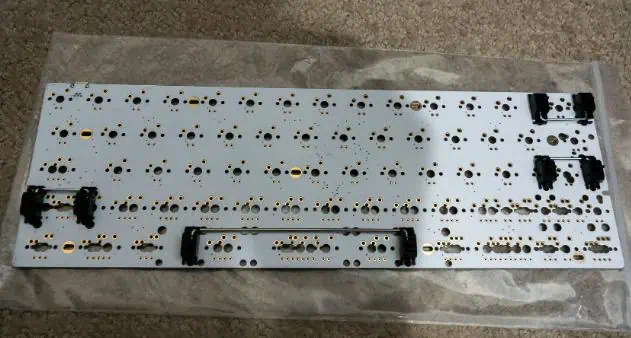
It also supports customized designs for ergonomic split keyboards and non-standard industrial keyboard sizes for special development demands.
FAQ About PCB Meaning in Keyboard
Does every keyboard come with a built-in PCB?
Yes. All mechanical, membrane and capacitive keyboards depend on an internal PCB to complete signal conduction and normal operation.
Is the hot-swap function determined by the keyboard PCB?
Absolutely. Hot-swap sockets are pre-soldered on the PCB, which directly decides whether users can replace switches without soldering.
Can I replace only the keyboard PCB without changing other components?
You can replace the standalone PCB as long as its layout and hole positions match the existing keyboard case and positioning plate.
Does a thicker keyboard PCB always mean better quality?
Not necessarily. Overall quality depends on material grade, routing precision and copper purity, rather than just board thickness.
Does PCB design affect keyboard typing latency?
It does. Optimized PCB routing greatly shortens signal transmission time and delivers faster keystroke response performance.
Get Reliable Custom Keyboard PCB
If you need premium PCB for keyboard design, custom layout development or mass production, we are your trusted professional partner.
We support on-demand customization and provide a free DFM report for every keyboard PCB project to avoid potential design risks before production.
We professionally manufacture high-performance keyboard PCB covering consumer electronics, industrial control, medical electronics and automotive electronics industries.
If you need keyboard PCB products or related customized solutions, you are welcome to place an order with us. Feel free to contact our team via email: sales@pcbtry.com for technical support and business cooperation.
0 Comments