



What Does PCB Mean in Texting?
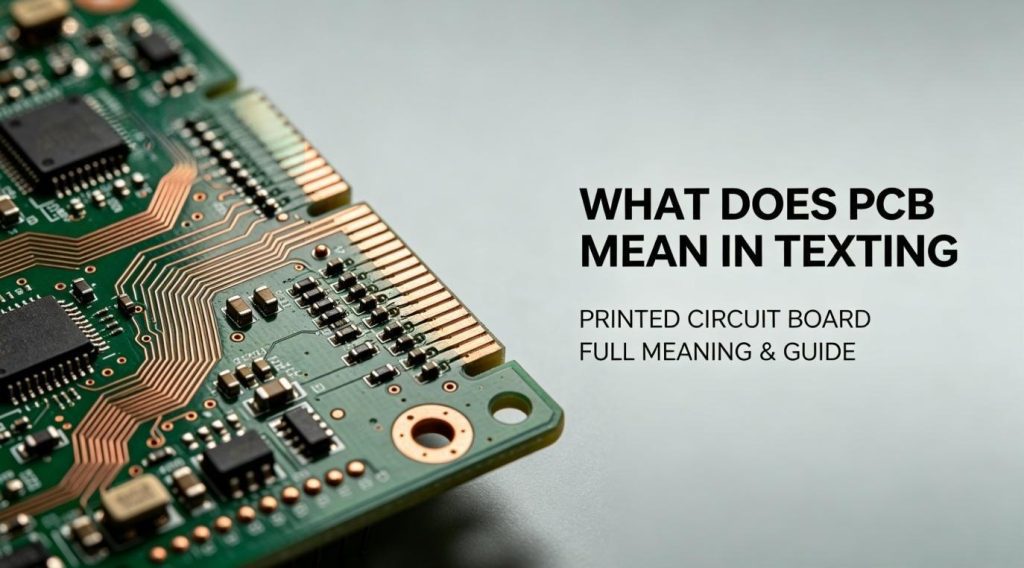
In texting and casual online communication, PCB most often refers to Printed Circuit Board, the core electronic component used in nearly all digital devices. This technical definition is far more common than any casual slang meaning for the acronym PCB.
This guide breaks down every use of PCB in messaging, technical contexts, industry applications, and common misunderstandings for clear, confusion-free communication.
Is PCB a Popular Slang Term in Texting?
PCB is not a mainstream casual texting acronym like LOL, BRB, or OMG.
It almost never appears in personal, non-technical conversations.
Nearly all uses of PCB in written messages come from engineering, electronics hobby, or professional industry discussions.
What Is the Full Technical Meaning of PCB?
PCB stands for Printed Circuit Board, a rigid or flexible substrate with etched copper traces that mechanically supports and electrically connects electronic components.
Every modern electronic device relies on a PCB to link chips, resistors, capacitors, and connectors into a functional system.
Without a properly designed PCB, no electronic product can operate reliably.
What Are the Most Common PCB Industry Use Cases?
We focus on four high-demand, high-volume industries for PCB applications, with real-world use cases:
Consumer Electronics PCB Applications
Consumer electronics uses compact, high-density PCBs for daily-use devices.
Smartphones, tablets, and wireless earbuds use HDI PCBs for miniaturization and signal stability.
These PCBs solve space constraints while maintaining high performance for portable consumer devices.
Automotive Electronics PCB Applications
Automotive PCBs are built for extreme durability and temperature resistance.
Engine control units (ECUs), advanced driver-assistance systems (ADAS), and infotainment systems use heavy-duty PCBs.
They withstand vibration, high heat, and long-term use to support vehicle safety and functionality.
Medical Electronics PCB Applications
Medical devices require zero-failure, high-reliability PCBs compliant with strict industry standards.
Diagnostic tools, patient monitoring devices, and portable medical equipment use precision PCBs.
These boards ensure consistent performance and safety for life-critical medical applications.
Industrial Control & Automation PCB Applications
Industrial PCBs operate reliably in harsh factory environments.
Programmable logic controllers (PLCs), factory automation systems, and industrial sensors use rugged PCBs.
They resist dust, moisture, and electrical interference for uninterrupted industrial operation.
PCB vs PCBA: What Is the Key Difference?
| Term | Full Name | Core Definition |
|---|---|---|
| PCB | Printed Circuit Board | Blank circuit board with copper traces, no electronic components mounted |
| PCBA | Printed Circuit Board Assembly | Fully assembled PCB with all components soldered, tested, and ready for use |
What Are the Most Common PCB Design & Production Pain Points?
Users across all electronics fields face consistent, solvable challenges with PCB projects.
Complex high-speed circuit layouts cause signal interference and performance failures.
Poor design for manufacturing leads to production delays, high defect rates, and wasted resources.
Long lead times and inconsistent quality disrupt project timelines and product launches.
Specialized industry requirements (medical, automotive) create compliance and reliability hurdles.
How to Resolve Common PCB Design & Production Issues?
Targeted solutions eliminate the most frequent PCB-related problems.
Optimize circuit layouts early to reduce signal loss and interference in high-speed designs.
Use design validation before production to catch errors and avoid manufacturing setbacks.
Partner with experienced manufacturers to meet strict industry compliance standards.
Leverage custom design support to match your device’s unique performance needs.
What Types of PCBs Are Used in Modern Electronics?
Different PCB types serve unique device and industry requirements.
Rigid PCBs: Standard FR-4 boards for most general electronic applications.
Flexible PCBs (FPC): Bendable substrates for compact, wearable, and portable devices.
HDI PCBs: High-density interconnect boards for miniaturized consumer electronics.
Metal-core PCBs: Thermally efficient boards for power electronics and LED lighting systems.
How to Avoid Misunderstanding PCB in Text & Professional Messages?
Context is the simplest way to identify the meaning of PCB in any conversation.
If the chat involves electronics, devices, or engineering, PCB always means Printed Circuit Board.
In non-technical messages, PCB has no widely used meaning, so clarification is rarely needed.
This eliminates miscommunication in both casual texts and professional project discussions.
Why is PCB a Critical Acronym in Tech & Engineering Circles?
PCB is the foundational component of all modern electronic systems.
It enables miniaturization, mass production, and reliable performance for every digital device.
Standardization of the PCB acronym simplifies communication between designers, manufacturers, and supply chain teams.
Mastering the meaning and use of PCB is essential for anyone working in electronics fields.
FAQ: Common Questions About PCB in Texting & Technology
Does PCB have a negative meaning in texting?
No, PCB has no widely recognized negative or informal slang definition in any texting platform. All common uses are technical.
Why do people use PCB instead of “circuit board” in messages?
PCB is shorter, industry-standard, and universally understood by electronics professionals and hobbyists, saving time in written communication.
Can PCB stand for other phrases in casual texting?
Rarely. Obscure, non-standard meanings exist but are never widely used. The Printed Circuit Board definition is always the primary one.
Is PCB used in gaming or social media slang?
No, PCB is not part of gaming, influencer, or mainstream social media slang. Its use is exclusive to technical and industrial contexts.
Do all electronic devices need a PCB?
Nearly every functional electronic device uses a PCB to connect components. No modern digital product can operate without a properly designed PCB.
What makes a PCB reliable for industrial or medical use?
Reliable PCBs use high-grade materials, strict manufacturing controls, and compliance with industry-specific standards for long-term performance.
Key Benefits of Professional PCB Manufacturing Services
Professional PCB production ensures consistent quality, performance, and compliance for all industry applications.
Custom PCB designs match exact device specifications and performance requirements.
Pre-production design validation reduces defects, delays, and project costs.
Rigorous quality testing guarantees reliability for mission-critical devices.
High-Quality PCB Solutions Tailored to Your Needs
Thindry delivers professional PCB manufacturing and assembly for consumer electronics, automotive, medical, and industrial applications.
We support custom PCB design and provide free DFM reports to optimize your designs for seamless production.
Our precision manufacturing meets strict industry standards for reliability and performance.
For custom PCB solutions and project support, contact us at sales@pcbtry.com to place your order.
0 Comments