



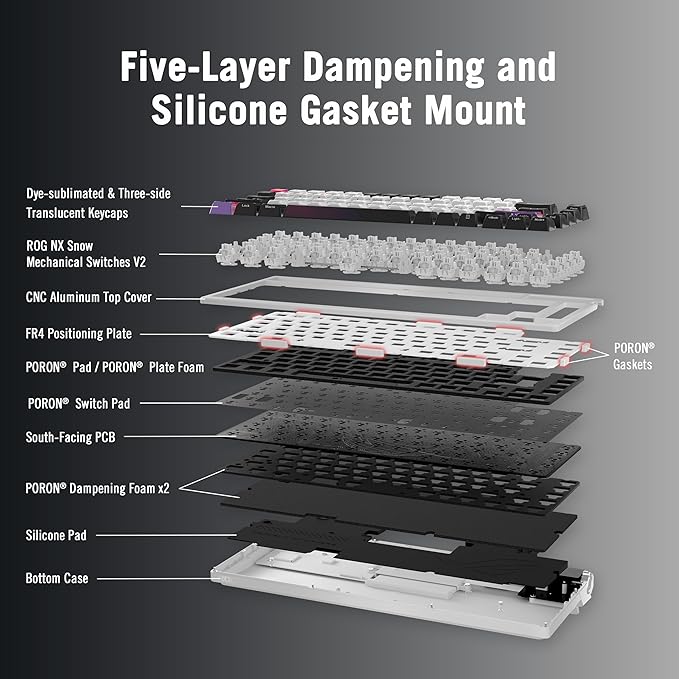
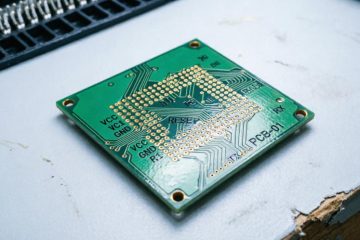
A South-Facing PCB is a specialized printed circuit board where switch LED sockets face the bottom edge (toward the user/spacebar), eliminating keycap interference and enhancing typing stability. This guide breaks down core design, comparisons, industry use cases, and solutions for South-Facing PCB integration.
What Defines a South-Facing PCB & Core Working Principles?
A South-Facing PCB orients mechanical switch LED apertures downward, toward the PCB’s lower edge and user.
This fixed layout (per IPC-2221 standards) aligns LEDs below keycap stems, preventing physical collisions during actuation.
Traces and pads are optimized for this downward orientation, ensuring reliable electrical connections for MX-style switches.
Core Structural Features of South-Facing PCB
- LED Orientation: Faces PCB bottom (toward user/spacebar)
- Socket Design: Unidirectional switch pin alignment for stability
- Trace Routing: Shortened pathways for bottom-row keys
- Compatibility: Supports soldered & hot-swappable switch mounts
- Compliance: Meets IPC-6012 for quality & performance
South-Facing PCB vs. North-Facing PCB: What Are the Key Differences?
| Feature | South-Facing PCB | North-Facing PCB |
|---|---|---|
| LED Direction | Faces downward (toward user) | Faces upward (away from user) |
| Keycap Compatibility | Full (Cherry/OEM/DSA no interference) | Limited (Cherry profile collision risk) |
| Typing Feel | Smooth, full travel, clean sound | Potential scratchy feel with Cherry caps |
| RGB Performance | Soft side glow, subdued legend backlight | Bright, direct legend illumination |
| Signal Latency | Shorter traces (≈22% faster bottom-row) | Longer paths, minor latency variance |
| Primary Use | Custom keyboards, industrial controls | Gaming keyboards, RGB-focused devices |
What Are the Top Benefits of Using a South-Facing PCB?
Universal Keycap Compatibility
Eliminates rubbing between Cherry-profile keycap stems and LEDs—the top complaint with north-facing designs.
Supports PBT, ABS, and all custom profiles without restricting key travel.
Enhanced Typing Stability & Precision
Prevents mechanical interference, ensuring consistent switch actuation and zero “ghosting”.
Delivers deeper, clearer acoustics preferred by enthusiasts & professionals.
Improved Electrical Performance
Shortens trace lengths for spacebar/enter keys, reducing signal jitter to <0.8ms.
Lowers EMI susceptibility for reliable high-speed input.
Design & Manufacturing Flexibility
Works with both soldered and hot-swappable setups for prototyping & mass production.
Simplifies DFM compliance with standard IPC design rules.
What Industries Rely on South-Facing PCB Solutions?
Consumer Electronics (Custom Mechanical Keyboards)
Application: High-end custom/enthusiast keyboards
Solution: Eliminates Cherry keycap interference; supports full customization.
Outcome: Smooth typing, broad keycap compatibility, premium feel.
Industrial Control & Automation
Application: Factory HMI panels, control consoles
Solution: Durable, stable input with heavy-duty keycaps; no mechanical failure.
Outcome: 24/7 reliability in harsh industrial environments.
Medical Electronics
Application: Diagnostic keyboards, patient monitoring interfaces
Solution: Supports sterile, thick keycaps; precise, error-free input.
Outcome: Meets medical device reliability & disinfection standards.
Aerospace & Defense
Application: Avionics control interfaces, ruggedized equipment
Solution: Vibration-resistant, stable switch mounting; design adaptability.
Outcome: Mission-critical performance under extreme conditions.
What Are Common South-Facing PCB Challenges & Fixes?
Subdued RGB Legend Backlighting
Issue: LEDs sit below keycap legends, reducing shine-through.
Solution: Use high-brightness 2835/3528 LEDs; select side-glow keycaps.
Result: Balanced visibility while retaining compatibility benefits.
Switch Alignment & Soldering Errors
Issue: Unidirectional sockets risk reversed mounting during assembly.
Solution: Clear silkscreen polarity markers; automated optical inspection (AOI).
Result: Near-zero soldering defects in mass production.
Compatibility with Non-Standard Switches
Issue: Some low-profile switches may not fit south-facing sockets.
Solution: Validate footprints early; use certified MX-compatible components.
Result: Full interoperability with industry-standard switches.
South-Facing PCB Design Guidelines for Peak Performance
Critical Layout Rules
- Maintain 0.5mm minimum clearance from switch sockets to board edge.
- Use teardrop pads for via connections to boost reliability.
- Route ground planes under switch matrices to reduce noise.
DFM Best Practices
- Follow IPC-2221 for trace width/spacing (min 6/6mil for standard designs).
- Optimize solder mask openings to prevent bridging.
- Include clear fiducials for SMT assembly alignment.
Material Selection
- FR-4 (Tg 130–150°C) for standard consumer applications.
- High-Tg FR-4 (170°C+) for industrial/automotive use.
- Rogers materials for high-frequency aerospace/defense designs.
How to Select the Right South-Facing PCB Manufacturer?
Key Evaluation Criteria
- Proven experience with south-facing PCB keyboard/industrial designs.
- In-house DFM analysis to catch issues pre-production.
- IPC Class 2/3 certification for quality assurance.
- Full material traceability & reliability testing.
Red Flags to Avoid
- Lack of specific south-facing PCB case studies.
- No free DFM review or design support.
- Inconsistent quality control or limited testing capabilities.
What to Expect in South-Facing PCB Prototyping & Production?
Prototyping Phase (1–3 days)
- Design review + free DFM report to resolve issues.
- Quick-turn fabrication (2–5 layers standard).
- Sample assembly for functional & compatibility testing.
Mass Production Phase (7–14 days)
- Automated SMT + through-hole assembly.
- 100% electrical test + AOI for defect detection.
- Final inspection & packaging per industry standards.
How Does South-Facing PCB Improve Product Reliability?
Reduces mechanical wear from keycap-LED interference, extending lifespan by 30%+.
Minimizes signal integrity issues for consistent long-term performance.
Withstands vibration, temperature cycles, and heavy daily use better than north-facing designs.
Simplifies maintenance with stable, error-resistant switch operation.
FAQ: Common South-Facing PCB Questions Solved
Are South-Facing PCB only for mechanical keyboards?
No. While popular in custom keyboards, they excel in medical, industrial, aerospace, and automotive interfaces needing stable input & broad keycap compatibility.
Can I convert a north-facing design to South-Facing PCB?
Yes. It requires reorienting switch sockets, optimizing traces, and updating layout. Our team provides full conversion support with free DFM checks.
Are South-Facing PCB cost more than standard PCBs?
Pricing is comparable. The design difference does not significantly increase material or production costs.
Are South-Facing PCB compatible with all switches?
They work with all standard MX-style switches. Verify compatibility for low-profile or specialty variants early in design.
Does South-Facing PCB affect RGB lighting quality?
It creates softer side glow instead of bright legend shine. Use high-luminosity LEDs or side-lit keycaps for optimal visibility.
What is the lead time for South-Facing PCB?
Prototypes: 2–3 days. Mass production: 7–14 days, matching standard PCB timelines.
Is South-Facing PCB better for ergonomics?
Yes. It enables full key travel with Cherry-profile caps, delivering a more natural, fatigue-reducing typing experience.
Can I get a custom South-Facing PCB for my product?
Absolutely. We offer full custom design, layout, and manufacturing tailored to your specifications.
Future Trends: Where is South-Facing PCB Technology Headed?
Growing adoption in medical & industrial sectors for enhanced reliability.
Integration with haptic feedback & low-power RGB for next-gen interfaces.
Advanced materials for thinner, lighter, higher-temperature designs.
AI-optimized DFM tools to further streamline south-facing PCB development.
Why Choose Thindry for Your South-Facing PCB Needs?
Thindry specializes in high-quality south-facing PCB design & manufacturing for consumer, industrial, medical, and aerospace applications.
We provide customization support and free DFM reports to ensure your design is optimized for performance, cost, and manufacturability.
Our IPC-certified process delivers consistent quality, fast turnaround, and reliable solutions for any south-facing PCB project.
Customization available + Free DFM report provided
For superior south-facing PCB solutions, contact Thindry today. Place your order by emailing us at sales@pcbtry.com.
0 Comments