




Choosing between OSP and ENIG surface finishes directly impacts PCB reliability, assembly yield, and long‑term performance. This OSP vs ENIG guide explains critical differences, ideal applications, and industry best practices to help you select the right surface finish for medical, aerospace, and industrial equipment PCBs.
What Is OSP Surface Finish for PCBs?
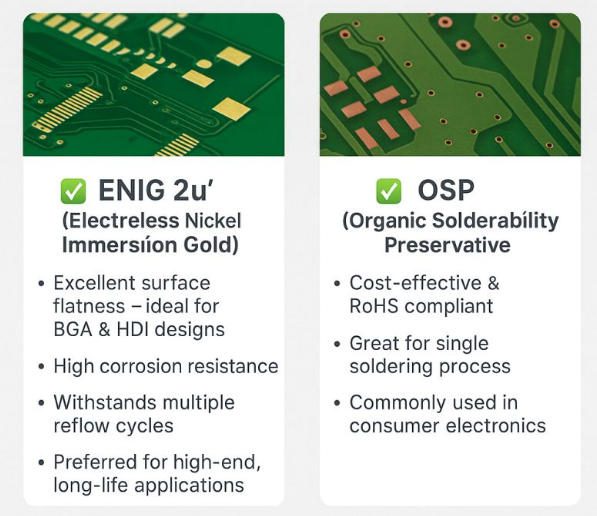
OSP (Organic Solderability Preservative) is a thin, water‑based organic coating applied to bare copper pads to prevent oxidation and maintain solderability. The coating safely decomposes during reflow soldering, exposing clean copper for strong, reliable solder bonding.
Key Properties of OSP
- Typical thickness: 0.2–0.5 μm
- Appearance: Clear coating over natural copper color
- RoHS compliant and free of heavy metals
- Ultra‑flat surface ideal for fine‑pitch assembly
What Is ENIG Surface Finish for PCBs?
ENIG (Electroless Nickel Immersion Gold) is a two‑layer metallic surface finish consisting of a nickel barrier layer topped with a thin immersion gold layer. It provides excellent oxidation resistance, enables wire bonding, and supports multiple reflow soldering cycles.
Key Properties of ENIG
- Layer structure: Nickel (~3–6 μm) + Gold (~0.05–0.1 μm)
- Long shelf life: 12+ months
- High corrosion and wear resistance
- Compatible with wire bonding and press‑fit contacts
OSP vs ENIG: What Are the Core Differences?
| Parameter | OSP | ENIG |
|---|---|---|
| Coating Type | Organic (azole‑based) | Metallic (Ni + Au) |
| Surface Flatness | Ultra‑flat | Flat |
| Shelf Life | 3–6 months | 12+ months |
| Reflow Cycles | 1–2 cycles | 3+ cycles |
| Wire Bonding | Not supported | Supported |
| Rework Difficulty | Easy | Moderate |
| Environmental Suitability | Clean, dry environments | Harsh or humid environments |
Which Is Better: OSP or ENIG for Fine‑Pitch PCBs?
Both OSP and ENIG perform well in fine‑pitch applications, but OSP provides superior flatness for ultra‑fine‑pitch designs, while ENIG offers better long‑term stability for high‑reliability fine‑pitch assemblies.
Fine‑Pitch Application Notes
- OSP: Ideal for consumer electronics and high‑volume SMT production
- ENIG: Preferred for aerospace, medical, and high‑frequency RF designs
Can OSP Withstand Multiple Reflow Cycles?
Standard OSP coatings break down after 1–2 reflow cycles and are not recommended for multiple passes. ENIG easily withstands 3+ reflow cycles due to its stable metallic structure.
Thermal Stability Comparison
- OSP: Thermally decomposes during soldering; limited thermal resistance
- ENIG: Nickel layer delivers high thermal and mechanical stability
How Long Do OSP and ENIG PCBs Last in Storage?
OSP PCBs have a shelf life of 3–6 months and require sealed, low‑humidity storage. ENIG PCBs remain solderable for 12+ months and tolerate standard industrial storage conditions.
Storage Best Practices
- OSP: ≤30°C, ≤60% RH, vacuum‑sealed packaging
- ENIG: Standard factory storage conditions
Is ENIG Suitable for Medical Device PCBs?
ENIG is the preferred finish for medical PCBs due to its biocompatibility, corrosion resistance, and zero‑defect reliability. It meets ISO 13485 and regulatory requirements for diagnostic and implantable medical devices.
Medical PCB Case Study
- Diagnostic imaging systems: ENIG ensures stable signal integrity
- Wearable health monitors: ENIG resists corrosion from body fluids
- Surgical tool controllers: ENIG supports long‑term reliable operation
Why Choose ENIG for Aerospace and Industrial PCBs?
ENIG provides exceptional durability for aerospace and industrial equipment operating in extreme temperatures, vibration, and humidity. It meets DO‑160 and IPC Class 3 standards for high‑reliability applications.
Aerospace & Industrial Case Study
- Avionics control modules: ENIG withstands extreme thermal cycling
- Factory automation controllers: ENIG resists oxidation in harsh industrial environments
- Satellite communication boards: ENIG supports stable RF performance
When to Select OSP Instead of ENIG for PCBs?
Choose OSP for high‑volume, short‑cycle designs that require only one reflow, limited storage time, and no wire bonding. It is ideal for consumer electronics and basic industrial control boards.
Ideal OSP Applications
- Consumer electronics mainboards
- High‑volume SMT assemblies
- Short‑life industrial sensor boards
What Are Common Defects in OSP and ENIG Finishes?
OSP defects include coating scratches, premature oxidation, and poor solder wetting. ENIG risks include black pad, uneven nickel deposition, and gold porosity.
Defect Prevention Tips
- OSP: Gentle handling, strict environmental control, visual inspection
- ENIG: Strict process control, nickel thickness monitoring, IPC‑standard testing
OSP vs ENIG: Which Is More Reliable for Long‑Term Use?
ENIG is more reliable for long‑term, high‑stress applications. OSP offers good reliability for short‑to‑medium lifecycle products with controlled assembly and storage.
Reliability Metrics
- ENIG: Excellent corrosion resistance and stable contact resistance
- OSP: Strong initial solderability; may degrade over time in harsh environments
FAQ About OSP vs ENIG PCB Finishes
Is OSP more cost-effective than ENIG?
OSP generally involves lower material and processing costs than ENIG, making it economical for high‑volume production.
Can ENIG support wire bonding?
Yes, ENIG is widely used for aluminum and gold wire bonding in high‑reliability electronic devices.
Does OSP affect PCB electrical performance?
OSP is non‑conductive and decomposes during soldering; it does not negatively affect electrical performance.
Which finish is better for BGA components?
Both are suitable. OSP is preferred for flatness; ENIG is preferred for high‑reliability BGA applications.
Can OSP and ENIG PCBs be reworked?
OSP is easy to rework. ENIG requires controlled rework to avoid damaging the nickel‑gold layer.
Are OSP and ENIG RoHS compliant?
Yes, both OSP and ENIG are RoHS compliant and lead‑free.
How to verify OSP and ENIG quality?
Use solderability testing, coating thickness measurement, and visual inspection per IPC standards.
Thindry provides high‑quality OSP and ENIG PCB surface finish solutions for medical, aerospace, and industrial equipment applications. For inquiries and orders, contact us at sales@pcbtry.com.
0 Comments