



When sourcing circuit boards for an electronics project, two terms appear again and again:
PCB and PCBA. They look similar, and many buyers use them almost interchangeably, but they refer to different stages of electronic manufacturing.
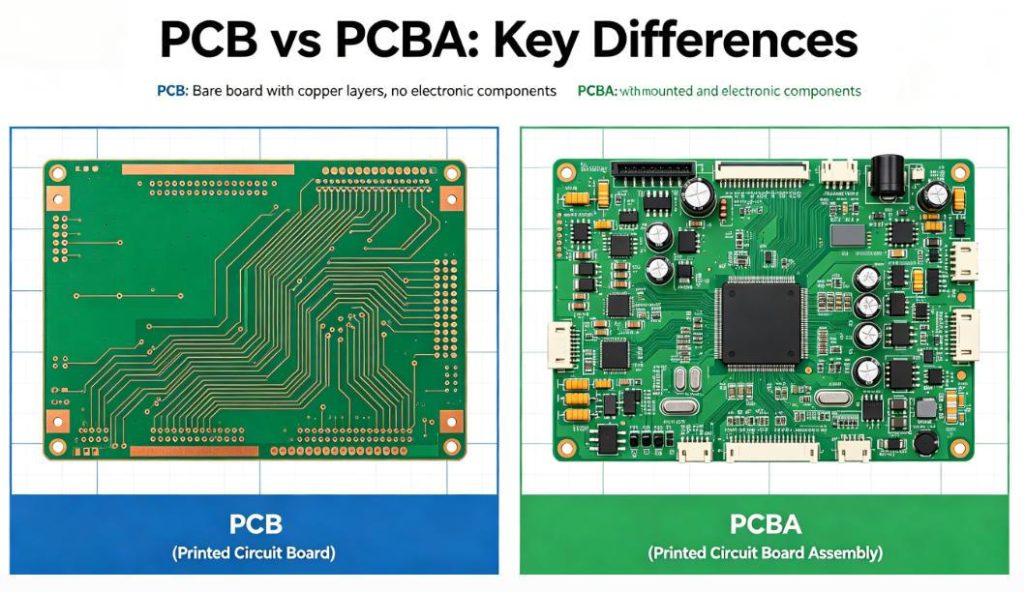
A PCB, or printed circuit board, is the bare board without electronic components mounted on it. A PCBA, or printed circuit board assembly, is the completed board after components have been soldered onto the PCB.
This difference affects much more than terminology. It influences cost, manufacturing process, lead time, testing requirements, quality control and supplier selection. If you are comparing PCB vs PCBA for prototyping, low-volume production or mass manufacturing, this guide will help you make a clearer and more practical sourcing decision.
PCB vs PCBA: Quick Comparison
The simplest way to understand the difference is this: PCB is the bare board, while PCBA is the assembled and functional board.
| Comparison Item | PCB | PCBA |
|---|---|---|
| Full Name | Printed Circuit Board | Printed Circuit Board Assembly |
| Basic Meaning | Bare circuit board | Assembled circuit board with components |
| Components | No components mounted | Components soldered onto the PCB |
| Main Function | Provides electrical connections and mechanical support | Performs the actual electronic function |
| Purchasing Scope | PCB fabrication only | PCB fabrication, component sourcing, assembly and testing |
| Required Files | Gerber files, drill files, stack-up notes | Gerber files, BOM, pick-and-place file, assembly drawing and test requirements |
| Testing Focus | Open/short test, dimensions, impedance, visual inspection | AOI, X-ray, ICT, functional test, programming verification |
| Delivery Status | Bare boards | Assembled boards ready for testing or installation |
| Typical Use | Board fabrication, engineering validation, in-house assembly | Prototype validation, OEM production, finished electronic modules |
If you only need a bare board, you should order PCB fabrication. If you need a board that can be powered, tested and installed into a product, you need PCBA manufacturing.
What Is a PCB?
A PCB is the physical platform that connects electronic components through copper traces. It defines the electrical paths, mechanical structure and layout of an electronic circuit.
A bare PCB normally includes:
- Base material such as FR-4, aluminum, copper base, polyimide or high-frequency laminate
- Copper layers for power and signal transmission
- Solder mask to protect copper and prevent solder bridging
- Silkscreen markings for component identification and assembly guidance
- Through holes, vias, blind vias or buried vias
- Surface finish such as HASL, lead-free HASL, ENIG, OSP, immersion silver or immersion tin
A PCB itself usually cannot perform the final electronic function because it has no components installed. It is more like the road system of a city: it defines where signals can travel, but it does not perform active operations by itself.
What Is a PCBA?
A PCBA is a printed circuit board after electronic components have been assembled and soldered onto it. It is the stage where the design becomes a working electronic module.
A PCBA may include:
- SMT components such as resistors, capacitors, ICs, LEDs and sensors
- Through-hole components such as connectors, relays, terminals and transformers
- BGA, QFN, QFP, LGA, SOP and other IC packages
- Firmware programming or calibration
- Functional testing before shipment
- Optional conformal coating, potting or aging test
Compared with PCB fabrication, PCBA manufacturing involves more responsibility. The supplier must handle component sourcing, assembly process control, soldering quality, inspection and testing.
PCB vs PCBA Manufacturing Process
The manufacturing process is one of the clearest differences between PCB and PCBA. PCB production focuses on making the bare board. PCBA production includes the bare PCB plus component procurement, SMT assembly, soldering and testing.
| Process Stage | PCB Manufacturing | PCBA Manufacturing |
|---|---|---|
| Engineering Review | Review Gerber files, drill files, stack-up, board thickness and copper weight | Review Gerber files, BOM, pick-and-place file, assembly drawing and test plan |
| Material Preparation | Prepare laminate, copper foil, prepreg and other PCB materials | Prepare bare PCBs, components, solder paste, stencil and fixtures |
| Circuit Formation | Imaging, etching, drilling, plating, lamination and routing | Usually not involved unless the supplier also provides PCB fabrication |
| Surface Finish | Apply HASL, ENIG, OSP, immersion silver or other finishes | Use finished PCBs as the base for assembly |
| Stencil Production | Not required | Required for solder paste printing in SMT assembly |
| Solder Paste Printing | Not required | Apply solder paste onto PCB pads through a stencil |
| SMT Placement | Not required | Place surface-mount components onto the PCB |
| Reflow Soldering | Not required | Melt solder paste to form solder joints |
| Through-Hole Assembly | Not required | Insert and solder through-hole components if required |
| Inspection | Electrical test, visual inspection, dimensional check | AOI, X-ray, ICT, functional test and visual inspection |
| Final Delivery | Bare printed circuit boards | Assembled and tested circuit board modules |
This is why the PCB assembly manufacturing process is more complex than bare PCB fabrication. PCBA production requires both manufacturing capability and supply chain control.
PCB vs PCBA Testing Methods
Testing is another major difference in a PCB vs PCBA comparison. PCB testing checks whether the bare board meets the manufacturing specification. PCBA testing checks whether the assembled board works as expected.
| Testing Item | PCB Testing | PCBA Testing |
|---|---|---|
| Testing Object | Bare printed circuit board | Assembled circuit board with components |
| Main Purpose | Verify electrical continuity, dimensions and fabrication quality | Verify soldering quality, component placement and circuit function |
| Open/Short Test | Common standard test | May be checked through ICT or functional testing |
| Visual Inspection | Check solder mask, silkscreen, surface finish, scratches and contamination | Check component position, polarity, solder joints and cleanliness |
| Dimensional Inspection | Check board outline, thickness, hole size and hole position | Check assembled height, connector alignment and mechanical fit |
| Impedance Test | Common for high-speed and high-frequency PCBs | Usually controlled at PCB stage, with system-level signal verification later |
| AOI | Less common for bare boards | Commonly used to inspect missing parts, offset, solder bridges and polarity |
| X-ray Inspection | Usually not required | Used for BGA, QFN, LGA and hidden solder joints |
| ICT | Not applicable | Used to check component values, shorts, opens and circuit nodes |
| Functional Test | Not applicable | Used to verify power, communication, sensors, buttons, display and interfaces |
| Programming Verification | Not applicable | Required for boards with MCU, memory or programmable devices |
| Final Result | Confirms whether the bare board is acceptable | Confirms whether the assembled board can work correctly |
It is important to remember that a PCB passing electrical testing does not mean the PCBA will automatically work. PCBA performance also depends on component quality, placement accuracy, soldering quality, firmware and functional test coverage.
PCB vs PCBA Cost Comparison
Many buyers are surprised when they see the price difference between PCB and PCBA. A bare PCB may be inexpensive, while a PCBA quote can be much higher.
The reason is simple: PCB cost mainly comes from board fabrication, while PCBA cost includes the PCB, components, assembly labor, inspection and testing.
| Cost Item | PCB | PCBA |
|---|---|---|
| Bare PCB Fabrication | Included | Included |
| Component Cost | Not included | Included and often a major cost factor |
| SMT Assembly | Not included | Included |
| Through-Hole Soldering | Not included | Included if required by the design |
| Stencil Cost | Not required | Usually required for new SMT projects |
| Engineering Review | Focused on PCB manufacturability | Includes BOM, footprint, polarity and assembly review |
| Testing Cost | Mainly bare board electrical test | May include AOI, X-ray, ICT, FCT, aging test or programming verification |
| Fixture Cost | Usually not required | May be required for functional testing or mass production |
| Material Loss and MOQ | Relatively low | Higher because components may have minimum order quantities and assembly loss |
| Overall Cost | Lower, but only delivers a bare board | Higher, but delivers a functional electronic assembly |
The main factors affecting PCB cost include layer count, material type, board thickness, copper weight, surface finish, impedance control, special processes and order quantity.
The main factors affecting PCBA cost include component prices, SMT points, through-hole parts, complex packages such as BGA or QFN, testing requirements, programming, coating, potting and production volume.
Required Files for PCB and PCBA Orders
One common sourcing mistake is sending only Gerber files and expecting a full PCBA quotation. Gerber files are enough for many PCB fabrication quotes, but they are not enough for assembly.
| File Type | Required for PCB | Required for PCBA | Main Purpose |
|---|---|---|---|
| Gerber Files | Yes | Yes | Define copper layers, solder mask, silkscreen and board outline |
| Drill Files | Yes | Yes | Define vias, plated holes, mounting holes and slots |
| Stack-up Drawing | Recommended | Recommended | Define layer structure, dielectric thickness and impedance requirements |
| PCB Fabrication Notes | Recommended | Recommended | Specify material, copper thickness, surface finish and tolerances |
| BOM | No | Yes | List component part numbers, quantities, values, packages and brands |
| Pick-and-Place File | No | Yes | Define component coordinates and rotation angles for SMT assembly |
| Assembly Drawing | No | Recommended | Confirm component orientation, polarity and special assembly notes |
| Test Procedure | Usually no | Recommended | Define power-on test, functional test and inspection requirements |
| Firmware File | No | Required if programming is needed | Used for MCU, memory or programmable devices |
For accurate PCBA quotations, a complete BOM and pick-and-place file are especially important. Missing or unclear files can cause delays, incorrect pricing or assembly errors.
PCB vs PCBA Lead Time
In most cases, PCB fabrication has a shorter lead time than PCBA manufacturing. PCBA requires additional time for component sourcing, BOM confirmation, assembly scheduling, testing and possible engineering communication.
| Lead Time Factor | PCB | PCBA |
|---|---|---|
| File Preparation | Gerber and fabrication notes are usually enough | Requires Gerber, BOM, pick-and-place file, assembly drawing and test requirements |
| Material Preparation | Mainly PCB laminate and copper material | Requires both bare PCBs and all electronic components |
| Production Steps | PCB fabrication only | PCB fabrication, SMT, through-hole assembly and testing |
| Main Delay Risks | Special material, complex stack-up, impedance control or HDI process | Component shortage, alternative part approval, test fixture preparation and first article confirmation |
| Prototype Stage | Usually faster | Needs extra time for sourcing and assembly |
| Mass Production | Lead time is usually more predictable | More affected by component supply chain and testing complexity |
For PCBA projects, the longest delay often comes from component availability rather than the assembly process itself. Early BOM review can help reduce lead time risks.
When Should You Order PCB Only?
Ordering PCB only is a good choice when you already have assembly capability or when you only need to validate the bare board design.
| Suitable Situation | Why PCB Is Enough |
|---|---|
| You have your own SMT or assembly line | You can manage component sourcing and assembly internally |
| You only need to verify board dimensions | A bare PCB is enough for mechanical fitting checks |
| You want to test stack-up or impedance | PCB fabrication data is the main concern |
| You prefer to control critical components yourself | You can source and store sensitive or high-value parts directly |
| The project is still in early layout validation | Ordering bare boards can reduce initial cost |
When Should You Choose PCBA?
PCBA is a better choice when you need a working board instead of just a fabricated circuit board.
| Suitable Situation | Why PCBA Is Better |
|---|---|
| You need functional prototypes | PCBA allows you to power on the board and test real circuit behavior |
| You do not have SMT assembly capability | The supplier can handle component sourcing, assembly and inspection |
| You want faster product validation | One supplier can manage PCB fabrication and assembly together |
| You need small-batch or mass production | PCBA service provides a more complete manufacturing solution |
| You want to reduce supplier coordination | One-stop PCB assembly service reduces communication gaps |
How to Choose a PCB Assembly Supplier
Choosing the right supplier is especially important for PCBA projects. A low-cost PCB manufacturer may not always be the best PCBA partner if it lacks assembly experience, component sourcing control and testing capability.
| Evaluation Item | What to Check | Why It Matters |
|---|---|---|
| PCB Fabrication Capability | Layer count, material options, HDI, impedance control and surface finish | Ensures the bare board can meet your design requirements |
| Assembly Capability | SMT, through-hole, mixed assembly, BGA, QFN and fine-pitch components | Determines whether the supplier can build your product reliably |
| Component Sourcing | Approved channels, alternative part management and BOM review | Reduces risks from wrong parts, obsolete parts or unstable supply |
| Engineering Support | DFM, DFA, BOM checking and footprint review | Helps find design or assembly issues before production |
| Testing Capability | AOI, X-ray, ICT, flying probe, functional test and programming | Improves product reliability and shipment quality |
| Production Flexibility | Prototype, low-volume and mass production support | Allows your project to scale from sample to volume smoothly |
| Quality Control | Inspection records, traceability, process control and quality standards | Important for stable long-term production |
If you are wondering how to choose a PCB assembly supplier, do not look only at the lowest unit price. A reliable supplier should provide engineering review, stable component sourcing, strong assembly capability and appropriate testing methods.
PCB vs PCBA for Prototype and Mass Production
The right choice also depends on your project stage. In the prototype stage, PCB and PCBA serve different purposes. In mass production, the focus shifts to consistency, testing efficiency and supply chain stability.
| Project Stage | Choose PCB When… | Choose PCBA When… |
|---|---|---|
| Early Design Validation | You only need to check board size, holes, connectors or stack-up | You need to test real electronic functions |
| Functional Prototype | You have internal assembly capability | You need a powered and testable prototype |
| Pilot Run | You want to compare multiple assembly partners | You want one supplier to manage PCB, components and assembly |
| Mass Production | You already have a mature assembly supply chain | You need stable turnkey manufacturing and testing support |
Final Thoughts: PCB or PCBA, Which One Do You Need?
The difference between PCB and PCBA is simple in definition but important in real manufacturing. A PCB is the bare board that provides electrical connections. A PCBA is the assembled board that can perform the intended electronic function.
If your goal is to verify board structure, impedance, dimensions or fabrication quality, PCB manufacturing may be enough. If your goal is to test product performance, build prototypes, or prepare for OEM production, PCBA is usually the better choice.
For buyers, the key is to match your order type with your project stage. A clear understanding of the difference between PCB and PCBA can help you avoid wrong quotations, incomplete files, unexpected delays and quality risks.
Whether you need bare PCB fabrication or complete PCB assembly service, working with a supplier that understands both PCB manufacturing and PCBA testing can make your project move from design to production more smoothly.
If you’re sourcing reliable PCB/PCBA manufacturing — OEM, ODM, prototyping, mass production, or custom engineering solutions — reach out to our engineering team for technical support and a quote at sales@pcbtry.com.
0 Comments