



If you need practical guidance how to remove conformal coating from pcb for repair, component replacement or circuit troubleshooting, this hands-on guide lists verified low-damage stripping approaches. Mastering proper operations how to remove conformal coating from pcb avoids costly pad, chip or substrate scrap while shortening maintenance cycles for various finished circuit boards.
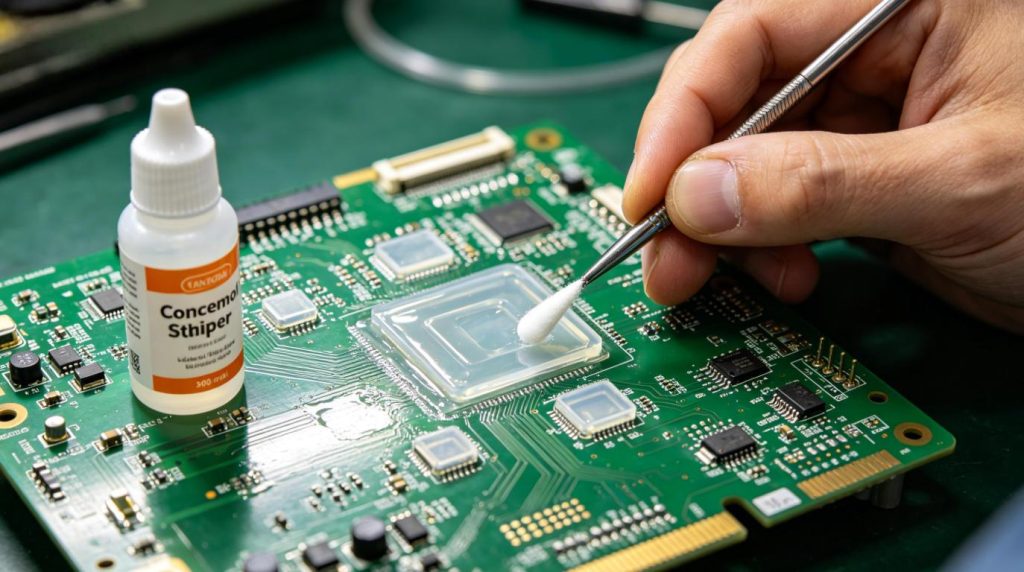
What mainstream methods work to remove conformal coating from PCB safely?
Three mature industrial techniques dominate conformal coating stripping for PCB, each matched to distinct coating chemistry and component density requirements. Professionals pick solutions based on coating material, board thickness and sensitive component placement.
| Removal Method | Applicable Coating Types | Core Advantages | Potential Limitations |
|---|---|---|---|
| Chemical Solvent Stripping | Acrylic, Urethane conformal coating | Uniform removal, minimal mechanical stress on small SMD parts | Requires proper ventilation to prevent solvent-induced bare copper corrosion |
| Mechanical Abrasion Stripping | Silicone, tough epoxy coating | No chemical residue, compatible with high-temperature resistant PCBs | Risk of scratching fine-pitch IC pads when using coarse hand tools |
| Thermal Peeling Removal | Most flexible organic conformal coatings | Rapid bulk stripping for large PCB surface sections | Elevated heat can degrade plastic-encapsulated semiconductor devices |
Key operation tips for each stripping option
Restrict solvent soak time to under 3 minutes on densely populated component regions.
Choose nylon brushes over metal blades for mechanical stripping near precision passive components.
How to pick suitable stripping materials for different types of PCB conformal coatings?
The base resin of conformal coating dictates compatible stripping fluid; mismatched chemicals either fail stripping or rapidly erode base PCB substrates.
Acrylic based conformal coating matching materials
A blend of standard isopropyl alcohol and dedicated acrylic remover suits most consumer-grade coated circuit boards.
Never employ acidic cleaners, which quickly eat away exposed copper traces on bare PCB areas.
Silicone conformal coating matching materials
Specialized silicone stripper paired with gentle mechanical scraping remains the only reliable combo for this chemically inert coating.
What risks happen when improperly removing conformal coating from PCB?
Incorrect stripping creates four common board defects that drive up rework expenses and shorten the operational lifespan of finished PCBs.
- Corroded exposed copper pads stemming from overexposure to aggressive stripping solvents
- Cracked ceramic capacitors caused by excessive physical pressure during abrasive stripping
- Delaminated PCB core material from uncontrolled overheating during thermal removal
- Trapped residual coating underneath ICs leading to intermittent short-circuit faults in long-term field use
Nearly all these defects can be avoided by pretesting stripping agents on unused scrap PCB pieces first.
How to execute targeted coating removal on partial PCB circuit areas?
Masking unaffected PCB regions is the core principle for localized conformal coating stripping to safeguard intact circuits and mounted components.
Steps for localized conformal coating removal
Cover surrounding components with high-temperature masking tape before initiating any stripping procedure.
Apply stripping solution dropwise instead of full-board submersion for precise spot treatment.
Wipe away leftover solvent with lint-free cloth immediately once target coating peels away fully.
How do different industrial scenarios choose conformal coating stripping solutions?
Four high-demand industrial fields adopt customized stripping workflows to maintain PCB functionality during maintenance and component upgrade cycles.
Automotive Electronics
Urethane-coated ECU control PCBs rely on chemical stripping for damaged vehicle sensor pin replacement.
This method eliminates pad cracking risks linked to brute-force mechanical stripping on automotive-grade PCBA.
Industrial Control & Automation
PLC mainboard PCBs combine thermal and partial chemical stripping to repair faulty relay circuits.
Tailored stripping preserves original anti-interference properties on remaining coated PCB segments.
Medical Electronics
Low-toxicity solvent stripping is standard for acrylic-coated PCBs inside portable patient monitoring hardware.
Strict residue cleanup complies with hygiene regulations specific to medical electronic manufacturing.
Aerospace
Precision micro-abrasion stripping serves silicone-coated onboard aerospace circuit boards.
Zero leftover chemical prevents gradual performance drift of high-reliability aerospace modules.
What tool preparations are required before removing conformal coating from PCB?
A complete pre-assembled tool kit minimizes accidental component damage and boosts overall stripping efficiency.
- High-temp masking tape, lint-free wipes and calibrated bottles of designated stripping solvents
- Soft nylon scrub brushes, temperature-regulated hot air gun for controlled thermal peeling
- Scrap PCB samples to test chemical reactivity prior to working on finished production boards
Always test solvent corrosiveness on spare PCB copper surfaces before primary stripping operations.
How to fix minor PCB damage caused during conformal coating removal?
Light pad scratches and mild copper corrosion can be repaired with targeted touch-up instead of full board remanufacturing.
Fix for slight copper pad corrosion
Buff corroded spots with fine abrasive pens then apply a thin solder layer to restore pad conductivity.
Fix for tiny substrate surface scratch
Seal clean, dust-free scratches with matching conformal coating to block future moisture ingress.
FAQ: Common Troubles on How to Remove Conformal Coating From PCB
These curated FAQs resolve frequent confusion encountered during routine conformal coating stripping across all PCB variants.
Can I remove silicone conformal coating only with regular alcohol?
No, standard alcohol cannot dissolve inert silicone coating; dedicated silicone remover plus gentle scraping is mandatory.
Is full thermal stripping safe for PCB fitted with electrolytic capacitors?
Not recommended; excessive heat ruptures internal capacitor electrolyte and triggers fluid leakage failures.
How long can leftover stripping solvent stay on exposed PCB copper safely?
Clean residual solvent within 60 seconds to slow copper oxidation and prevent gradual trace corrosion.
Is partial re-coating possible after local conformal coating removal?
Yes, thoroughly clean stripped zones then apply matching conformal coating to restore original PCB environmental protection.
Where to source reliable PCB & PCBA manufacturing after coating repair?
Once conformal coating removal and PCB rework finish, partnering with a dependable manufacturer simplifies subsequent prototype and batch PCBA production.
Thindry delivers professional on-demand customization service and free DFM report for all custom PCB and PCBA orders.
Our engineering team optimizes layout specs to avoid over-application of conformal coating that leads to frequent future stripping needs.
When you have PCB prototyping, mass fabrication or custom PCBA assembly requirements, connect our professional team via sales@pcbtry.com for high-reliability circuit board solutions for automotive, medical, aerospace and industrial control applications.
0 Comments