



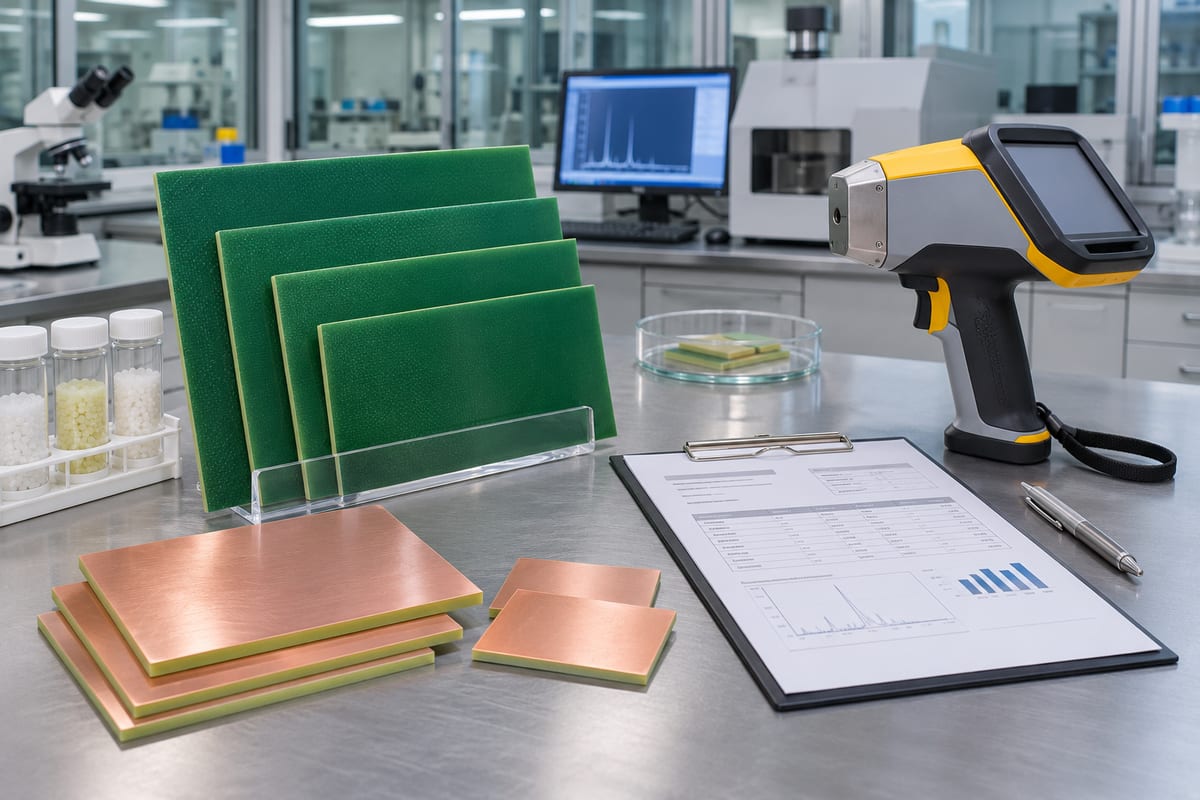
A halogen-free PCB is not a board containing absolutely zero atoms from every halogen element. In PCB procurement, the term normally refers to controlled chlorine and bromine content under a stated standard. IEC 61249-2-21 is widely used for laminate-related requirements: chlorine is limited to 900 ppm, bromine to 900 ppm, and their combined content to 1,500 ppm. A purchase specification must name the standard, scope, test basis and required records instead of relying on the words “halogen free” alone.
What Is a Halogen-Free PCB?
Halogens are a group of chemical elements, but common electronics definitions focus on chlorine and bromine because halogenated flame retardants have historically been used in polymer systems. IPC’s standards resources summarize IEC 61249-2-21 with maximum values of 900 ppm chlorine, 900 ppm bromine and 1,500 ppm total chlorine plus bromine. The same numerical limits are reported by semiconductor and connector manufacturers that align their definitions with this standard.
| Controlled item | Common IEC 61249-2-21 limit | Procurement interpretation |
|---|---|---|
| Chlorine (Cl) | Less than 900 ppm by weight | Verify against the declared material scope and method |
| Bromine (Br) | Less than 900 ppm by weight | Do not infer the result from “lead-free” or “RoHS” labels |
| Chlorine + bromine | Less than 1,500 ppm by weight | Both individual and combined conditions must be addressed |
Wording and inequality conventions should be copied from the governing specification used by the customer and supplier. If a customer specification is stricter or controls more substances, that document takes priority for the order.
Detailed Material and Verification Parameters
The chemical limit is only one part of a manufacturable board specification. A halogen-free resin system can differ from a conventional laminate in processing behavior, so the exact material grade, stackup and assembly exposure must be reviewed together.
| Parameter | Information to control | Why it matters |
|---|---|---|
| Laminate grade | Manufacturer and exact product designation | “Halogen-free FR-4” is a category, not a complete material identity |
| Compliance basis | Named standard, revision and customer addenda | Prevents different definitions from being treated as equivalent |
| Test scope | Laminate, solder mask, finished board or complete assembly | A laminate declaration does not automatically cover every material on the PCBA |
| Thermal data | Tg, decomposition behavior and approved reflow exposure from supplier data | Supports lamination and assembly process review |
| Electrical data | Dk, loss and insulation properties at relevant conditions | Material substitution can change impedance and signal behavior |
| Construction | Core/prepreg types, resin content, copper and finished thickness | Controls stackup and manufacturability |
| Traceability | Lot, certificate, declaration and approved material list | Connects the compliance claim to delivered boards |
Halogen-Free vs RoHS vs Lead-Free
These terms solve different compliance questions and are not interchangeable. RoHS restricts specified hazardous substances in electrical and electronic equipment. Lead-free normally describes solder, finishes or product content relative to lead requirements. Halogen-free controls chlorine and bromine under a named definition. A PCB can be RoHS compliant without meeting a customer’s halogen-free limits, and a halogen-free laminate does not by itself prove that every component, cable, adhesive or coating in the final product meets the same requirement.
| Requirement | Main question | Evidence normally requested |
|---|---|---|
| Halogen-free | Are Cl and Br within the stated limits and scope? | Material declaration, certificate and test report where required |
| RoHS | Are restricted substances within applicable legal thresholds? | Supplier declaration and supporting substance data |
| Lead-free assembly | Does the soldering and finish system meet the defined lead requirement? | Finish declaration, solder alloy and process records |
| REACH | Are communication duties or restrictions triggered by listed substances? | Current supplier declarations and substance communication |
Halogen-Free Laminate vs Conventional FR-4
Both can belong to the broad FR-4 family, but their flame-retardant resin chemistry and processing windows may differ. Do not replace a released laminate merely because thickness and Tg look similar. Compare the exact grade’s resin system, flow, cure, adhesion, CAF-related data, dielectric properties, thermal behavior and availability. Confirm that the stackup and impedance calculation use the proposed production material rather than a generic FR-4 value.
The correct choice is application-specific. A conventional laminate may remain acceptable where no halogen-free requirement exists. A halogen-free material becomes necessary when the product specification, customer policy or environmental program explicitly requires it. The requirement should be flowed down to the PCB drawing, approved material list and supplier purchase order.
How to Verify a Halogen-Free PCB
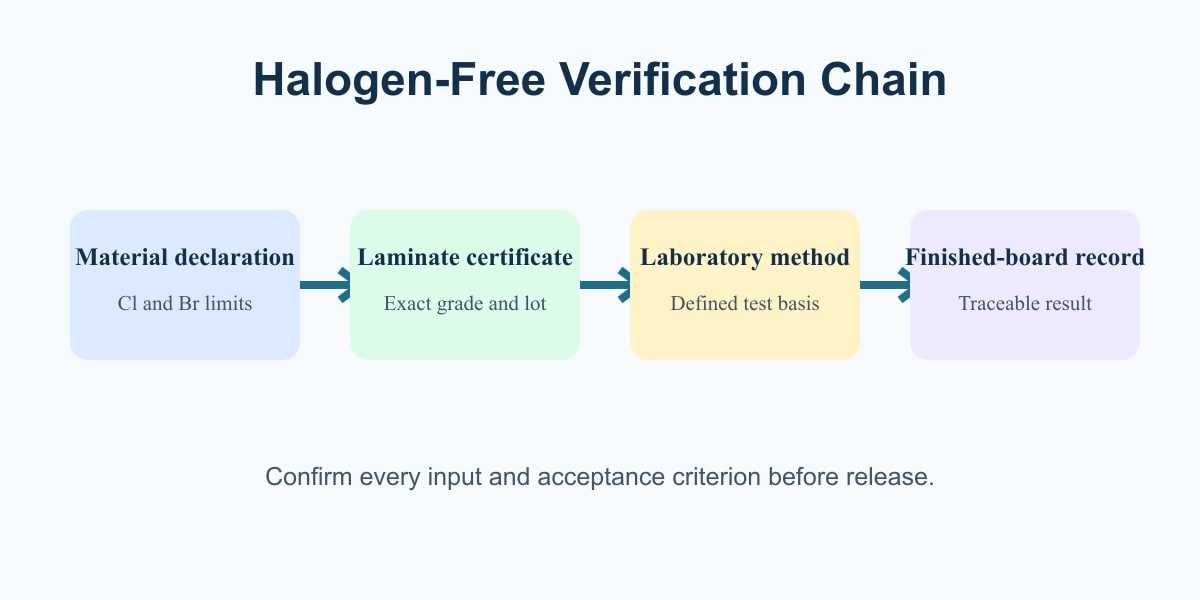
- Define the scope. State whether the limit applies to laminate, solder mask, bare PCB or the complete assembled product.
- Name the governing document. Record the standard, revision and any customer-specific additions.
- Approve exact materials. Use manufacturer product designations rather than a generic “HF” note.
- Collect declarations and certificates. Ensure the documents identify the supplier, material and relevant limit.
- Specify testing when necessary. State the method, sampling, laboratory qualification and acceptance criteria.
- Maintain lot traceability. Link delivered boards to the approved laminate and production records.
Common Specification Failures
- Writing only “HF” on the drawing: the abbreviation does not define limits, scope or evidence.
- Treating RoHS as proof: RoHS and halogen-free declarations answer different compliance questions.
- Checking only the base laminate: solder mask, ink, adhesive, components and cables may fall inside a broader product-level requirement.
- Allowing uncontrolled equivalents: another laminate can change electrical, thermal and processing behavior even if it also carries a halogen-free declaration.
- Requesting a test without a method: results are hard to compare if sample preparation, basis and acceptance rules are undefined.
FAQ
Does halogen-free mean zero halogens?
No. Common PCB usage is threshold-based and focuses on chlorine and bromine under a named definition. State the applicable standard rather than interpreting the label literally.
Is every halogen-free PCB also RoHS compliant?
Not automatically. Suppliers often support both requirements, but each claim needs its own evidence and defined scope.
Can XRF alone certify a finished board?
A screening instrument can support material control, but the accepted method, detection capability, sample preparation and laboratory requirements must come from the governing specification and customer plan.
What should an RFQ include?
Provide the exact material or approved list, stackup, board data, standard and revision, controlled substances and limits, required declarations or test reports, sampling, traceability and quantity.
Sources
- IPC standards-related resources: halogen-free limits
- Renesas: IEC 61249-2-21-aligned definition
- Hirose: halogen-free definition and customer-specification caution
For a halogen-free PCB review, send the fabrication data, exact compliance requirement, approved material information, quantity and required records to sales@pcbtry.com.
0 Comments